

Hello good people of Ankara / Türkiye.
Today will be a long day for Turkey’s Minister of National Education, as the ministry’s budget talks will be held today.
A COUNTRY WHERE CHILDHOOD IS SHAPED BY POVERTY AND EXCLUSION
In societies that take social justice seriously, childhood is treated as a protected stage of life—shielded from deprivation and supported by strong public policy. In Türkiye today, that protection is increasingly absent. According to Eurostat data for 2024, 39.5% of children under the age of 18 are at risk of poverty or social exclusion. Put differently, nearly four out of every ten children are growing up under conditions that limit their access to basic opportunities.
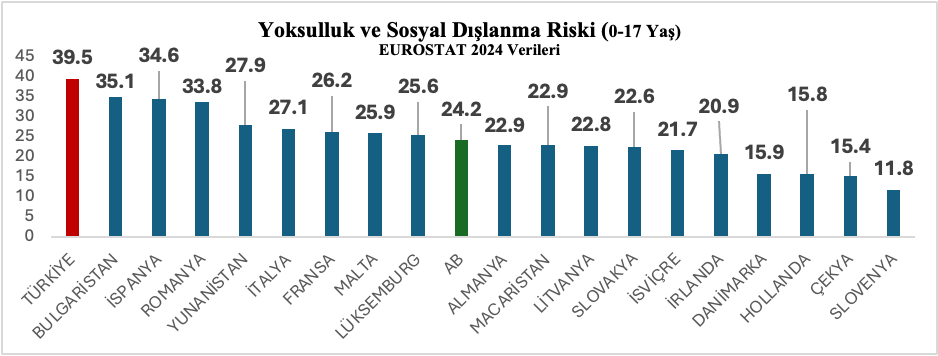
The comparison with Europe is stark. While the European Union average stands at 24.2%, Türkiye ranks at the very top of the list with the highest rate. The contrast becomes even more striking when set against countries such as Slovenia, where the rate is nearly four times lower. These figures do not merely reflect economic difficulty; they point to structural weaknesses in social protection, education, and income distribution policies.
Child poverty on this scale is not a temporary fluctuation—it is a warning sign. When large segments of a generation grow up feeling excluded from society, the long-term consequences extend well beyond individual hardship. Educational attainment declines, social cohesion weakens, and inequality becomes self-reproducing. Addressing child poverty, therefore, is not only a moral obligation but a prerequisite for sustainable social development.
HIGHER EDUCATION BUDGETS: SUSTAINING THE SYSTEM, STARVING THE MISSION
At first glance, the 651 billion TL higher education budget for 2026 appears substantial. A closer look, however, reveals a structural imbalance that limits universities’ ability to fulfill their core mission. Nearly 74% of university budgets (73.8%) is allocated to personnel expenses, including salaries and employer social security contributions. In effect, the system is financed primarily to keep itself running.
What remains for research, innovation, infrastructure, and academic development is comparatively modest. Only 26.2% of the total budget is directed toward research and development activities, scientific projects, laboratories, and the procurement of goods and services. This distribution ensures basic continuity, but it leaves little room for progress.
Universities cannot compete internationally, generate high-quality scientific output, or contribute meaningfully to innovation without sustained investment in research. When funding for R&D is limited, the consequences are predictable: fewer research projects, outdated laboratory facilities, reduced publication output, and declining academic motivation. Over time, this financial structure constrains not only scientific productivity but also academic freedom and intellectual depth.
A higher education system that prioritizes survival over substance risks falling behind in the global academic arena. Rebalancing budget priorities—by strengthening research funding and supporting advanced academic work—is essential if universities are to move beyond routine instruction and become engines of knowledge production and innovation.
WHEN TEACHERS ARE UNDER-SUPPORTED, EDUCATION SUFFERS
Education systems rise or fall with the conditions under which teachers work. The education preparation allowance for the 2025–2026 academic year, set at 5,225 TL, is intended to support teachers with essential expenses at the start of the school year. In today’s economic climate, however, this amount falls far short of meeting real needs.
What was designed as supportive assistance has instead become a symbol of insufficiency. Teachers are expected to cover classroom materials, stationery, and basic educational tools with resources that no longer match market prices. Rather than enabling quality education, the allowance increasingly limits teachers’ capacity to improve learning environments.
The problem extends beyond preparation allowances. Additional lesson (overtime) fees remain inadequate, leaving teachers undercompensated for extra working hours. This not only affects income security but also undermines professional motivation. An education system that relies on underpaid overtime sends a clear message: teachers’ labor is essential, yet insufficiently valued.
Quality education cannot be built on strained working conditions. Improving teacher support requires increasing preparation allowances, revising additional lesson payments, and ensuring fair and transparent employment practices—particularly in private schools, where data gaps and delayed disclosures deepen inequality.
Equal opportunity in education begins with ensuring that teachers work under decent, humane, and sustainable conditions. When teachers are supported, students benefit—and so does society as a whole.