

Enjoy Turkey’s budget talks—basically the annual tradition where Parliament pretends it still has a say, even though the country’s been running on “one-man executive mode” since 2017. Think of it like watching a play where most of the actors are gone but the story still pretends they’re there.
Throughout 2025, investigations, suspensions, and the appointment of government trustees to municipalities have raised profound concerns about the state of local democracy in Türkiye. Time and again, administrative measures were enforced before judicial processes had reached any conclusion—an approach that disregards the presumption of innocence and undermines the basic principle that elected officials deserve institutional respect. The result is a growing perception that the Ministry of Interior is using its oversight authority not as a neutral guardian of legality, but as a weapon of political control.
Whenever the government struggles to accept the results of local elections, a now-familiar playbook kicks in: criminal probes targeting mayors, detentions, arrests, and suspensions. And when lawful grounds prove insufficient or impossible to establish, the fallback mechanism is the appointment of trustees, effectively placing municipalities under central control. In practice, this creates a two-pronged pressure system—judicial intimidation on one side, the threat of trusteeship on the other—keeping elected local administrations in a permanent state of vulnerability.
Elected officials are increasingly treated not according to the law, but based on political alignment. “Unfavorable” mayors face scrutiny and sanctions that appear selective and disproportionate. What should be an extraordinary, last-resort legal remedy has been turned into a routine political instrument, eroding public administration’s credibility and damaging democratic norms.
Party-switching under pressure: another symptom of the crisis
Since the 2024 local elections, several mayors have resigned from the parties under which they were elected and crossed over to other parties—often amid rumors of political pressure or implicit threats of investigation. This pattern suggests a broader climate of coercion surrounding local government.
The scale of the trusteeship problem
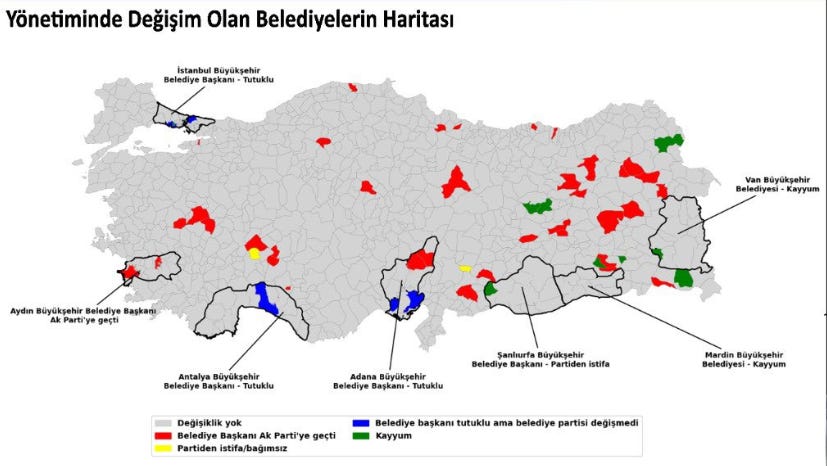
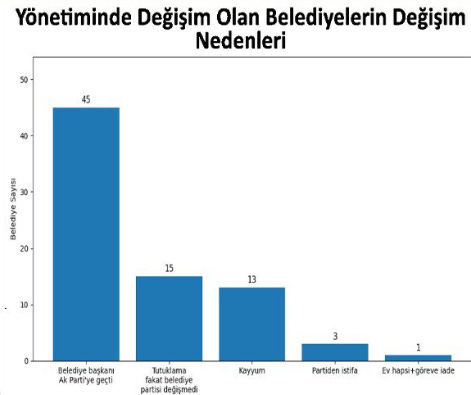
According to the Social Studies Institute (TÇE) report dated 22 August 2025:
62 municipalities faced administrative intervention,
15 mayors were arrested,
13 municipalities—including two metropolitan municipalities—had trustees appointed.
Between 22 August and 10 November, three more mayors (two in Istanbul, one in Kırıkkale) were arrested.
In total: 18 mayors arrested, 13 municipalities taken over through trusteeship.
These numbers tell a clear story: a measure designed to be rare and temporary has become normalized—almost an alternative form of governance.
Trusteeship: From Legal Safeguard to Political Tool
No one disputes that the state must act when serious crimes or abuses occur. The question is how it acts. The trusteeship mechanism cannot become a tool for politically motivated takeovers of elected administrations. A trustee is not a substitute for the ballot box, and trusteeship is not a remedy for political inconvenience.
For a trustee appointment to be legitimate in a democratic system governed by the rule of law, three principles are essential:
1. Evidence-based, transparent, and judicially reviewable grounds
Vague allegations, intelligence notes, media speculation, or political labeling cannot justify removing an elected mayor. Only concrete, verifiable evidence can.
2. Temporariness and proportionality
Trusteeship must remain a strictly temporary measure—narrow in scope and limited in duration. It must never evolve into a parallel form of centralized governance.
3. Respect for local representation
A trustee regime that sidelines municipal councils effectively nullifies local democracy. Councils must remain active, relevant, and empowered throughout the process.
Any trusteeship that fails to meet these conditions is not safeguarding legality—it is undermining it.
The Reality in Türkiye: Double Standards, Arbitrary Power, and the Erosion of Neutral Governance
Türkiye’s current trusteeship practice reveals a disturbing pattern:
Similar allegations receive different treatment depending on political ties.
Those close to the government are afforded leniency, while critics face aggressive prosecution.
In some cases, trustees are appointed without a court ruling or adequate opportunity for defense.
Entire municipal administrations—and the will of voters—are overturned through a single administrative order.
This is the institutionalization of a dangerous logic:
“If you’re with us, everything is permissible; if not, everything is punishable.”
Such a system corrodes trust in public institutions, undermines the justice system, and creates a climate of insecurity for all citizens, regardless of political affiliation.
A Path Forward: Stronger Laws, Stronger Checks, and a Restored Respect for Local Democracy
The root of the problem is clear: the legal framework regulating trusteeship is broad enough to allow for political manipulation. Türkiye urgently needs a framework that:
clearly defines trustee powers,
strengthens judicial oversight and transparency,
prevents municipal councils from being bypassed,
ensures that trusteeship remains temporary and proportionate,
and, above all, protects voter sovereignty.
When an elected mayor must be removed due to serious, proven misconduct, the municipal council—elected by the same constituents—should have the authority to elect a replacement from within. This approach protects both public integrity and democratic legitimacy.