Today marks the first round of Türkiye’s annual budget talks—a ritual that still carries the formality of parliamentary oversight, even as its substance steadily evaporates. The proceedings have begun, but the real question remains whether Parliament will be allowed to do more than simply watch the executive’s decisions pass through. Here is my take on the TBMM’s budget and what these numbers really tell us about the state of legislative power in Türkiye.
The Legislative Process in the Turkish Grand National Assembly: Commissions Reduced to a Hollow Ritual
Think of the commission stage in lawmaking as the place where real democracies actually do the work—where deliberation happens, expertise flows in, and legislation gains quality. In Türkiye’s current setup, that entire function has been downgraded to something closer to a rubber-stamp counter. The shift is so stark that even the long-repeated promise of “a stronger Parliament and stronger lawmakers” now feels like an abandoned slogan rather than a governing principle.
Today, commissions operate in a way that strips them of their core purpose. Civil society organizations, academics, and professional associations—the very actors that should inform and refine legislation—are largely sidelined. Draft laws move forward without serious impact analysis, without hearing those who will be affected, and without the grounding that makes laws durable and legitimate. The result is predictable: weaker democratic legitimacy, lower policy quality, and laws that often struggle to function in real life.
Opposition lawmakers? Their contributions are routinely ignored. Proposals pass exactly as they arrive—commas, wording, and all—simply carried through by the numerical advantage of the governing bloc. What should be a charged, substantive, pluralistic exchange has instead become a one-directional technical formality. The institutional dignity of the Assembly erodes when the legislative branch behaves as if serious scrutiny were an inconvenience rather than a constitutional duty.
Even the internal procedures meant to structure lawmaking are being bent out of shape. Bills that must, under the Rules of Procedure, be referred to secondary (tali) commissions are instead fast-tracked directly to the main commission. This shortcut not only undermines specialization—one of the pillars of modern parliamentary work—but also creates situations where sprawling omnibus bills, loaded with unrelated provisions, are handled by a single commission with insufficient expertise. It’s a legislative technique that invites errors, inefficiency, and a lack of accountability.
The consequence is clear: commissions have become dysfunctional, and with them, a large part of Türkiye’s parliamentary heritage has slipped backward. Instead of expressing the nation’s will, instead of serving as a mechanism of democratic problem-solving, the Assembly increasingly operates as an approval chamber for executive preferences.
The principle carved into the Constitution—that sovereignty belongs unconditionally to the nation—is reduced to ceremonial language when the legislative branch functions in deference to the executive. A Parliament that should be shaping the future is instead confined to endorsing decisions already made elsewhere.
In systems where democracy is healthy and institutions are respected, such a regression would be unthinkable. Yet here, it has become the new normal.
Lack of Transparency in Commissions and the Silencing of the Press
In recent years, the ability of parliamentarians to reach the public during committee proceedings has been systematically restricted. The Turkish Grand National Assembly is supposed to be the highest institution where the nation’s will is expressed; therefore, ensuring that elected representatives can communicate their views to the public is not a luxury—it is a democratic necessity.
Yet the current practice tells a very different story. During committee meetings, only the presentations of ministers and vice presidents are recorded by cameras. The moment elected lawmakers take the floor, cameras are ushered out of the room.
This is not a small procedural choice. It casts a direct shadow over democratic representation. The fact that the statements of appointed officials are broadcast publicly while the words of elected parliamentarians are concealed runs contrary to the very logic of democratic governance. Despite repeated objections raised before committee chairs, the practice persists, leaving the public unaware of what their representatives actually say and do in Parliament.
Transparency is not optional. Committees that deal with matters affecting society should be fully open to the press and the public, allowing citizens to hear their representatives directly and without filters. Anything less undermines trust in the legislative process and erodes the legitimacy that democratic institutions depend on.
Legislative Activity Statistics
Bill Submission Statistics
During the 1st, 2nd, 3rd, and 4th legislative years of the 28th Term, a total of 3,677 bills were submitted by members of parliament (as of 4 December 2025). Of these, only 111 were debated and adopted in the General Assembly. The remaining 3,516 bills—97% of all submissions—were referred to committees but never placed on a committee agenda.
And when we look at what actually did pass, the pattern becomes even clearer:
64 of the adopted bills were proposals submitted by the Speaker of the Parliament for the approval of international agreements.
5 were the Central Government Budget Bill and Final Accounts Bill submitted by the President.
42 were bills submitted by lawmakers from the governing bloc.
Of those 42, 41 were never discussed in any of the secondary committees to which they were referred.
And 37 of the 42 were omnibus bills—packages that amend multiple laws at once and have become the go-to method for pushing through sprawling legislative changes with minimal scrutiny.
As for bills submitted by opposition MPs?
Not a single one made it onto a committee agenda.
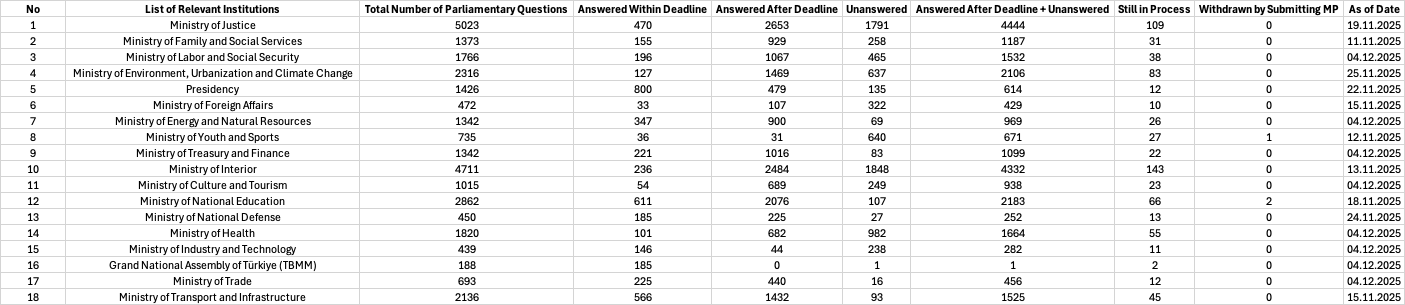
Below you can find a table that shows how different government ministries and institutions are responding to parliamentary questions. It lists the total number of questions submitted to each institution, how many were answered on time, how many were answered late, and how many haven’t been answered at all. It also shows the number of ongoing cases and any questions that were withdrawn. The final column indicates the date on which each set of figures was recorded. Overall, the table gives a clear snapshot of how responsive each institution has been.