

Justice System and Everyday Life in Türkiye
🔍 Gülistan Doku probe: dam searched with ‘bottle cap’ as evidence emerges of wiped data
The investigation into the disappearance of Gülistan Doku, now being pursued on murder charges six years on, has thrown up striking new details about the searches conducted in the dam reservoir at the time. According to T24 columnist Tolga Şardan, a member of the Gendarmerie Search and Rescue (JAK) unit told prosecutors that they had become “absolutely certain” Doku’s body could not be in the reservoir on the basis of a simple test in which a bottle cap was thrown into the water and found floating on the surface the next day, taken as proof that the bed of the dam was not silt and the body therefore could not lie there. The JAK official said he had recommended that the search instead be focused on land, and had passed the conclusion on to the then Tunceli AFAD director Cem Erdoğan, who personally relayed it to the now-suspect provincial governor Tuncay Sonel; the JAK officer told the prosecutor’s office that Sonel reacted angrily, saying “they shouldn’t tell the family this and confuse them”. The same officer was later among a group of public personnel removed from Tunceli on Sonel’s orders, and prosecutors questioned the now-detained governor on both points, though he reportedly gave only generic answers. Meanwhile, according to a Karar report, a fresh piece of evidence has emerged showing that data was deleted from the mobile phone of Zainal Abakarov, the first suspect named in the file, while the device was held in judicial custody by the Tunceli Chief Public Prosecutor’s Office. Asked who had performed the operation and whether anyone else knew his WhatsApp password, Abakarov said he did not know who had carried it out, when or why. A National Criminal Bureau analysis found that on 18 April 2020 at 14:19 — about three-and-a-half months after Doku’s disappearance — an email about an Instagram password change arrived at a Gmail account said to belong to Abakarov, “zaynal.abakarov13”, and that a link relating to the permanent deletion of the Instagram account was opened and visited a total of 13 times. The Doku family had spent days waiting and staging a sit-in at the Uzunçayır Dam reservoir in Tunceli, where the water level was lowered and underwater searches were conducted, but no trace of Gülistan Doku was found; the case was reopened on murder charges by Tunceli Chief Public Prosecutor Ebru Ceyhan after new evidence came to light, with 12 people detained so far, and the family has now raised concerns that the prolonged search at the dam may have served as a cover-up.
🚧 Istanbul road closures announced for International Defence, Aviation and Space Industry Fair
Istanbul Police Department’s Traffic Inspection Branch has announced road closures during the 5th International Defence, Aviation and Space Industry Fair, which will be held in the Bakırköy district from 5 to 9 May 2026. Between 07:00 and 19:00 on those dates, traffic will be closed on the Yeni Havalimanı Caddesi turn-off to the Istanbul Fair Centre on the D-100 side, the Yeni Havalimanı Caddesi turn-off to the Istanbul Fair Centre on the coastal side, and the side road connecting the junction of Hanımeli Sokak and Mimar Basri Mete Sokak to Yeni Havalimanı Caddesi. Mimar Basri Mete Sokak, Hanımeli Sokak and Yeni Havalimanı Caddesi have been designated as alternative routes.
✉️ Eylem Tok writes from US prison: ‘I acted on instinct to protect my son’
Eylem Tok, who is being held in custody in the United States, has written a letter from prison about the fatal road accident of 1 March 2024 in Istanbul’s Eyüpsultan district, in which a car driven by her then 16-year-old son Timur Cihantimur struck and killed Oğuz Murat Aci. Tok and her son fled to the US after the incident and were arrested in Boston on 14 June 2024 after a red notice was issued for them. In the letter, shared by journalist Razi Canikligil, Tok said she had long preferred to remain silent but had watched with sorrow as incomplete, incorrect and prejudiced commentary, ignoring police and expert reports, turned into a “lynching campaign”. She described her son — who she said had been preparing for university entrance exams at the time and has since completed high school in prison and begun university courses — as sensitive and conscientious, and said that on the night of the accident she had been a mother in no fit state to weigh right and wrong, acting on instinct rather than reason in an attempt to protect a frightened and shaken child. She acknowledged that, as parents, she and her husband bore the greatest responsibility for any wrongdoing and said she carried that weight every day. Tok directly denied claims that she had been to the scene, taken a phone call from there or prevented the police from being called, insisting the official reports made the truth clear, and described her decision to step away that night not as flight but as a desperate attempt to find her bearings. She said the deepest pain belonged to the family of Oğuz Murat Aci, expressing her condolences and acknowledging that nothing could undo their loss, while disclosing that a settlement agreement had been reached with the legal heirs and that the families had “made their peace” (helalleşme). Tok said she bore no resentment towards her critics, asked forgiveness from anyone she may have hurt, and asked that her words be read not as a defence but as the feelings of a mother poured out from her heart.
⚖️ Women’s groups call for justice in Türkiye’s Çelik–Şengüler abuse case
The trial of Ayhan Şengüler, manager of the “Service to the Quran” Foundation, accused of sexually abusing three-year-old Hifa İkra Şengüler, is to be heard today at Istanbul’s Anatolian Courthouse, with women’s organisations urging the public to follow the case and renewing their call for justice. According to a report by Rengin Temoçin in Cumhuriyet, Fatma Nur Çelik — who is alleged to have been abused by Şengüler as a child and later married off to him — and her daughter Hifa İkra, said to have been subjected to years of abuse herself, were both found dead on the shore in Kazlıçeşme, Zeytinburnu, Istanbul, last March. Women’s groups stressed that the case was not merely a legal matter and that the deaths of the alleged victims did not bring about the dismissal of the trial; if anything, they argued, its character as a public prosecution had only been strengthened. Müjde Tozbey, chair of the Children and Women First Association, expressed deep grief and outrage at the loss of Fatma Nur Çelik and her 8-year-old daughter Hifa İkra Şengüler, saying their deaths had pushed the legal struggle into the territory of seeking accountability for a killing and for lives that had been cut short, and that those who could no longer defend their own rights now had to be spoken for. Reactions were also directed at the fact that the defendant Şengüler is being tried without being remanded in custody, with calls before the hearing emphasising that the case would be closely monitored to safeguard evidence and ensure a fair trial.
🎖️ Former Turkish Land Forces Commander Muhittin Fisunoğlu dies aged 98
Retired General Muhittin Fisunoğlu, a former commander of the Turkish Land Forces, has died at the age of 98. The funeral will be held following midday prayers on Wednesday 6 May at the Selimiye Mosque in Üsküdar, after which he will be laid to rest at Karacaahmet Cemetery; a large-scale state ceremony has been announced for the service. Born in Tokat in 1928, Fisunoğlu graduated from Kuleli Military High School in 1946 and from the War Academy as an artillery second lieutenant in 1948, before completing the War College in 1958 and the French War College in 1962. Until 1974, he served in various unit and headquarters posts and as a teacher at the war academies, as well as taking up military attaché duties in Damascus and Beirut. He was promoted to brigadier general in 1974, major general in 1978, lieutenant general in 1982 and full general in 1987. His commands across those ranks included the Land Forces Organisation and Operations Department, the 4th Armoured Brigade, the 28th Infantry Division, the General Staff Organisation and Training Department, the General Staff Operations Directorate, the 5th Corps, the deputy commandership of the War Academies for the army branch, and the National Security and Armed Forces Academy. As a full general, he served as commander of the Aegean Army and the 1st Army before being appointed Commander of the Land Forces on 1 January 1991, a post he held until 30 August 1993. He retired on that date after then Prime Minister Tansu Çiller extended Chief of the General Staff Doğan Güreş’s term in office. Fisunoğlu later served as a board member at Sümerbank and, in the second term of Mehmet Ali Yılmaz at Trabzonspor in 1992, took on the role of vice-president of the football club.
Politics
🌙 Erdoğan announces 9-day Eid al-Adha holiday for Türkiye
President Recep Tayyip Erdoğan has announced that Türkiye’s Eid al-Adha (Kurban Bayramı) holiday will be extended to nine days, after speaking following a cabinet meeting at the presidential complex. Public sector employees will be granted an additional day-and-a-half of administrative leave on the Monday and the Tuesday morning before the holiday — which officially begins on the afternoon of Tuesday 26 May — bringing the total break to nine consecutive days. Erdoğan also extended his condolences to those affected by the recent storms, particularly in Gaziantep, Şanlıurfa and Adıyaman, offering his prayers for those killed in storm- and rainfall-related accidents and wishing the injured a swift recovery; he said the agriculture and interior ministers were closely monitoring the situation in the field and that damage assessments were being conducted meticulously. Turning to the European Union, Erdoğan said a “strategic short-sightedness” towards Türkiye remained clearly visible in many EU institutions, arguing that an EU without Türkiye as a full member could not become a global actor or centre of attraction, and warned the bloc not to take Ankara’s constructive stance for granted, asserting that “Europe’s need for Türkiye today is greater than Türkiye’s need for Europe”. He also announced an addition to the marriage loan scheme, saying that if a second child is born during the repayment period, the remaining instalments will be written off entirely.
💸 Türkiye launches major operations against money laundering and illegal betting networks
Justice Minister Akın Gürlek has announced two major operations targeting alleged money laundering and illegal betting networks, centred on Istanbul and Izmir. The Izmir-centred operation, conducted simultaneously across eight provinces, struck at a criminal organisation accused of managing around 1.6 billion lira in illicit money flows. Gürlek said the operation had dealt a heavy blow to a network undermining public peace, targeting the family unit and seeking to drag young people into its grip, pledging that the state would continue its determined fight against all illegal structures. The Istanbul operation, dubbed “Paymix-3” and carried out with the Istanbul Provincial Gendarmerie Command, was described by the minister as a historic strike against organised crime in cyberspace, dismantling a network said to have reached around $3 billion in monthly transaction volume through cryptocurrency assets and shell companies. The technical infrastructure of 49 illegal betting sites was targeted, servers taken offline, and what Gürlek called the “cyber arteries” linked to 15 million user records and 1,200 web extensions severed. A total of 38 suspects with domestic and international links were targeted, and the Savings Deposit Insurance Fund (TMSF) was appointed as trustee to companies financed by the proceeds of crime. The Istanbul Chief Public Prosecutor’s Office confirmed that, by order of the Istanbul on-duty Penal Court of Peace, TMSF had been appointed trustee to three firms: Pentech Bilişim Teknolojileri Sanayi ve Ticaret Limited Şirketi, Beluza Yazılım Bilişim Teknolojileri Turizm Tarım Gıda ve İnşaat Yatırımları Limited Şirketi, and Pen Telekomünikasyon ve Data Merkezi Limited Şirketi.
🧾 Four key Turkish ministries spend 7 million lira on representation in 90 days despite austerity decree
Four critical Turkish ministries spent a combined 7 million lira on representation and promotion activities during the first quarter of 2026, despite the Austerity Measures Decree introduced in July 2024 to rein in public spending. According to figures reviewed by BirGün, the Ministry of Family and Social Services, Ministry of Health, Ministry of Justice, and Ministry of Labour and Social Security all booked substantial expenditure in the January–March 2026 period under the heading of representation and promotion. The Ministry of Family and Social Services topped the list with 4,616,880 lira spent over the three months, followed by the Ministry of Justice on 1,072,979 lira, the Ministry of Labour and Social Security on 677,555 lira and the Ministry of Health on 634,437 lira. The figures are particularly striking given the public mood, with citizens accusing ministries of working “more for ruling-party propaganda than to solve their problems”, and with members of the cabinet routinely deployed to the field at election time and regularly visiting AKP provincial organisations during city trips. The combined representation and promotion spend of the same four ministries for the whole of 2025 stood at 40.6 million lira. The Austerity Measures Decree, which came into force in July 2024 with the stated aim of curbing public spending, specifically flagged representation and promotion as a priority area, recommending that such expenses be cut except in cases of “necessity”.
🛡️ Türkiye introduces cyber-security regulation for nuclear facilities
Türkiye’s Nuclear Regulatory Authority (NDK) has introduced a new regulation setting out the procedures and principles for cyber security at nuclear facilities, published in the Official Gazette and now in force. Under the rules, primary responsibility for cyber security rests with the organisation establishing, operating or decommissioning the facility, which must protect digital assets against cyber attacks, prevent and detect intrusions, respond when they occur and recover any affected systems, with these duties continuing until the facility and site are released from regulatory control. Each facility must appoint a manager responsible for the cyber security of all digital assets and embed that role in its organisational structure. Measures will be designed and implemented based on the principles of “graded approach” and “defence in depth”, building a risk-based, layered protection structure according to the impact of digital assets on safety, security and nuclear safeguards. Organisations must identify all digital assets, define their roles in relation to safety, security and safeguards, assign each a criticality level, and maintain an up-to-date inventory of critical digital assets including name, type, location, backup details, criticality level and the person responsible. A cyber-security plan will be drawn up and submitted to the NDK, reviewed at least once a year, and renewed whenever the risk picture changes, related documents are updated, the organisational structure changes or the threat-based design document is revised. Reactor-bearing facilities will undergo a planned cyber-security risk assessment at least once a year and other nuclear facilities at least once every three years, with additional assessments triggered by changes to critical digital assets, evolving threat intelligence or newly identified vulnerabilities. Backup mechanisms must be established for critical digital assets, and a disaster recovery centre is to be located far enough from the main systems to remain unaffected, ensuring continuity of critical digital assets and electronic communications in the event of disaster, malfunction or attack. Cyber incidents and threats that harm or could harm safety, security or safeguards must be reported to both the NDK and the Cyber Security Directorate, with a written report submitted within five working days covering causes, effects, response activities, lessons learned and corrective and preventive actions. Cyber incident response plans will be tested at least once a year through scenario exercises involving critical digital assets, with hybrid drills combining cyber, security and safety scenarios held at least every two years. All facility personnel will receive cyber-security training and awareness sessions at least annually, with specialised programmes for cyber-security staff and access rights restricted according to job description and level of expertise. Organisations must report on their cyber-security activities by the end of February each year, covering testing, internal audits, training, vulnerability remediation and the year ahead. All activities under the regulation are subject to NDK inspection, with administrative sanctions in cases of non-compliance, while organisations already authorised — or those currently applying — must submit compliance action plans within six months, extendable to up to a year if their justification is accepted.
⚡ Türkiye redraws netting rules for unlicensed electricity generation
Türkiye’s Energy Market Regulatory Authority (EPDK) has redefined the netting arrangements for unlicensed electricity generation on an hourly basis and set out a new framework for pricing surplus output. The board decision, setting the procedures and principles governing netting operations, has been published in the Official Gazette and is now in force. Under the rules, netting will be carried out by the market operator, with generation and consumption volumes balanced hour by hour. The requirement that generation and consumption facilities belong to the same natural or legal person is preserved, with operations conducted on a tax identification number basis, and facilities may be linked on a group basis under defined procedures. Multiple consumption facilities may now be paired with a single generation facility, provided they fall within the same subscription category, and under certain conditions facilities with different billing periods may be included in the same group. Where generation exceeds consumption, surplus energy will be calculated hourly; if generation exceeds the designated remunerated production limit, the excess will be subject to a system usage fee, while in certain cases it will be treated as an unpaid contribution to the Renewable Energy Resources Support Mechanism (YEKDEM) under the relevant legislation. The regulation also clarifies how the remunerated production limit is calculated, monitored and how changes to it are recorded, with surplus output continuing to be netted but its character determined in light of that limit. Data used in netting will be collected by network operators from measurement points and uploaded to the market management system, with network operators responsible for both the accuracy and timely entry of generation and consumption data. Designated supply companies will make payments to unlicensed generation facilities based on the netting results and handle collection of system usage fees. Applications to link generation and consumption facilities must be made to the relevant network operator, with evaluation, data checks and notification of outcomes carried out within set timetables. The new regulation supersedes the previous netting procedures and includes a transitional provision on the remunerated production limit for 2026.
🛢️ TPAO’s Diyarbakır oil exploration licence extended to 2027
The oil exploration licence held by Turkish Petroleum Corporation (TPAO) in Diyarbakır has been extended, according to a Petroleum Rights Decision issued by the General Directorate of Mining and Petroleum Affairs of the Ministry of Energy and Natural Resources and published in the Official Gazette. Under the decision, the licence covering an onshore area of 15,253 hectares in Diyarbakır has been extended until 11 May 2027, with the stated aim of identifying and bringing the area’s hydrocarbon potential into the economy.
🍔 Türkiye opens probe after mother and daughter ‘turned away from Burger King for looking poor’
Türkiye’s Ministry of Trade has opened an investigation into claims that a mother and her daughter were refused entry to a Burger King outlet in Tarabya, Istanbul, on the grounds that they “looked poor”. Ministry press adviser Bekir Kaplan announced the inquiry on social media, saying officials were closely monitoring posts and messages about the alleged “discrimination against customers and refusal of service” at the burger chain restaurant. Kaplan thanked the public for the sensitivity shown over the case, describing it as a clear sign of the strength of the nation’s collective conscience, and said it was unacceptable for any citizen to face discrimination on the basis of their economic situation, appearance or any other reason. He confirmed that the matter was under the ministry’s follow-up, that the necessary review and inspection processes were under way, and that further details and updates would be shared with the public as soon as possible.
🚄 High-speed rail link to connect four southern Turkish provinces by 2028
Gaziantep Metropolitan Mayor Fatma Şahin has shared an update on the high-speed rail project that will connect the southern Turkish provinces of Mersin, Adana, Osmaniye and Gaziantep, announcing that the line is set to enter service in 2028. Writing on social media, Şahin said the journey time between Gaziantep and Mersin would fall from six-and-a-half hours to two hours and fifteen minutes once the line opens. The 303-kilometre project includes 50 tunnels, 63 bridges and viaducts, and 130 underpasses and overpasses, with physical works said to be more than 80 per cent complete. Şahin described the Mersin–Adana–Osmaniye–Gaziantep High-Speed Rail Line not merely as a transport investment but as a major development drive expected to multiply the region’s trade — particularly with the Middle East — and add to the strength of its cities and the country as a whole. The mayor thanked President Recep Tayyip Erdoğan and Transport Minister Abdülkadir Uraloğlu for delivering the investment to the region.
🚓 Interpol Secretary General visits Türkiye for talks with police chief
Türkiye’s National Police Chief Ali Fidan has met Interpol Secretary General Valdecy Urquiza in Ankara, alongside their respective delegations. According to a post on the General Directorate of Security’s official social media account, the meeting addressed the strengthening of the global security architecture, the development of international police cooperation, and the enhancement of joint capacity in the fight against crime.
🐕 Istanbul governor: 46 per cent of stray animals rounded up across the city
Istanbul Governor Davut Gül has announced that 46 per cent of the city’s stray animals have been collected as part of ongoing operations across the metropolis, pledging that the remainder will also be gathered. Writing on social media, Gül said bringing stray animals under control was not a matter of choice but of necessity, dismissing extreme approaches and stating that “neither mass culling nor leaving animals to roam free or unmanaged is acceptable”, and that the law was clear: stray animals are to be collected immediately, neutered and kept in shelters under appropriate conditions. Stressing that no stray animals would be left on the streets, the governor said citizens wishing to adopt could do so only to keep the animals in their own homes or gardens, and warned that the breeding, sale and adoption of banned breeds was prohibited by law, with administrative and judicial action taken against those flouting the rules. Gül placed the responsibility for carrying out the operations squarely on the municipalities, saying all of them must fulfil their obligations promptly and in full, and that no negligence or delay would be tolerated. He concluded that citizens’ safety was an unquestionable priority and that no weakness in public order or city security would be permitted.
🩺 New İstanbul Medical Chamber chair warns Türkiye may run out of surgeons
Prof Dr Talat Kırış, the renowned neurosurgeon newly elected as chair of the İstanbul Medical Chamber on the Democratic Participation Group ticket, has warned that Türkiye may face a future shortage of surgeons in high-risk specialties unless its health system is restructured along more public-spirited lines. In a wide-ranging interview with T24, Kırış argued that the Health Transformation Policy — accelerated under the AKP government but rooted in earlier reforms — has commercialised what should be a public service, increasingly channelling public funds into the private sector and binding doctors to private hospitals under turnover pressure, while the public performance system squeezes consultation times to as little as five minutes. He said the recent newborn scandal was likely “only the visible tip of the iceberg” of unsupervised medical procedures at hospitals contracted by the state. Kırış was particularly scathing about city hospitals (şehir hastaneleri), arguing the model — eventually halted with only around 17–18 of an originally planned 34 facilities built — became an unsustainable economic burden, with the state granting public land free of charge to private firms, guaranteeing their foreign loans, accepting in some cases the jurisdiction of London courts in disputes (according to Court of Accounts reports), guaranteeing 70 per cent occupancy and paying high foreign-currency rents on its own land, all while many easily accessible city-centre state hospitals were closed or left idle and a presidential decree now opens the way for the sale of those valuable urban sites; he said Türkiye would continue paying this heavy price for another 25 years under existing contracts. On rising emigration of doctors, Kırış said young graduates are heading to Germany not for the lifestyle but for security — free education and healthcare for their children, safe working conditions and prospects for development — and that reversing the trend requires increasing the share of national income spent on health and distributing it on a more public-oriented, popular basis, moving away from purely market-driven structures. He said that with regulations now squeezing private practice and pushing salaried employment in private hospitals, doctors remain unsure whether they will be paid fairly under the new model, and the chamber will hold a meeting on 12 May with its private practice commission and legal office for all privately employed doctors. On violence in healthcare, he argued legal sanctions alone are insufficient: the conditions producing the violence must be analysed and improved, with stressed doctors and unhappy patients trapped in five-minute appointments creating a tinderbox, while television dramas glamorise violence — including in healthcare settings — and risky branches like brain, heart and paediatric surgery are increasingly avoided. Kırış pledged that the chamber will keep speaking out on social issues — opposing war, holding workshops on earthquakes, supporting the Istanbul Convention against violence against women, defending children against exploitation, and standing against opening up Black Sea highlands and Aegean olive groves to mining — saying that “if this is perceived as politics, then we will continue with this politics.” Acknowledging that the chamber has not adequately reached younger doctors, he said the new leadership will rethink its language and approach, use social media more actively, plan training, courses and social events shaped by the input of younger members, and ask them what they want; rejecting suggestions that the chamber is too political, he insisted health policies are inherently political and that his focus will be on doctors’ rights and on bringing more colleagues into the chamber’s work. Kırış was elected on 19 April 2026 with 5,099 votes, defeating Prof Dr Salih Aydın of the Turkish Doctors’ Union Group and Dr Nedim Uzun of the Change Group, and will serve a two-year term. Reflecting on his neurosurgery and sailing background, he said both disciplines train one to plan meticulously, anticipate every possibility and respond rapidly with the right decisions — an approach he intends to bring to the chamber’s two-year roadmap, with the goal of leaving behind a more populous and more actively engaged membership.
💧 Erzurum villagers say hydropower plant has wrecked their land and dried fruit trees
Residents of the Köprübaşı neighbourhood in the Oltu district of Türkiye’s eastern province of Erzurum say a hydroelectric power plant (HES) commissioned in 2022 has upended their lives, with backed-up waters flooding registered farmland every spring as the Oltu Stream swells. Mehmet Sezgin, a local resident, said the damage now extended to fruit trees that had dried out, with even the livestock refusing to eat the grass cut from the affected land. Villagers complain that they cannot find anyone to address their grievances, alleging that when they apply to the HES management they are referred to the State Hydraulic Works (DSİ), and from DSİ back to the HES; despite an on-site inspection a year ago, no concrete steps have been taken, and locals are now seeking permanent solutions such as expropriation or the construction of an embankment. The problems are not limited to flooding: resident Ömer Yalçın said standing water on the land posed a fatal risk to children, while dust from a nearby concrete plant had rendered crops in the area entirely unusable. Eighty-eight-year-old Zeytun Yüksel, one of the oldest residents, expressed frustration that the soil she had worked her whole life was being submerged, saying they laboured all summer only for floodwaters to destroy everything, that they could not even step into the garden when the waters rose, and that they were waiting for help from the state, with locals saying they want urgent intervention from officials before resorting to legal action.
Ruling Government (AKP, MHP and DEM coalition aka People’s Alliance)
⚽ Bahçeli congratulates Amedspor on Süper Lig promotion
MHP leader Devlet Bahçeli has sent a congratulatory message to Amedspor chair Nahit Eren after Amed Sportif Faaliyetler clinched promotion to Türkiye’s top football division for the first time in the club’s history. Founded in 1990, Amedspor — based in Diyarbakır — finished the Trendyol 1. Lig season in second place after a 3–3 draw away at Alagöz Holding Iğdır FK. In his message, Bahçeli described the achievement as a valuable development for Diyarbakır and Turkish football, expressing hope that the city — one of the country’s most precious, with its historical depth, cultural richness and ancient memory — would be further revitalised socially, culturally and economically off the back of the success. He said the promotion would strengthen the city’s brand value, encourage young people to take up sport and help football’s unifying spirit reach wider audiences, and added that he believed the club, on its Süper Lig journey, would act with an understanding that prioritises fair play, sporting ethics and the bonds of brotherhood, contributing positively to Türkiye’s climate of peace, unity and solidarity. Bahçeli congratulated the club’s directors, technical staff, footballers, employees and supporters, wishing the 2026–2027 season well for Amedspor, Diyarbakır and Turkish football.
📊 Polls show Aydın voters broadly content with mayor Çerçioğlu after CHP-to-AKP switch
A new opinion poll has gauged public reaction to Aydın Metropolitan Mayor Özlem Çerçioğlu’s defection from the CHP to the ruling AKP, finding that satisfaction with her tenure remains comfortably above dissatisfaction. According to a Sonar Anket poll for April, shared by Hürriyet columnist Abdulkadir Selvi, 47.1 per cent of respondents said they were “satisfied” and 7.5 per cent “very satisfied” with the services of Aydın Metropolitan Municipality, bringing combined satisfaction to 54.6 per cent. By contrast, 27.7 per cent said they were “not satisfied” and 14.4 per cent “not at all satisfied”, giving a combined dissatisfaction rate of 42.1 per cent, while 3.3 per cent had no opinion. On Çerçioğlu’s personal performance, 46.5 per cent considered her successful and 12.9 per cent very successful, against 23.9 per cent who deemed her unsuccessful and 9.4 per cent very unsuccessful, with 7.3 per cent declining to comment.
🏨 Turkish Education Ministry holds 30 million lira meeting at five-star hotel days after school massacre
Türkiye’s Ministry of National Education (MEB) held a “Data Security Meeting” at a five-star hotel in Antalya in the immediate aftermath of the school attack in Kahramanmaraş in which one teacher and ten pupils were killed. According to a report in Sözcü, the meeting was held between 27 April and 1 May at the Sueno Hotels Beach Side resort in Side, with around 500 attendees and a total cost of 30,250,000 lira. The beachfront hotel boasts a blue-flag beach, an aqua park, a hammam, a massage salon, a VIP sauna and even an “Adventure Shower” offering tropical rain, jet rain, light effects and combinations of scents and aromas at varying pressures. Despite a series of austerity decrees urging public institutions to hold their meetings at their own facilities, the ministry’s preference for the luxury venue has drawn sharp criticism, particularly given that schools across the country are struggling to obtain basic supplies, unable to feed pupils properly and grappling with unresolved security problems. The wider context has only sharpened the backlash: 11-year-old Almina, who survived the Kahramanmaraş attack with injuries, has died of her wounds in hospital. Murat Çalık, the detained mayor of Beylikdüzü, shared a photograph of Almina at Anıtkabir and offered his condolences to her family.
🔑 Anahtar Party leader Yavuz Ağıralioğlu hits back at ‘second Sinan Oğan’ label
Yavuz Ağıralioğlu, the leader of Türkiye’s Anahtar Party (Key Party), has responded to opposition claims that he could become a “second Sinan Oğan” — a reference to fears in some opposition quarters that his party may end up siding with the ruling bloc — telling Halk TV columnist İsmail Saymaz that voters had “every right” to be sceptical of anyone who claims the mantle of opposition. Ağıralioğlu pushed back against critics who portray Anahtar as a “pseudo-opposition” appealing to AKP and MHP voters and keeping its distance from CHP and the left, framing his party instead as one born of responsibility — saying the religious had seen their religiosity eroded under devout governments and nationalists had been left tarred under nationalist rule — and offering “quality governance” while urging the country to set aside debates over identity and ethnicity in favour of development, production, justice, democracy, prosperity, peace and freedom. On the long-running insinuation that he himself would defect to the AKP, Ağıralioğlu retorted that everyone who had spread that rumour had already done so themselves, saying those who had “sown discord” within his own party with such claims had in the end joined the AKP. He rejected calls to account for the fallout of the Sinan Oğan candidacy, arguing that responsibility lay with Ümit Özdağ, who had fielded Oğan as a presidential candidate only for him to depart 15 days later, and asked why he should answer for it. Calling Anahtar an “opposition of objection party”, Ağıralioğlu said voters had grown weary of being “left stranded along the way”, that anxieties had been compounded by alliances once thought impossible, and that the only road to power lay through winning the hearts of those who had voted AKP and MHP and remained loyal despite the country’s many problems — adding, on the tone of opposition politics, that his approach was not so much “soft” as “well-mannered”.
🔥 Local Turkish journalist sets fire to rival newspaper office, livestreams attack on Facebook
A local journalist in Ankara’s Şereflikoçhisar district set fire to the office of a rival newspaper while livestreaming the attack on Facebook, levelling accusations of corruption against local officials during the broadcast. According to reports, Yunus Emre Işılak, owner of the Şereflikoçhisar Hisar Gazetesi, set alight the entrance of the office of Tuzgölü Haber Gazetesi, run by Yusuf Özdemir, with whom he has a longstanding feud. Filming on his mobile phone as the flames took hold, Işılak addressed President and AKP leader Recep Tayyip Erdoğan, claiming there were “endless corruption and brazenness” in the district that no one was able to stop, and accusing Özdemir of carrying out widespread corruption with the backing of the AKP and Şereflikoçhisar District Governor Taner Tengir. Pointing the camera at the flames, Işılak also addressed Tengir and AKP district chair Levent Sarıkaya, telling them they could “be proud of this scene”. The two men’s feud is reported to date back some time, with Işılak said to have assaulted Özdemir at his office last year. Firefighters extinguished the blaze after arriving at the scene, and the on-duty prosecutor carried out a detailed inspection during the night, opening a wide-ranging investigation into the arson. Işılak and another individual identified as O.M.Y., who was with him at the time, were taken into custody.
Opposition Parties (CHP and others)
🔴 Özel: ‘CHP shifts from defence to attack’ as nationwide field campaign launches
CHP leader Özgür Özel has declared that the main opposition party’s electoral campaign has entered a new phase, with simultaneous field operations launched across all 81 provinces and 973 districts of Türkiye. Speaking after a three-and-a-half-hour meeting of the Presidential Candidate Office (CAO) Executive Committee, Özel said the day marked the start of an intensive month-long programme that would continue at a steady, scheduled pace until election day. Recalling the legal cases and political pressures the party has faced since 19 March 2025 — which he described as a “coup attempt” against the next president and against the next government — he said the question repeatedly put to CHP about how it would resist had a clear answer drawn from a popular footballing maxim: “the best defence is attack”. From now on, he said, the CHP was moving from defence to offence to change those responsible for the country’s troubles, change the government, and bring justice to the country, taking its solutions for chronic problems — poverty, unemployment, the loss of hope — directly to the people. Özel said the entire party machinery — the Central Executive Committee (MYK), Party Council (PM), CAO Executive Committee, MPs, provincial and district chairs, women’s and youth branches and high disciplinary council members — was now in the field, with particular emphasis placed on 106,000 ballot-box officials already designated, each tasked with meeting voters one by one, from villages of 40 people to metropolitan districts of 320 voters. He told supporters that the party’s message was no longer one of mere determination but of “good news” (müjde): the news of a Türkiye in which corruption in governance ends and strong institutions and rules take root; in which money no longer flows to interest payments, waste, luxury and ostentation, and taxes are collected fairly and shared justly; in which hostility, polarisation and othering are over; in which the state is strong, the nation at peace, and citizens equal and free. Pledging that no operation or plot would deflect the party from its path, Özel said that on 4 May the 19 chairs of the CAO’s policy councils — described as the future ministers of the next government and their teams — were being dispatched first to all of Ankara’s districts and from there across the country, while continuing their work on a programme for government in parallel. Following his remarks, the policy council chairs duly fanned out across Ankara’s 19 districts to begin their fieldwork.
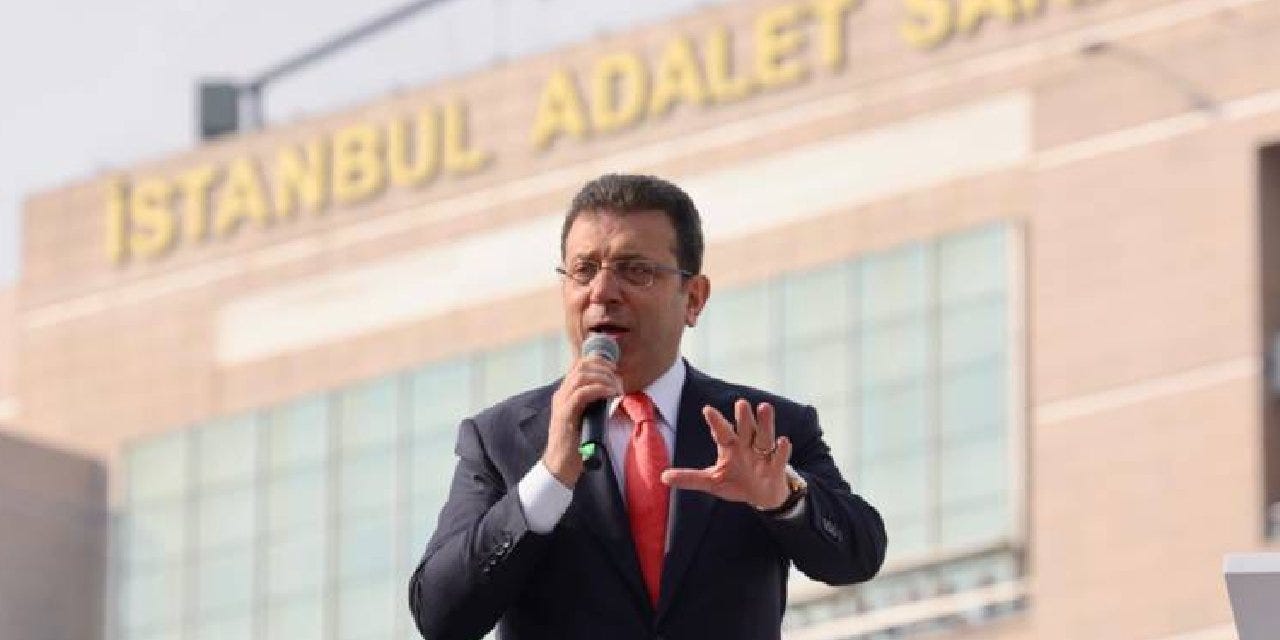
⚖️ İBB trial: lawyers report pro-government journalist seen in judges’ corridor
On the 31st day of the İBB case — in which 414 defendants, including CHP’s presidential candidate Ekrem İmamoğlu and 77 others held in custody, are on trial — lawyers logged a formal record alleging that a journalist with known ties to the government, Ferhat Murat, had been seen in the corridor used by the judges and prosecutor. The hearing ended before it had properly begun after tensions broke out and was adjourned by the bench until the following day. As the courtroom was being cleared, the lawyers’ record stated that, after the panel called a recess, Murat — who had recently interviewed alleged co-operating witness Servet Yıldırım — appeared at the door used by the bench, gestured threateningly and hurled insults at the defendants and lawyers, replying “I am here” when asked what he was doing there. While gendarmes refused to allow lawyers seeking to approach the bench through, the same officers were said to have closed the door rather than answer questions about how the journalist had access, with Murat believed to be still inside the area used by the bench and continuing to post in real time, prompting a reference to Article 217 of the Turkish Penal Code in the record. Leaving the courtroom, İmamoğlu told supporters: “Sadly, the panel does not want to conduct a trial. They are trying to engineer perceptions by allowing pro-government media into a space no one else can enter and letting one of them shake a finger at our colleague. We will carry on our struggle. I love you all very much.” Journalist Burcu Uğur reported that on his way out, Murat had passed into the car park reserved for prosecutors and judges and driven out from there, noting that even MPs are not allowed to park in that area. CHP group deputy chair Murat Emir shared the record on social media, saying the “salaried operatives” of what he called the “İBB conspiracy case” had been caught red-handed, accusing a pro-government media figure of staging interviews with “false co-operating witnesses” and now hurling threats at defendants and lawyers from the very door of the judges’ panel at Istanbul’s 40th High Criminal Court. He demanded to know on what privilege the gendarmes — who had formed a wall against lawyers — were hosting Murat in the panel’s chamber, and described the document as evidence of how the judiciary had been “taken hostage” and of what he called the government’s “dark blackmail politics” and conspiracies, vowing that “this asymmetrical order in which you treat the courthouses as your back garden will change”.