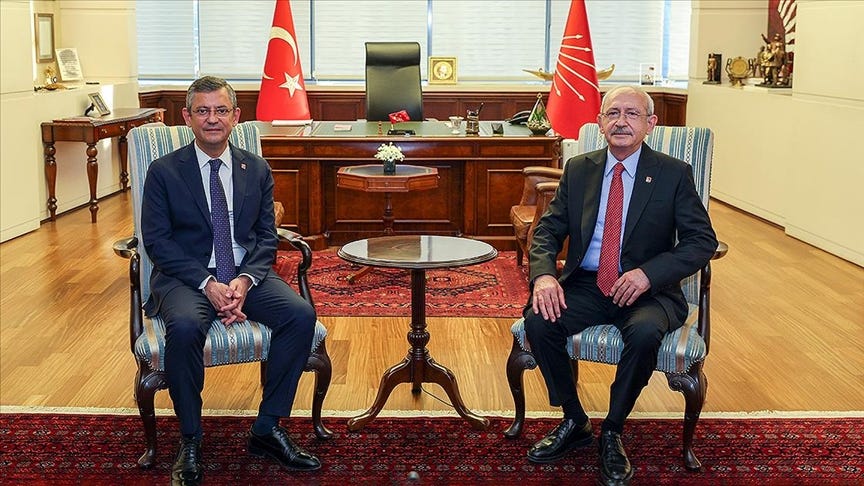
Yesterday, the 36th Civil Chamber of the Ankara Regional Court of Justice annulled CHP’s 38th Ordinary Congress, held on 4–5 November 2023, on grounds of absolute nullity — meaning, in effect, Kemal Kılıçdaroğlu is back in charge of CHP.
So, let’s start from the top: the A, B, C of what’s what and what on earth is going on in Türkiye.
CHP
What does ‘absolute nullity’ mean?
The Ankara Regional Court of Justice’s 36th Civil Chamber has annulled CHP’s 38th Ordinary Congress, held on 4–5 November 2023, on grounds of “absolute nullity” (mutlak butlan) — bringing this legal term back into the public conversation. So what does “absolute nullity” mean, and in what cases is it applied? “Absolute nullity” means that a legal act is deemed definitively void because it contains a serious defect of invalidity from the outset. In its CHP ruling, the Ankara Regional Court of Justice’s 36th Civil Chamber annulled the 38th Ordinary Elective Congress with effect from the date it was held on grounds of “absolute nullity”, and tied to this outcome the ordinary and extraordinary congresses held and the decisions taken after that congress. According to Türkiye’s Language Association (TDK), “butlan”, derived from the Arabic buṭlān, means “the state of being void” in law; TDK also defines the concept as “the state in which a mandatory element required by law in the conditions of validity is missing in a legal act whose constituent elements meet the conditions envisaged by the legislation”. The word “mutlak” is an Arabic-derived word meaning “unconditional, absolute, pure”. For this reason, the term “absolute nullity” describes, in law, a state of severe and definitive invalidity that cannot easily be cured through approval, the passage of time or a subsequent act. Article 83 of the Turkish Civil Code, when regulating the time limits for the annulment of general assembly decisions, expressly reserves the cases of “non-existence” and “absolute nullity”; the Law on Political Parties provides that the provisions on associations may also apply to political parties insofar as they are not contrary to the law. In terms of its legal consequences, “absolute nullity” carries a heavier character than an ordinary procedural defect: in relative nullity, an act can continue to produce valid results until specific parties object, while in absolute nullity, because the invalidity is linked to public order, the court can take note of it of its own motion. As the act is deemed void from the outset, subsequent acts based on it can also become open to dispute.
‘Absolute nullity’ ruling issued for CHP
Türkiye’s Ankara Regional Court of Justice’s 36th Civil Chamber has ruled in CHP’s congress case that Özgür Özel and the party leadership be removed from their posts as a precautionary measure, and that Kemal Kılıçdaroğlu and his former administration take over. The chamber lifted the first-instance court’s ruling in the cases brought seeking the annulment of CHP’s 38th Ordinary Congress, ruling that the congress held on 4–5 November 2023 was annulled with effect from the date it was held on grounds of “absolute nullity” (kesin hükümsüzlük). After the ruling, CHP’s Central Executive Committee (MYK) convened in an extraordinary session at the call of leader Özgür Özel. The chamber also annulled all ordinary and extraordinary congresses convened after the 38th Ordinary Congress and all decisions taken at those congresses, ruled for a return to the situation before the congress, and decided that the leader of the day, Kemal Kılıçdaroğlu, and the party organs in office at that time should continue in their posts. The court suspended as a precautionary measure CHP leader Özgür Özel and members of the Central Executive Committee, Party Assembly and Supreme Disciplinary Board who had taken office through the same congress, ruling that Kılıçdaroğlu and the previous Party Assembly and Supreme Disciplinary Board members should take over their duties on an interim basis until the ruling becomes final. The chamber also annulled CHP’s Istanbul Provincial Congress of 8 October 2023 and all decisions taken at it on grounds of “absolute nullity”, ruling for a return to the situation before the Istanbul Provincial Congress and that the provincial chair and the party’s provincial organs in office before the date of the congress should continue in their duties. The chamber also ordered that the decision be forwarded to the Supreme Election Council, the Ankara Provincial Election Council, the Çankaya 4th District Election Council and the Ankara Governor’s Office for the necessary action. The parties may apply to the Court of Cassation on appeal within two weeks of notification against the ruling, which was taken unanimously on file on 21 May 2026.
Özgür Özel calls CHP’s Central Executive Committee back into session
CHP leader Özgür Özel has called the party’s Central Executive Committee (MYK) back into session in response to the “absolute nullity” ruling. Özel is also to meet CHP’s metropolitan mayors. Reactions to the “absolute nullity” ruling against CHP are growing. The Ankara Regional Court of Justice’s 36th Civil Chamber issued the “absolute nullity” ruling in CHP’s congress case; under the decision, Özgür Özel and his administration — who took CHP to first place for the first time in 47 years — are to be removed from their posts as a precautionary measure, while Kemal Kılıçdaroğlu and his former administration are to return to office. Özel had made statements on the ruling at the party’s headquarters the day before. Stressing that they were being treated as guilty for having made CHP the leading party in the local elections, Özel had said: “They tell us, ‘Leave Ekrem, leave the struggle, come back to Ankara, do Ankara-based politics, sit at the head of the party.’ I am fighting to seat the leader of my party in the seat of power, to seat my presidential candidate in the presidential seat, and to seat my party’s officials in ministers’ seats — and I refuse. I refuse the comfortable seat of an opposition party leader.” Addressing those gathered outside CHP’s headquarters, Özel had said: “Of course our organisations have made the necessary planning. We are on watch and in resistance to defend the father’s hearth. From here I declare to all of Türkiye and the world: from this moment on, until the danger has passed and until it is once again CHP members — not the judicial arm of the AK Party — who decide who will run the Republican People’s Party, I am in this building, in my room, and I am not going anywhere.”
Wave of refusals after CHP’s ‘absolute nullity’: former post-holders won’t go back
Following the annulment of CHP’s 38th Ordinary Congress and the reauthorisation of the party’s previous organs, statements have come from Aylin Nazlıaka and Gençosman Killik, with Nazlıaka announcing she would not accept the Women’s Branches General Chair post in the event of an offer, and Killik announcing he would not accept the Youth Branches General Chair role. CHP’s 38th Ordinary Congress, held on 4–5 November 2023 — at which Özgür Özel was elected leader — was annulled by ruling of the Ankara Regional Court of Justice’s 36th Civil Chamber. Under the decision, Kemal Kılıçdaroğlu was returned to the CHP leadership and the party’s former organs reauthorised by the court. Statement after statement followed from CHP. Former CHP Women’s Branches Chair Aylin Nazlıaka described the ruling as “one of the darkest days in our democratic history”. Nazlıaka said: “The ‘absolute nullity’ ruling against our party is a clear sign of an attempt to shape politics through the judiciary. We do not, and will not, recognise this ruling, which is political rather than legal.” Recalling that she had served as Women’s Branches Chair between 2020 and 2024, Nazlıaka announced for the public’s information that she would not accept the post if a decision were issued for her to return to it, adding: “Under the leadership of our leader Özgür Özel, we will continue to defend the will of the people and to fight for a brighter Türkiye.” Former CHP Youth Branches Chair Gençosman Killik also reacted to the ruling, saying: “Who runs CHP is decided not by the palace’s courts but by CHP’s members. CHP’s leader is not appointed, but elected. I stand with our leader Özgür Özel and the will of the congress. In the event of a possible reversion, I do not accept the post of Youth Branches Chair either.”
Bahçeli calls on Özel and Kılıçdaroğlu to find a ‘joint solution’ for CHP
MHP leader Devlet Bahçeli, speaking on a CNN Türk programme following the Ankara Regional Court of Justice’s “absolute nullity” ruling, has called on the parties to seek reconciliation and refrain from provocation, urging former CHP leader Kemal Kılıçdaroğlu to renounce his post and warning Özgür Özel that “outbursts such as ‘we do not recognise the court rulings’ are unnecessary”. Speaking on the “Gece Görüşü” programme moderated by Hande Fırat after the ruling against CHP, Bahçeli said the decision of the Ankara Regional Court of Justice’s 36th Civil Chamber had “created serious uncertainty over the legal and de facto management authority within CHP”. Recalling that he had commented on the issue previously, Bahçeli said: “CHP is one of the most important political institutions in existence since the founding of the Republic. We expressed our wish that this institution should not be allowed to have its internal affairs stirred up, to be fragmented, to be damaged in legal terms or to be used for different purposes. At the point we have reached, our rightness has emerged. In our view, evaluating the matter with composure, acting in accordance with the law, with a sense of responsibility, and moving with the will to carry CHP’s historic and institutional identity into the future will be the soundest path.” Following the chamber’s ruling — which suspended Özgür Özel and the party administration as a precautionary measure and ordered a return to the pre-congress situation with the party leadership handed back to Kılıçdaroğlu and his then-administration — CHP headquarters had announced on social media that it did not recognise the ruling. Despite the criticism that the ruling has created “uncertainty”, Bahçeli defended its legal validity, saying: “By the court’s ruling, it has been accepted and confirmed by the court ruling that, as alleged, Mr Kılıçdaroğlu was subjected to injustice. At this point, outbursts such as ‘we do not recognise the court ruling’ are pointless and unnecessary.” Bahçeli argued that, rather than resisting the ruling, “the institutional identity of CHP, the century-old plane tree of Turkish political life, must be protected as a matter of priority for all”, and to that end the parties must come together with common sense on the common ground of CHP, acting with the will not to fragment, crumble or scatter. With the region a “ring of fire” and at a time when the will for a “Terror-Free Türkiye” was taking shape, he said, no opportunity should be given to attempts to direct social mobilisation through CHP, and CHP should not be made open to use for different purposes or left in such a state. He said “common reason” must prevail within CHP, and called on Kılıçdaroğlu to take on a historic responsibility — acknowledging the injustice done to him while not wounding or hurting an institution he had led as leader for 13 years and not causing chaos. Within the framework permitted by the law, Bahçeli said, Kılıçdaroğlu should meet Özel and announce his renunciation in order to forge a joint formula on CHP’s future, arguing that this would serve both CHP and the country, and that with this historic responsibility Kılıçdaroğlu would earn an exceptional place both in CHP’s institutional identity and in the hearts of those citizens devoted to it.
YSK to convene over CHP’s ‘absolute nullity’ appeal
Türkiye’s Supreme Election Council (YSK) is to convene at 11:00 today to consider CHP’s appeal against the “absolute nullity” ruling. The meeting will be held following CHP’s appeal application against the ruling. After the “absolute nullity” ruling issued by the Ankara 36th Regional Court, CHP leader Özgür Özel had announced that they had lodged an appeal in order to take the matter to the Supreme Election Council (YSK) and the Court of Cassation. In his statement following the ruling annulling the party’s 38th Ordinary Congress, Özel said: “We have made our appeal to the Court of Cassation, including for the lifting of the precautionary measure. Tomorrow we will apply to the YSK. We expect our applications to be considered as urgently and as quickly as possible, and the YSK to assume the area of responsibility uniquely defined to it. We expect the Court of Cassation to save Türkiye from a disaster by lifting the precautionary measure.” Describing the process as a “coup”, Özel said they would resist to the end.
Following Ankara, leave cancelled for police in Istanbul too
Police in Istanbul have had their weekly and annual leave cancelled, following a similar move at the Ankara Police Directorate, in the wake of the “absolute nullity” ruling on CHP’s 38th Ordinary Congress. Previously approved leave permits have also been cancelled, except in compulsory cases. After the “absolute nullity” ruling in the case seeking the annulment of the 38th Ordinary Congress — at which Özgür Özel was elected leader — leave arrangements were adjusted at police units. Under the ruling, the congress has been deemed void and former leader Kemal Kılıçdaroğlu and the previous administration have been ordered to take over once again. Following the ruling, a call went out to CHP’s headquarters and leave was cancelled at the Ankara Police Directorate. According to Cumhuriyet, a similar decision has now been taken at the Istanbul Police Directorate, where police officers’ weekly and annual leave has been cancelled, and previously approved leave permits — barring compulsory cases — have also been rescinded.
Other news
Detained Büyükçekmece Mayor Hasan Akgün hits back as indictment drawn up
Detained Büyükçekmece Mayor Hasan Akgün, against whom an indictment has been drawn up on the 330th day of his detention, has issued a statement from Silivri Prison, describing the process as a “disinformation and reputation-smearing campaign” and arguing that he has nothing to answer for and has acted in accordance with the law and the public interest, while underlining the presumption of innocence. Stressing that he had nothing in his life that he could not give account of, Akgün said: “I stand behind every step I have taken and every decision I have made throughout my term in office. I have carried out all my duties and responsibilities in accordance with the law, the public interest, and the sense of responsibility I bear towards our nation. The aim of the disinformation campaigns being conducted today is not to bring the truth to light, but to create ground for a smear before public opinion.” In the statement issued through his lawyers from the Marmara Prison in Silivri, Akgün said it was clear that some of the news items and assessments served to the public in recent days, on the basis of the indictment presented to him in the first year of his detention, had been turned more into an organised perception campaign aimed at producing prejudgement against him than at conveying the legal facts. He said that, with judicial proceedings not yet under way and the defence’s statements not even put forward, the distortion of the file’s contents and its serving to the public was incompatible with the principle of the rule of law and was also a clear violation of the presumption of innocence guaranteed by the Constitution; trying to shape a process within the judiciary’s remit through media headlines, he said, damaged not justice but the public conscience directly. He added: “I want to state clearly: I have had nothing in my life that I could not give account of. I stand behind every step I have taken and every decision I have made throughout my term in office. I have carried out all my duties and responsibilities with a sense of responsibility towards the law, the public interest and our nation. The aim of the disinformation campaigns being conducted today is not to bring the truth to light, but to create ground for a smear before public opinion. But the truth will emerge — not through manipulative headlines, but before independent courts, within the framework of concrete evidence and the rules of law.” Saying he trusted both the law and the conscience of the nation, since the truth, however much it was tried to be covered up, would sooner or later emerge, Akgün added that no-one should doubt: “Our heads are held high, our consciences are at ease, and our will is standing firm and upright.” He respectfully informed the public that he would exercise all his legal and criminal rights to the full against the untrue, manipulative and reputation-damaging smears directed at him through press statements, the written and visual press, social media posts and other communication channels.
CHP MPs sound alarm: Veli Ağbaba’s driver out of reach for four days
CHP Rize MP Tahsin Ocaklı and CHP İzmir MP Cumhur Uzun have said that no contact has been possible for four days with Gökhan Cumalı, the detained driver of CHP Malatya MP Veli Ağbaba, with İzmir MP Uzun arguing that what was happening “cannot be explained within the rule of law” and saying: “A suspect held in custody and specifically kept from his lawyers is being subjected to modern torture by being denied contact.” Speaking outside Silivri Prison alongside lawyer Doğa Can Coşar, Ocaklı said Cumalı was not being allowed to meet his lawyers or MPs and that they were there to announce a legal scandal to Türkiye, with the detained Cumalı out of reach for four days during which neither his lawyers nor MPs had been permitted to meet him. Ocaklı alleged that Cumalı had been steered at the prosecution stage, claiming the prosecutor had told him “If you say this, I will release you”, whereas, he said, the statement records showed Cumalı saying he had no knowledge of or connection with these matters and had only worked as a driver. Saying Cumalı had been sought in vain at different prison and courthouse units, Ocaklı argued: “We see and understand that the aim here is to pressure this detainee into giving the statement they want.” Calling on President Recep Tayyip Erdoğan and Justice Minister Akın Gürlek, Ocaklı asked: “What does it mean for four days that a lawyer cannot meet his client? Can such a thing be? Can it be that for four days no information is given to an MP?” Uzun argued that what was happening could not be explained by the rule of law and that “a suspect held in custody and specifically kept from his lawyers is being subjected to modern torture by being denied contact”. Uzun further alleged that in his initial meeting with his lawyer Cumalı had been threatened, saying: “We know that he was told ‘If you tell us what we want to hear, you will be outside. Otherwise, you will spend a long time here’.” Cumalı’s lawyer Doğa Can Coşar said they had been travelling for the past three days between Silivri and the Çağlayan Courthouse, adding: “Our only concern is to find out whether our client is well and is receiving proper legal support.” Saying they had not been given clear information about where his client was, Coşar warned: “If you prevent our client from meeting us, if you do not inform us of where our client is, you will cause all subsequent statements he may make to be tainted.”
Presidential approval now required for municipalities to set up companies and cooperatives
A change in the law published in Türkiye’s Official Gazette has made the setting up of new companies or cooperatives by local administrations, their affiliated institutions, local administration unions and their companies subject to presidential approval. The arrangement also covers contributions of capital to existing or to-be-established companies and cooperatives, the acquisition of shares — including via transfer free of charge — and the process of becoming a partner. With the publication in the Official Gazette of the “Law on the Amendment of the Land Registry Law and Certain Laws and Decree-Law No 375”, a new arrangement has come into force concerning municipalities’ processes for setting up companies and cooperatives. Article 17 of the law amends the fourth paragraph of Article 26 of the Law on Privatisation Practices No 4046. Under the new arrangement, the setting up of new companies or cooperatives by local administrations, their affiliated institutions, local administration unions, companies established by them and companies in which they directly or indirectly own more than half the capital is to be subject to presidential approval. The setting up of new companies or cooperatives by cooperatives in which these entities own more than half the shares, contributions of capital to existing or to-be-established companies and cooperatives, and all share acquisitions and partnership transactions — including those by way of transfer free of charge — are likewise made subject to presidential approval.
Bilgi University closed by presidential decree
Türkiye’s Istanbul Bilgi University — which since its founding in 1996 had grown to more than 20,000 students, over 1,000 academics, close to 50,000 alumni, seven faculties, three institutes and more than 150 programmes, and announced it was in the top five of the foundation universities ranked from Türkiye in the 2024 QS list — has been closed by President Recep Tayyip Erdoğan, who lifted the university’s operating licence by a Presidential Decision published in the Official Gazette on 22 May 2026. A trustee had previously been appointed to its founding foundation. The decision was taken under Additional Article 11 of the Higher Education Law No 2547, which provides for the lifting of the operating licence of foundation universities to whose founding foundation a trustee has been appointed. Istanbul Bilgi University had passed under the umbrella of Can Holding in 2019. On 11 September 2025, the Küçükçekmece Chief Public Prosecutor’s Office launched a major operation against Can Holding on allegations of “forming a criminal organisation”, “money laundering”, “smuggling” and “fraud”. As part of the investigation, holding executives were arrested and 121 companies linked to the holding — including Habertürk, Show TV, Doğa Koleji and Bilgi University — were seized, with their management transferred to the Savings Deposit Insurance Fund (TMSF) as trustee. Following the appointment by court order of a trustee to the university’s founding foundation, the Education and Culture Foundation, today’s final closure decision came as part of the resulting legal chain procedure. Under foundation higher education legislation, the students and archive of universities whose operating licence is revoked are transferred to a “guarantor university” that assumes the institution’s legal protection; Istanbul Bilgi University’s guarantor institution is Mimar Sinan Fine Arts University (MSGSÜ). Technically and under the legislation, active students’ rights to education are placed under state guarantee, with students required to continue their education within MSGSÜ following the legal transfer process, with their existing rights, credits and the fee conditions to which they are subject preserved; the academic calendar and the details of the transition are expected to be announced once clarified by the Council of Higher Education (YÖK). The closure decision will not affect the validity of the diplomas of past graduates, which will remain valid nationally and internationally; for requests such as transcripts or document verification, the point of contact will from this date onwards be the guarantor university, MSGSÜ. The heaviest blow from the university’s closure will fall on its staff, first and foremost the academic cadre. As foundation university personnel have no legal right to direct transfer to state posts, the employment contracts of existing academic and administrative staff will end by law. The fate of accumulated severance pay and salary entitlements also remains uncertain: although such payments are foreseen to be met from the liquidation of the institution’s assets, it is not known whether the amount of accumulated entitlements can be met from the revenue expected from this liquidation, and any prolongation of the liquidation and the consequent loss of value pose a significant potential problem for personnel.
Türkiye is heading down a dangerous path. The expectation now is that, in the long run, Erdoğan will attempt to hand the throne to his son, Bilal Erdoğan.