

⚖️ Justice System and Everyday Life in Türkiye
FETÖ operation launched across all 81 provinces, targeting 968 suspects
The Interior and Justice Ministries have announced that operations have been launched against 968 suspects in all 81 of Türkiye’s provinces targeting the Fetullahist Terrorist Organisation (FETÖ), with Interior Minister Mustafa Çiftçi and Justice Minister Akın Gürlek simultaneously sharing the two ministries’ joint press statement on their social media accounts. The statement, issued as the anniversary of the 15 July coup attempt is marked, remembered those who died and paid tribute to the veterans of that night, saying the fight against FETÖ was being pursued with the same determination despite the passing years. It said that, under the leadership of President Recep Tayyip Erdoğan, the state had conducted a major purge across all its institutions since 15 July and mounted an uncompromising struggle against the network, and that the operations launched that morning against 968 suspects in 81 provinces followed joint work by the chief public prosecutors’ offices, provincial police directorates and gendarmerie commands. Ankara, İzmir and Istanbul were the provinces with the highest numbers of suspects, while work continued in other provinces against the organisation’s current structures, its covert wing and associated elements. Both ministries pledged to continue the effort in close coordination and vowed that no terrorist organisation or centre of tutelage would be allowed to endanger the nation’s will, the state’s survival or the legal order. In his own remarks, Çiftçi thanked Erdoğan for his leadership and Gürlek for his support, saying no force would prevent Türkiye from reaching its goal of a strong country under the “Turkish Century” vision, while Gürlek said the coup attempt had not been forgotten, remembered those killed ten years ago, and pledged to uphold the trust left by them, the sacrifice of the veterans and the nation’s will to independence.
Prosecutors seek at least 10 years in prison for Saran and Cebeci
Prosecutors have called for prison sentences of no less than 10 years for the former Fenerbahçe president Sadettin Saran and the broadcaster Ela Rümeysa Cebeci in an indictment prepared on charges of trafficking or supplying narcotic or stimulant substances. According to a report in Sabah, the indictment in the drugs investigation targeting celebrities has been completed, with prosecutors seeking that Saran and Cebeci each be sentenced to at least 10 years for the offence, and the document has been sent to the Istanbul Heavy Penal Court for consideration. Saran, a businessman who gave a statement to prosecutors at the weekend, said he had been the victim of slander: he stated that he had met Cebeci three years ago when she messaged him, that he had never used narcotics with her, and that many people had given him organic sedatives after he was defamed during the Fenerbahçe presidential elections, adding that he did not believe these contained any narcotic active substance. Asked about a message from Cebeci cited in witness statements in the file — in which she reportedly described something as marvellous and asked him to bring some from “that garden” next time — Saran said it was a joke and a metaphor the two had developed between themselves based on lines from a film they had watched, and that he had absolutely no connection to any such thing.
Detained lawyer Ece Güner says Haluk Levent asked her for a loan after seeing her large donations to AHBAP
The lawyer Ece Güner, detained in the Istanbul Chief Public Prosecutor’s Office investigation into the Ahbap Association, has said that Haluk Levent, the association’s head, approached her after she made a large earthquake donation and asked for a temporary personal loan, saying he was in great difficulty — and that she struggled to get the money back, concluding that she had been deceived. In the investigation, it is alleged that Levent used his employees’ accounts and that transfers worth millions of lira took place between them; Levent was detained in Bursa after an arrest warrant was issued for him, and the prosecutor’s office has claimed that donations made to the association by citizens on 6 February were transferred to personal accounts, used for betting and passed to third parties. Güner was detained as one of the names to whom money was transferred, with allegations that she had sent large sums to three of Levent’s employees in exchanges totalling around 80 million lira. In statements on social media, Güner said she had never been the lawyer of Ahbap or of Levent, that she had made dozens of donations to the association over the years like tens of thousands of other citizens, had paid for people’s operations and had made one of the largest donations after the earthquake, which she said was on record and had been announced at the time. She said Levent, apparently having seen the size of her donations, approached her for a temporary personal loan, describing it as a matter of life and death and promising repayment within a month, and telling her he was the most trustworthy person in Türkiye, that people entrusted their millions to him and that he would repay immediately. She said she trusted him but was only barely able to recover the loan after about a year of effort, stressing that the donation and the loan were separate and that she had recovered only the loan; she added that she did not know whether Levent was guilty or innocent, but that she had never donated to him or to Ahbap again, and that she and her family had been deeply upset by the ordeal. Speaking to the journalist Seyhan Avşar, Güner said she was not Ahbap’s lawyer, that Levent had called saying he badly needed money and she had made a donation, which he later repaid; asked how a donation could be taken back, she replied that it was not a donation, that the sum was extremely high, and that she had been deceived. Responding to those questioning how a lawyer could lend such sums, she said she had been a lawyer for 30 years, had founded and owned one of Türkiye’s largest international law firms, had been among the country’s top taxpayers for most of that time, kept all her tax records, and had closed her office on entering politics, adding that at the time of the loan, just after the earthquake, she had been entirely convinced that Levent was a great philanthropist going through a temporarily bad period, and that everything about her was fully transparent.
ISIS suspect Talip Güler, subject of a yellow notice, captured and brought to Türkiye
The National Intelligence Organisation (MİT) has captured and brought to Türkiye Talip Güler, known by the code name Abdüsselam Türki, who was the subject of a yellow notice and who operated within ISIS’s so-called Türkiye Province structure, known as the Faruk Office. Intelligence work by MİT established that Güler is the brother of Kasım Güler, who before 2021 operated as ISIS’s “Türkiye province chief” and as the finance officer of the group’s Faruk Office. Talip Güler was found to have crossed illegally into Syria in January 2014, where he was determined to have carried out his activities in contact with organisation figures, chief among them his brother. After capturing Kasım Güler in Syria in June 2021 and bringing him to Türkiye, MİT continued its work on his brother, tracking his activities step by step before seizing him and bringing him from conflict zones to Türkiye. In his statement, Talip Güler gave details of his radicalisation in Türkiye, his illegal crossing into Syria and his joining of ISIS, as well as the activities he had carried out within the group alongside Kasım Güler. MİT is continuing its work to prevent ISIS’s planning of attacks against Türkiye, expose the group’s recruitment and seize its attack plans.
Second hearing in Kubilay Kaan Kundakçı murder trial
The trial over the killing of the footballer Kubilay Kaan Kundakçı in an armed attack in Istanbul’s Ümraniye district resumes today. The hearing at the Anadolu 27th Heavy Penal Court will continue the prosecution of the remanded defendants Aleyna Kalaycıoğlu, Alaattin Kadayıfçıoğlu, Hüseyin Can Avcı, Mustafa Rece, Metin Kadayıfçıoğlu and Ahmet Özkoç, along with Zuhal Kalaycıoğlu, who is not in custody. According to the indictment prepared by the Anadolu Chief Public Prosecutor’s Office, Kundakçı died as a result of the armed attack in Ümraniye; in the investigation carried out in connection with the incident, prosecutors sought life sentences for Alaattin Kadayıfçıoğlu and Aleyna Kalaycıoğlu, and up to five years in prison for İzzet Yıldızhan. Following the acceptance of the indictment, the case began at the Anadolu 27th Heavy Penal Court, where proceedings over the charges against the defendants continue.
🏛️ Politics
Cabinet meets today: what is on Erdoğan’s agenda?
The cabinet convenes today at the Presidential Complex in Ankara under the chairmanship of President Recep Tayyip Erdoğan, with the fallout from the NATO summit expected to be taken up. Meeting on the first day of the new week, the cabinet’s first agenda item will be the NATO summit of heads of state and government held in Ankara, with the decisions taken there to be assessed. The reverberations of Erdoğan’s meeting with US President Donald Trump will also be reviewed, with the lifting of CAATSA sanctions, developments regarding Türkiye’s return to the F-35 programme and cooperation in the defence industry among the topics on the agenda. Regional developments will likewise be discussed: renewed fighting in the area of the Strait of Hormuz and the latest situation centred on Iran will be taken up under the security heading, while Israel’s attacks on Gaza, the humanitarian situation and ceasefire efforts will also be assessed. The legal steps to be taken as part of the process known as “Terror-Free Türkiye”, along with the economy, will also feature on the cabinet’s agenda.
🤝Ruling Government (AKP, MHP and DEM coalition aka People’s Alliance)
Efforts to strengthen national memory of 15 July discussed
Culture and Tourism Minister Mehmet Nuri Ersoy has received İsmail Hakkı Turunç, chairman of the board of the 15 July Association, and an accompanying delegation, in a meeting at which efforts to strengthen the place of 15 July in the national memory were discussed, with Ersoy stressing that upholding the trust left by those who died and passing on the sacrifice of the veterans to future generations was a shared responsibility. The meeting was held at the Atatürk Cultural Centre in Istanbul and addressed work aimed at reinforcing the place of 15 July in collective memory. In an assessment posted on his social media accounts, Ersoy said they had reviewed efforts to keep the national memory alive and had held a productive discussion on themes that would contribute to strengthening that shared memory. Drawing attention to the importance of conveying 15 July accurately to future generations, he said it was the shared responsibility of all to uphold the trust left by the country’s martyrs and to pass on the sacrifice of its veterans correctly to coming generations. Ersoy thanked Turunç and the delegation for their visit and for their contributions to the discussion.
Hatimoğulları: operations against the CHP have begun to sabotage the process
DEM Party co-chair Tülay Hatimoğulları has said that operations targeting the CHP have effectively begun to sabotage the peace process, arguing that such practices are all the more striking at a time when peace is being discussed and that the government ought to be mindful of this. In an interview with the newspaper Nefes, she said the anticipated “root law” would mark the first legal and judicial step taken on the Kurdish question, which was why her party attached importance to it and called it a root law — one that should contribute to the emergence and strengthening of other laws and other foundations within the resolution process. She said she did not know how the government was thinking, but that the essential question was whether a sincere step would be taken towards a political and legal resolution of the Kurdish question; DEM had not seen the AKP’s draft, she added, and despite reports that a consensus had been reached on a joint text that had been shared with her party, no text had reached them and they did not know what the law would contain. Hatimoğulları said Öcalan had prepared a seven- or eight-article outline for a root law which had been shared with state representatives, and that although her party had been briefed on its broad content, no concrete text had reached them and no general agreement had yet been achieved; a law that failed to meet expectations, she warned, would not help the process, since it should accelerate disarmament and strengthen the political and legal ground. Noting that the legislation was said to be coming in July, she said such promises had been made repeatedly before, that parliament was close to rising, and that if the government had a draft it should share it that week, adding that parliament should not close before the law was passed. She said DEM opposed from the outset any categorisation of people and any approach evoking effective remorse or repentance, since people wanted a genuinely fresh start in politics and an effective remorse law already existed in Türkiye; Öcalan, she said, had made clear at İmralı that such an approach would not be accepted. Her party’s own draft, which it might share publicly depending on developments, would contain no categories, she said, invoking a phrase often used by parliamentary speaker Numan Kurtulmuş about the dignity and honour of both Turks and Kurds, and describing an inclusive root law resting on democratic ground, along with work prepared on Öcalan’s “right to hope”. Asked whether the organisation’s leaders would fall within the regulation’s scope, she said the government’s thinking was unclear, with hints that only a few hundred people who had received armed training but taken part in no actions might be covered — which would make the law’s scope very narrow — and that reducing the debate to categorising people would squander the process. She said DEM would present its proposals when the time came, including possible transitional mechanisms under which those laying down arms might stay at certain centres for a period, though she did not call this an “adjustment process”. On disarmament itself, she said technical details did not reach her party, but that the PKK had stated it would wage no armed struggle in Türkiye after dissolving itself, describing this as strategic rather than tactical. On the delay in the İmralı talks, she said there was no clear information but she suspected a dialogue on the law was under way in the background, and that Öcalan wanted to meet not only the İmralı Delegation but also press organisations, journalists, jurists and politicians. Turning to the CHP, she said the operations against it were among the greatest obstacles to embedding peace in society, that they had extended beyond detentions and arrests to interventions in the party’s internal workings through the absolute-nullity dispute, and that the CHP’s full support was extremely important in such a process. She contrasted the AKP’s failure to prepare its base with the MHP’s efforts under Devlet Bahçeli and with the “Wise People” committee of the 2013-2015 process, while praising the CHP’s positive stance and its participation in the parliamentary commission. On a possible early election and a presidential candidacy, she said the matter had not yet been discussed and would be assessed according to developments at the time, with her party’s congress still ahead. Asked whether the hardest phase of the process was over, she said she was not so sure, since no legal regulation had yet been passed, and that they had reached the point of wanting to see it enacted before feeling confident.
Poll: 40 per cent of MHP voters do not approve of Erdoğan’s performance in office
According to MetroPOLL Research’s June 2026 survey, the proportion of people approving of President Recep Tayyip Erdoğan’s performance in office stood at 44.5 per cent, with 51 per cent disapproving, while 40 per cent of those who voted for the MHP in the 2023 elections said they did not approve of the way he was carrying out his duties, and CHP leader Özgür Özel’s job approval was measured at 50.7 per cent. In the “Pulse of Türkiye June 2026” survey, reported by Halk TV, respondents were asked whether they approved of the way Erdoğan was performing his presidential duties, with 44.5 per cent approving and 51 per cent disapproving nationwide. Among voters who said they had backed the AKP in the parliamentary election of 14 May 2023, 81.1 per cent approved of his performance, while among MHP voters the figure was 60 per cent, with the remaining 40 per cent disapproving. Disapproval rates were higher among opposition voters: 83.4 per cent of CHP voters, 88.8 per cent of İYİ Party voters and 66.7 per cent of HDP/Green Left Party voters said they did not approve of Erdoğan’s performance. The survey also measured Özel’s performance as leader of the main opposition, with 50.7 per cent of respondents saying they approved and 43.1 per cent saying they did not; 83.8 per cent of CHP voters approved of his performance, as did 29.5 per cent of AKP voters, 32.3 per cent of MHP voters, 76.7 per cent of İYİ Party voters and 65.5 per cent of HDP/Green Left Party voters.
Şirvan mayor Necat Cellek dies
Necat Cellek, mayor of the Şirvan district of Siirt, has died at the hospital in Istanbul where he was receiving treatment. Cellek had been treated in Istanbul for some time for long-standing health problems. His death has plunged those close to him into mourning; during his time in office he had won the appreciation of residents for the services he brought to the district and the work he carried out. Cellek, who was elected mayor as an AK Party candidate, will be laid to rest in the Şirvan district.
EU funds flow to foundations close to the government: Ensar, TÜGVA and Hayrat among recipients
Foundations and associations regarded as close to the government received a total of €197,895 in European Union funds in the first half of 2026, among them the Ensar Foundation, TÜGVA and the Hayrat Foundation, known for its links to the Nur religious community. According to a report in BirGün, numerous new foundations and associations have begun operating during the AKP’s time in power, many of them granted tax-exempt status, with bodies such as TÜRGEV, TÜGVA and Ensar widely regarded as structures close to the government; criticism has been raised over the substantial public resources channelled to them, and it has been alleged that some municipalities transferred large sums from their budgets to these foundations. After the changes of administration at the local elections of 31 March 2019, foundations that had received tens of millions of lira from municipal budgets turned instead to EU funds, and the grants that seven such foundations secured from the Turkish National Agency (TUA) between January and June 2026 approached €200,000. The recipients included the Ensar Foundation, the Önder İmam Hatip Graduates’ Association, Kartal İmam Hatip High School, the Genç Hayrat Association, the Öncü Gençlik Association, the Diyanet Foundation and TÜGVA. Ensar was awarded a grant of €37,106 in March 2026 for a project on returning to nature, while TÜGVA was approved for funding of up to €14,490 for a project called “Rise Towards Hope”. The most striking name on the list was the Türkiye Diyanet Foundation — which receives billions of lira in donation income almost every year — whose “Growing Together” project was awarded €14,490 in EU grants. The Önder association received €34,392 and its affiliated youth association €35,810, while Kartal İmam Hatip High School was awarded €35,777 and the Hayrat Foundation, part of the Yazıcılar branch of the Nur community, €25,830.
İmralı Secretariat’s Atabey: the war lobby is determined to keep the Kurds inside the war
Ergin Atabey of the İmralı Secretariat has written a piece from İmralı for the newspaper Yeni Yaşam, in which he argues that the “war lobby” is insistent on keeping the Kurds inside the war, while stressing that “the equation of the table matters” and that avoiding becoming bait within it is the other side of the task. Atabey writes that the issue is not one of trust or mistrust: he argues that what he calls the abnormal or war lobby has constructed a game confining the question to an equation of trusting or not trusting, accepting or rejecting, and that remaining within it means being trapped on their playing field in a vicious cycle, as he says has been the case for the past 30 years — with Öcalan, whom he calls Rêber Apo, having broken that equation. He describes this as a historic rupture and manoeuvre, pulling the matter out of the “abnormal” equation and into a struggle within the equation of the table, in which the relationship and contradiction with the state is moved from a traumatic and paradoxical plane to one of ideological-political struggle, and where the struggle for and construction of a democratic society and nation will continue with free will. Atabey writes that great games are being played over the Kurds, aimed at the total collapse of the Kurds by a denialist mindset, and that the table does not mean everything is resolved: even if a democratic republic and democratic integration emerge, the relationship and contradiction between the commune and the state will persist. The essence of the current move, he argues, is to carry the struggle inside the state — a form of struggle socialists have neglected, since the state has been treated as a homogeneous, single entity and the struggle has always been waged outside it. Social reality, he writes, is reflected in the state and creates clusters within it, and failing to see this and to carry the struggle inside amounts to falling into the war lobby’s trap; the lobby, he says, claims to be the true owner of the state and escalates war on that basis, doing everything it can, including provoking the Kurds through psychological warfare, so that saying “it isn’t working” in response to such provocation is to fall into the trap. He concludes that the plane of relationship and contradiction with the state at the table is a great opportunity, not granted by anyone but won through half a century of resistance, and that those who bore its cost cannot afford not to understand it; avoiding becoming bait requires understanding the commune-state relationship and developing creative politics, grasping the dialectical wholeness of relationship, contradiction and struggle rather than focusing on only one of the three.
🗳️ Opposition Parties (CHP and others)
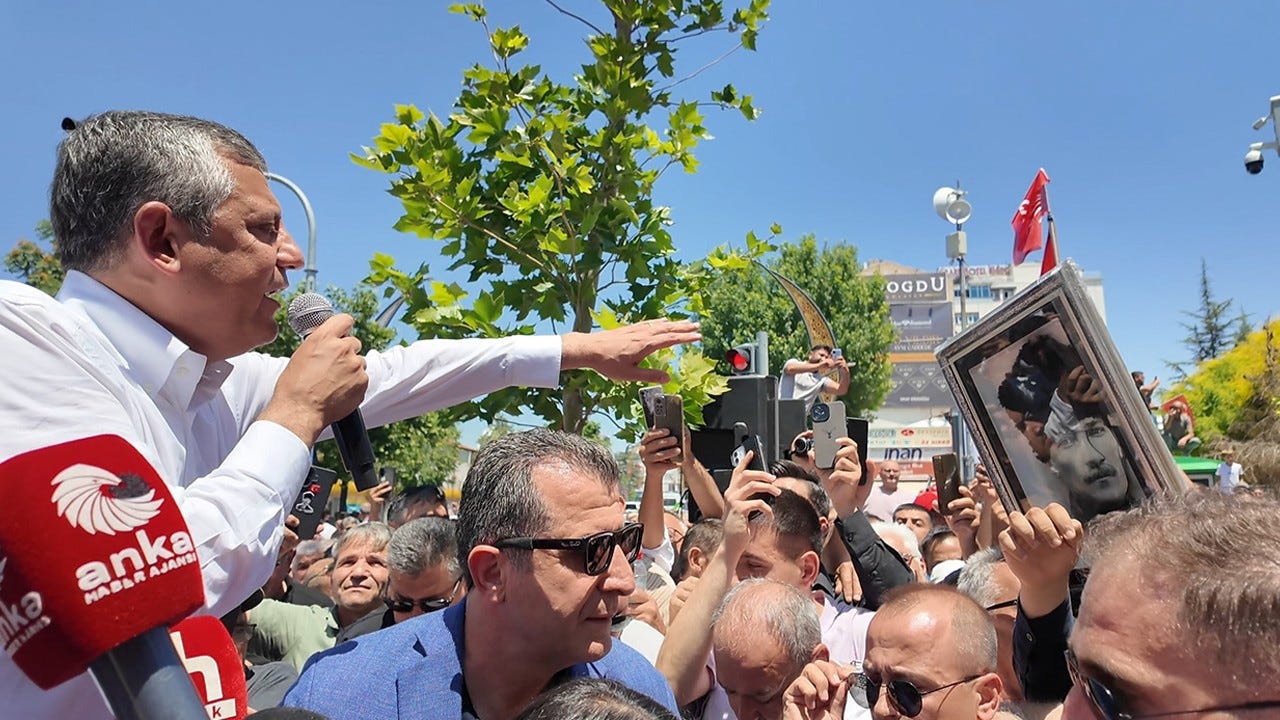
Crowd crush danger at Özgür Özel’s Niğde event
Members of the public were at risk of being crushed at an event held by CHP group chairman Özgür Özel in Niğde. Özel addressed party supporters at Niğde’s Yeni Çarşı, where the temperature of around 35C and the narrowness of the site left those present in difficulty. In an area where people struggled to move, women and children in particular were in danger of being crushed. Journalists covering the event also had trouble protecting their equipment, and teams attended to people who fell ill at the site.