

The Istanbul Security Conference was excellent, came away with plenty to chew on regarding future NATO scenarios and the upcoming 2026 NATO Summit here in Ankara. One small note: NATO, as a rule, does not share intelligence with Belarus or Russia. There was, however, a Belarusian attendee in the room. One does hope NATO guards its top-secret information with slightly more care than it guards its guest list.
Justice System and Everyday Life in Türkiye
🚨 21 foetuses found in a plastic barrel at Urfa cemetery
An investigation is under way after 21 human foetuses were found inside a plastic barrel at the New Cemetery in Şanlıurfa, with judicial and administrative inquiries launched into the case. The discovery came to light when members of the public at the cemetery noticed the suspicious barrel and alerted the authorities; according to the account, citizens who saw the foetuses in containers inside the barrel left in the cemetery area notified police, after which police and relevant examination teams were dispatched to the scene. The foetuses were reportedly found to bear labels belonging to the Urfa Training and Research Hospital, raising the claim that they had been released from the hospital to be properly buried or disposed of but had instead been left in the cemetery area. The foetuses were sent to the Forensic Medicine Institute morgue for identification and examination. Şanlıurfa Governor’s Office said the incident was being investigated in all its aspects, with police continuing work to identify the person or persons responsible for the process by which the foetuses left the hospital, were transported and were left in the cemetery area.
🎲 Şamil Tayyar on Rasim Ozan Kütahyalı: ‘He declined effective remorse — a 244-page record, a tough job ahead’
Former AKP MP Şamil Tayyar has weighed in on the case of pundit Rasim Ozan Kütahyalı, detained in an illegal betting investigation, saying his statement record runs to a hefty 244 pages and that he faces a difficult task. Speaking first on TGRT Haber, Tayyar took the opportunity to air personal grievances with Kütahyalı for the first time, saying: “In 2010 he stitched me up. He said he would put it right but never did. After that day our relationship was kept at arm’s length.” Tayyar also posted his assessment of Kütahyalı’s police statement and the MASAK (Financial Crimes Investigation Board) report on social media. He wrote that the statement record was “quite bulky” at exactly 244 pages, much of it consisting of questions and excerpts from the MASAK report, and that Kütahyalı was charged with managing and being a member of a criminal organisation, illegal betting, fraud and laundering proceeds of crime. According to Tayyar, Kütahyalı did not wish to benefit from the effective remorse provisions, stating that he had no company and was, alongside his commentary work, an individual investor. None of the suspects accept the accusations, Tayyar said, explaining away account movements totalling more than 50 million lira as “money drawn from credit cards at low commission and transferred to his account” and as “commercial loans”, and answering all questions with the same template — in Tayyar’s wrestling metaphor, choosing to grapple off the mat. He concluded that the MASAK report was highly detailed and meticulously prepared to leave no gaps, and that while Kütahyalı had answered professionally, his task was hard: in seeking his release he had said his wife was pregnant, that their 12-year-old daughter had been subjected to peer bullying, and that his wife was at risk of miscarriage as a result of these events. “In short,” Tayyar wrote, “that’s the matter.”
🔥 Masquerade fire trial: expert report clears public officials despite ‘20 years without inspection’
A new expert report submitted in the trial over the Masquerade nightclub disaster in Istanbul’s Gayrettepe, in which 29 workers lost their lives, has cleared municipal personnel of any fault — drawing anger because it found no responsibility on the part of public officials despite stating that the venue had not been inspected for fire safety for 20 years. According to information provided by T24 columnist Candan Yıldız, a case opened against a total of 13 personnel from the Istanbul Metropolitan Municipality (İBB) and Beşiktaş Municipality on charges of “neglect of duty” had been merged with the main case, but the court-appointed five-member panel of experts attributed no fault to the municipal employees in its report. The most striking and contradictory finding, the report’s critics say, was that despite the premises undergoing repeated licence and plan changes over the years, it had not been inspected for fire safety in any way for 20 years — yet, even against this two-decade chain of non-inspection, public officials were found blameless. The families of the victims and their lawyers had asked for the expert panel to be drawn from impartial universities, but the court rejected the request; the presence on the appointed panel of some figures who had previously worked at various municipalities was criticised by the families on grounds of a “community of interest” and loss of impartiality. The scandal did not end there: in a process in which the families’ on-site inspection requests were rejected, the presiding judge was changed and some detained defendants were released, the victims’ lawyers’ requests that the defendants be tried for “killing with probable intent” (olası kast) were turned down, and the trial continues under the article for “killing by negligence”. A question also still awaits an answer as to why Nuri Umut Çıtak — whose name was written alongside that of the venue’s owner Şahzade Şazi Şekergümüş on the nameplates in the management room where the fire broke out — does not appear in the file as a suspect or defendant in any way. Zülfiye Dolu, who lost her brother Şivan Dolu in the fire, set out in an application to the Presidential Communications Centre (CİMER) claims that lay bare the failures in the proceedings: it was observed, she said, that two of the three judges on the panel were not actively participating in the hearings, and that to date no critical questions going to the substance of the case — on work safety, licensing, inspections and the causes of death — had been put to the defendants.
🔫 Third armed attack on the same business in Çorum
A restaurant in the city of Çorum has come under armed attack for the third time, leaving material damage. The attack on the restaurant belonging to a person identified by the initials B.D., on Dr İlhan Gürel Street in the Buharaevler neighbourhood, was carried out by an as-yet-unidentified person or persons, with bullets striking the premises and causing damage. Police teams were dispatched to the scene following a report, and an examination found a large number of spent cartridges along the street. Work has begun to apprehend the suspect or suspects. The same restaurant had reportedly been targeted in two previous armed attacks.
Politics
🏛️ Turkish cabinet to convene with US–Iran ceasefire process on the table
President Recep Tayyip Erdoğan is to chair a Presidential Cabinet Meeting at Beştepe after a two-week break, with foreign policy topics set to take centre stage. The meeting will focus on the indirect talks continuing between the United States and Iran, which have yet to reach a concrete stage, examining where matters stand in the search for a lasting and comprehensive ceasefire. The cabinet meeting chaired by Erdoğan is expected to begin at 16:00. Also on the agenda will be the effects on the Turkish economy of the de facto blockage in the Strait of Hormuz, with current data on the energy diversification policy to be reviewed, as well as the reflections of Erdoğan’s visit to Kazakhstan, covering both steps taken with the Turkic world and the outcomes of bilateral contacts. In domestic politics, the latest state of the “Terror-Free Türkiye” process and the legal steps expected to be taken in the coming days will be discussed, with projections for possible moves under the roof of parliament reviewed following a report from the security units. Inspection activities ahead of the Eid al-Adha holiday will also be raised, with the Trade Ministry having stepped up market inspections ahead of the approaching festival, and security measures taken within the Interior and Transport Ministries to be examined.
🎰 Justice Minister Gürlek: ‘Two major blows dealt to illegal betting networks today’
Türkiye’s Justice Minister Akın Gürlek has announced that 189 people were detained in illegal betting operations across 21 provinces, with a transaction volume of 18 billion lira identified. In a statement on social media, Gürlek said the fight against criminal organisations preying on the nation’s “lawful earnings” — chiefly through illegal betting and online gambling — was continuing with relentless determination, and that two major blows had been struck at dawn against illegal betting networks targeting children’s futures and the country’s economic security. In the Antalya-centred investigation, he said, 183 people were detained: coordinated by the Antalya Chief Public Prosecutor’s Office and following months of meticulous work by the police, a simultaneous operation involving 139 teams across 20 provinces had taken judicial action against 183 suspects whose accounts showed a transaction volume exceeding 11.3 billion lira. In the Mersin investigation, conducted by the gendarmerie on the instruction of the Mersin Chief Public Prosecutor’s Office, an organised crime network laundering the revenues of foreign-linked illegal betting sites had been brought down, with 50 suspects holding a transaction volume of 7 billion lira apprehended and all their assets — including luxury vehicles and flats obtained from crime — seized. Gürlek thanked the Antalya and Mersin Chief Public Prosecutors’ Offices, the General Directorate of Security, the Gendarmerie General Command and the cyber-crime teams he called “the invisible heroes of the cyber world”, adding that no centre of crime was privileged before justice and that the fight against crime and criminal organisations would continue uncompromisingly, with the authority given by law, until its roots were dug out.
⛪ Orthodox gathering at historic Cappadocia church as Patriarch Bartholomew attends service
Ecumenical Patriarch Bartholomew has attended a Sunday service at the historic Church of Saint Theodoros Trion — also known as the Üzümlü Church — in the Derinkuyu district of Nevşehir in Cappadocia. Around 100 Orthodox worshippers from Türkiye and abroad attended the three-hour service, during which passages from the Bible were read. Speaking afterwards, Patriarch Bartholomew thanked the Turkish people for their hospitality, and offered his heartfelt gratitude to the Interior Ministry and local authorities for graciously granting the permission needed for the service to take place. He said he was sure the visit would create fond memories for the guests from abroad, who would leave the country with positive impressions and become “ambassadors” for Türkiye, and extended wishes of health, wellbeing and all of God’s blessings to “our dear Muslim brothers and sisters” on the occasion of the approaching Eid al-Adha. The Archbishop of Albania, John, and other Orthodox clergy also took part in the service.
⚓ Turkish submarine and warship to make port visits in Northern Cyprus
A Turkish Naval Forces submarine and missile boat are to make port visits in the Turkish Republic of Northern Cyprus (TRNC), according to a written statement from the TRNC Security Forces Command. As part of events for 19 May Commemoration of Atatürk, Youth and Sports Day, the submarine TCG I. İnönü (S-360) will be opened to the public at Kyrenia (Girne) Tourism Port, and the missile boat TCG Meltem (P-334) at the Famagusta (Gazimağusa) Commercial Port. The statement noted that citizens would be able to visit the submarine and the vessel between 10:00 and 12:00 and 14:00 and 17:00 local time.
🚪 Azerbaijan’s ambassador: ‘Türkiye–Armenia border to open after 7 June election’
Azerbaijan’s Ambassador to Ankara, Reşad Memmedov, has told Cumhuriyet that the border between Türkiye and Armenia will open once Armenia changes its constitution following its 7 June election, addressing claims that Azerbaijan is the party blocking the opening. Speaking to journalist Batu Bozkürk after a concert programme held at Beştepe in Ankara for Azerbaijan’s Independence Day and Armed Forces Day, Memmedov responded to the question of whether it was Azerbaijan that did not want the Türkiye–Armenia border opened by saying that his country pursued a policy agreed with Türkiye, was in constant contact with the Turkish foreign ministry, and was running the Armenia–Türkiye and Armenia–Azerbaijan normalisation processes in parallel, step by step and in mutual agreement. He said Armenia’s constitution contained a territorial claim against Azerbaijan, that after the 7 June election Armenia would change the constitution and hold a referendum, and that once the territorial claim was removed, the Azerbaijan–Armenia peace agreement initialled in the United States would be signed — after which both the Armenia–Türkiye and Armenia–Azerbaijan borders would open. Asked how he assessed Türkiye and Armenia beginning direct trade the previous week, Memmedov said small steps were being taken by both Azerbaijan and Türkiye, noting that Azerbaijan too had started trading and now played a role in Armenia’s energy security by supplying oil and fuel and enabling the transport of Armenian wheat and other products via Azerbaijan, Kazakhstan and Russia, telling the Armenians that peace would also improve their security. He recalled that Foreign Minister Hakan Fidan had said the previous November that Türkiye would open the border gates the moment the Azerbaijan–Armenia peace agreement was signed. Türkiye closed its border gates with Armenia in 1993 over the expansion of Armenia’s occupation around Karabakh, with the Türkiye–Armenia normalisation process beginning from 2020 onwards as the areas in question were retaken by Azerbaijan, and expectations of the gates reopening forming with Azerbaijan’s return to Karabakh and its surroundings.
🕋 Türkiye’s Diyanet ‘lucky few’: some staff sent abroad on the hajj 25 times
A row has broken out within Türkiye’s Directorate of Religious Affairs (Diyanet) over a “lucky personnel” controversy, with reports that some staff have travelled abroad as “hajj officials” as many as 25 times — while dozens of people, including the spouses of senior managers, are said to have been taken on the pilgrimage without going through the usual lottery. According to a report by Mustafa Bildircin in BirGün, when umrah and other Saudi Arabia assignments are added, some personnel’s combined hajj and umrah visits reach 35. Directorate sources said certain senior figures received a hajj assignment every two years, and that most of those who went to Mecca in 2026 as team leaders, deputy team leaders and regional officers had also gone as officials two years earlier. Diyanet staff stressed that in an institution of 140,000 employees there were thousands who had never been on the hajj at all, with some officials retiring without ever going, prompting one staff member to ask whether they were “working in a different institution”. The discontent extends to imams: while Türkiye has 81 provincial muftis, 220 deputy provincial muftis and 921 district muftis, it was claimed that some muftis enjoyed a “hajj privilege”, with certain muftis going almost every year, fuelling the debate. Directorate sources said the costs of Diyanet personnel going on the hajj were covered by the fees collected from pilgrims, with a daily allowance also paid, and that some who went every year derived large earnings from the hajj duty. As the assignments continued to be debated, Diyanet had also completed its postings for the approaching Eid al-Adha, with around a thousand officials reportedly set to go abroad for the sacrifice organisation and paid a daily overseas allowance from the sacrifice funds; staff said inspectors went abroad one year for the hajj and the next for the sacrifice, claiming the lion’s share of the allowances went to inspectors. Speaking to BirGün, directorate sources said the hajj and the sacrifice had become “a gateway to profit”, with those assigned every year having effectively taken out “a subscription to the hajj” — without whom, the sources said sardonically, either the hajj organisation does not happen or the hajj is not accepted — and that with thousands of qualified muftis and preachers available to do the same work, it was striking that the senior officials assigned to the teams were always chosen from among the same people, with “the nation’s trust” having turned into a gateway to profit for a small group.
Ruling Government (AKP, MHP and DEM coalition aka People’s Alliance)
🕊️ Erdoğan adviser Uçum: ‘Liquidation must come before legal steps’ in Terror-Free Türkiye process
Presidential Chief Adviser and Deputy Head of the Presidential Legal Policies Board, Mehmet Uçum, has set out a detailed framework for the process the government calls “Terror-Free Türkiye”, arguing in a piece written for AA Analiz that the predominant matters from here on are practical ones, with legal regulations occupying a proportionally smaller place in terms of workload — though not, he stressed, in importance. Uçum argued it was beyond dispute that, in line with Öcalan’s perspective of integration with the state and society, there must be an abandonment of the effort to push an “ethnic politics style” to the forefront of Turkish politics and to turn it into a condition of the transition process. He listed the requirements for the definitive and permanent liquidation of systematic terror as the liquidation of active terror practice, of practices supporting active terror, of the language built and fed in the shadow of terror in every sphere, and of the “terror tutelage” over democratic politics, adding that an “illegitimate and condescending cadre tutelage” established over democratic politics through illegal structures, old or new, must be completely eliminated and future such attempts prevented. He recalled the key milestones of the process: Öcalan’s “historic and generally binding” call of 27 February 2025, whose defining feature, he said, was the complete abandonment of status demands as not corresponding to objective reality, with integration with the state and society as its aim and a “single state, single nation” approach as its backbone; the terrorist organisation’s dissolution decision of 12 May 2025; the weapons-burning ceremony of 11 July 2025; the organisation’s decision to withdraw from Türkiye; Erdoğan’s “Manifesto of Brotherhood” speech of 12 July 2025; and the establishment of the “National Solidarity, Brotherhood and Democracy Commission” in parliament on 5 August 2025. That commission completed its report on 18 February 2026, he noted, drawing a clear framework for the law of the transition process: that the state’s security units must determine and confirm that the dissolved PKK has laid down arms and liquidated itself with all its elements through a verification mechanism; that a general understanding had been reached on the legal regulations needed during disarmament; that a purpose-specific, standalone and temporary legal regulation was needed; that criminal and enforcement law provisions would apply to members of the dissolved organisation without creating a perception of impunity or amnesty; and that a monitoring and reporting mechanism should be set up within the executive, informing the public and submitting reports to parliament. Uçum said parliament was empowered to enact the standalone and temporary law subject to conditions such as liquidation and definitive disarmament, and could authorise the President to extend the law’s duration by a reasonable number of reasonable periods, with the commission’s report serving as an important reference document. On the importance of political language, he argued that one cannot speak of “political prisoners” and judicial reform at the same time, since characterisations made through ideological-political approaches have no place in the law in force, and that the state’s interlocutors in the dialogue bore greater responsibility to give confidence to all sections of society and dispel concerns — including by stating that the politics of terror and violence is illegitimate and that any return to “the language of weapons”, open or implicit, must be wholly abandoned. He drew a qualitative distinction between the past use of “Kurdistan” as the name of a geographical region and its use today as an instrument of “ethnic politics”, arguing it was wrong to legitimise the latter by reference to the former, and that the issue was not who had done wrong but the placing of ethnic politics ahead of Türkiye’s integrity, stressing that constructing language with regard to the Turkish nation’s unchanging acceptances and sensitivities about the country’s integrity would contribute to the process. The state’s dialogue with its interlocutors, he wrote, was contact carried out for the definitive and permanent liquidation of terror from every sphere, and loading it with different meanings or carrying it into unrelated areas would only waste time. He concluded that once the transition process was completed, its interlocutors meeting the legal conditions could become more effective by adopting tutelage-free democratic politics, cautioning against the “absurd” inference that democratic advances were being deferred to after the process, since the transition itself widened the space of democratic politics — and closing with Erdoğan’s words on the plane returning from Kazakhstan: that the government was determined, would not gladden those who did not want the “Terror-Free Türkiye” goal, and would overcome all obstacles with dignity to reach it.
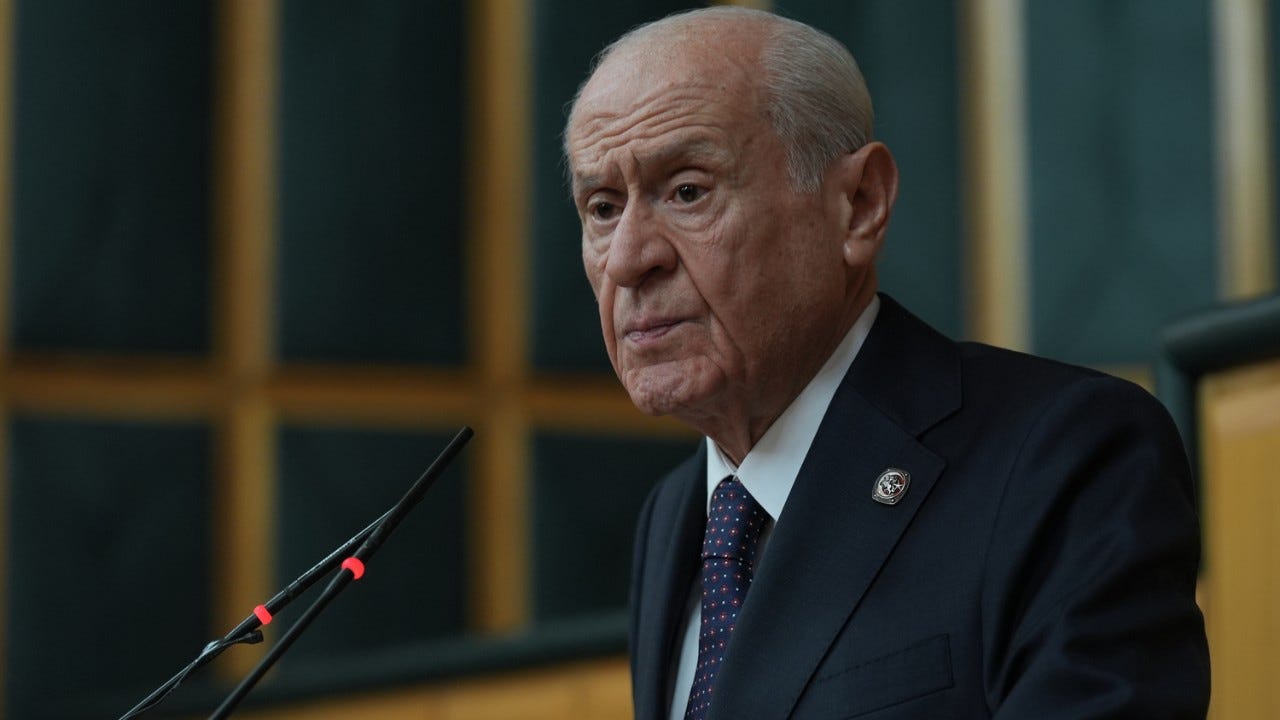
🕊️ Bahçeli sets out seven-point roadmap for ‘Terror-Free Türkiye’ and a defined role for Öcalan
MHP leader Devlet Bahçeli has set out a detailed seven-section assessment of the process the government calls “Terror-Free Türkiye”, arguing that a major threshold has been crossed and that a new “move” and roadmap are now needed — with the central proposal being a structure through which Abdullah Öcalan could maintain his influence over the dissolved PKK in place of the role of “founding leadership”. In the article published in the TÜRKGÜN newspaper, organised under seven headings, Bahçeli wrote that Türkiye was witnessing “a new dawn” with the dissolution of the PKK after some fifty years of bloodshed, and that disarmament and dissolution should be reinforced through democratic, political and economic reforms grounded in social consensus, justice and equality. He recalled the key milestones — the PKK’s 12 May 2025 congress and decision to dissolve and abandon armed struggle following Öcalan’s 27 February 2025 call, the 11 July 2025 weapons-burning by 30 militants, the partial continuation of disarmament, Öcalan’s 27 February 2026 reaffirmation with an implicit call to the PKK’s regional extensions, and the parliamentary National Solidarity, Brotherhood and Democracy Commission’s near-unanimous report — adding that developments in Syria, Iran and Iraq, including a claim that the United States had supplied weapons to PKK elements in Iran in expectation of support, underlined the importance of ending the organisation with all its regional extensions and components. Bahçeli argued that a communication gap had emerged in actions and statements acquiring mutual meaning, and that walking the road with “fragmented structures” would delay results, increase provocations, allow foreign intervention and surface internal conflict dynamics — which was why the term “founding leader” had been used from the start. Drawing on political-science concepts of charismatic authority, organisational institutionalisation and leader-centred mobilisation, and citing the mono-leadership structures of ETA in Spain’s Basque region and the IRA in Northern Ireland, he argued that multiple voices in the leadership during a liquidation process could spawn rival leaderships and the organisation’s reconstitution under other names, making it essential to set out the interlocutor clearly. He proposed that, with the PKK’s “founding leadership” status ending on dissolution, Öcalan be equipped with a social status — his conviction notwithstanding — under the title “Peace Process and Political Engagement Coordinator”, strictly limited to the organisation’s liquidation process and explicitly not covering leadership or representation of Kurds or advocacy of ethnic and categorical rights. Citing the IRA precedent and the Independent International Commission on Decommissioning (IICD), he said the role’s “politicisation” concept meant not Öcalan or any member becoming a political figure but their political counterparts becoming “Turkified” and nationalised — as with Sinn Féin, so DEM Party or future alternatives should produce country-based politics — with Öcalan, as coordinator, provided communication and logistical means in prison by state-designated officials to steer the dissolution and disarmament from a single centre, prevent organisational attempts to sabotage the process, and (without addressing the public directly) be allowed contact with media, academics and civil society, reporting his activities to state organs. Bahçeli proposed building institutional structures to monitor the process: a parliamentary follow-up commission including all parties represented in the assembly, and a “Liquidation and Regulation Process Steering and National Unity” commission chaired by a vice-president and comprising the Justice, Interior, National Defence, Family and Social Services, and Treasury and Finance ministries plus the National Intelligence Organisation, within which a “State Coordination Centre for the Fight Against Terror” would be formed to run the process, counter “black propaganda”, centralise information and serve as the venue for state-side talks with the coordinator. In the remaining sections, on perceptions and social order, he stressed that “peace” did not mean peace with terror but the rehabilitation of the wounds terror had inflicted and the cleansing of separatist discord, that identity should not be made the subject of politics, that representation should be fair and inclusive, and that Terror-Free Türkiye was a holistic transformation — economic, democratic, social and cultural — to consolidate national unity and brotherhood, concluding that the process must be brought to a result without slackening, delay or exploitation, and was not a negotiation or concession with the organisation but the building of an infrastructure to give effect to its declared will.
Opposition Parties (CHP and others)
🚧 New wave of İBB operation: 12 suspects sent to courthouse
Twelve people detained in a fresh operation in the Istanbul Metropolitan Municipality (İBB) investigation have been sent to the courthouse after completing health checks, in a probe centred on allegations that a fictitious tender system was operated in violation of procedure. According to the Istanbul Chief Public Prosecutor’s Office, the operation — carried out on Friday 15 May — concerned allegations of rigged procurement in certain tenders held by İBB’s Road Maintenance and Repair Branch and its Electronic Systems Branch, with 12 people taken into custody. The detainees were brought to Bayrampaşa State Hospital in the morning for medical checks. Those detained include Murat Er (European Side Road Maintenance and Repair Branch Manager), Hakan Çakır (Electronic Systems Manager), technician Erkan Kavlak, engineer Menderes Çakmak, several individuals who prepared the technical specifications (Erkan Koç, İbrahim Yaşaroğlu, Muhammet Sertaç Kazıcı and Niyazi Baştürk), İnform company partner Zeynep Düşmez, and Koloni İnşaat company officials İsmail Kurtuluş and İhsan Sabri Kurtuluş. İnform company official Levent Ilgın, for whom a detention order had been issued, could not be detained as he was abroad. The 12 were referred to the courthouse following their health checks.
🏛️ Corruption operation against CHP-run Tepebaşı Municipality: 25 suspects at courthouse
Twenty-five suspects detained in a corruption operation against the CHP-run Tepebaşı Municipality in Eskişehir have been referred to the courthouse, in a case where detention orders had originally been issued for 60 people, 33 of them municipal employees. Coordinated by the Eskişehir Chief Public Prosecutor’s Office and conducted by the Smuggling and Organised Crimes Investigation Bureau on the basis of tip-offs and complaints, the investigation covers charges of “aggravated embezzlement by chaining”, “forgery of documents”, “violation of Tax Procedure Law No 213”, “laundering of asset values arising from crime” and “abuse of office”. Among the suspects brought to the courthouse were deputy mayors S.Y. and B.Ç. and Ö.E., the private secretary of Tepebaşı Mayor Ahmet Ataç, with police taking extensive security measures outside the courthouse building during the transfer. In the Eskişehir-centred operation, also carried out in Ankara and Adana on 14 May, detention orders had been issued for 60 suspects, 33 of them municipal employees; 23 were initially detained, including deputy mayor S.Y. and the mayor’s private secretary Ö.E., while 35 others had their statements taken at the police station, with the detention figure rising to 25 after the apprehension of deputy mayor B.Ç. and one further suspect. During a search of the garden of Ö.E.’s residence in the Keskin neighbourhood, police from the Anti-Smuggling and Organised Crime Branch discovered a room hidden underground, in which they seized nine smuggled cryptocurrency-mining devices belonging to Ö.E.
Economy
💸 Millions in debt as Türkiye’s bad loans near 200 billion lira
The volume of bad loans that banks in Türkiye have been unable to collect and transferred to asset management companies (VYŞ) has historically neared 200 billion lira as economic difficulties deepen. According to an analysis by Dünya columnist Naki Bakır, the total size of bad bank loans taken over by the 28 asset management companies operating in Türkiye, from their founding to the end of 2025, has reached 199,916.4 million lira — around 200 billion lira — while loans currently under follow-up in the banking system exceeded 700 billion lira as of the start of May. Data compiled from the Financial Institutions Association’s (FKB) final-quarter 2025 sector report lays bare the scale of indebtedness and financial risk. Within the roughly 200 billion lira historical total — encompassing amounts bought, sold, collected, closed and still being pursued — commercial loans account for 71,120.7 million lira (a third of the portfolio), while other loans (individual and similar) make up 128,795.8 million lira (two-thirds). The amount the companies are actively trying to collect, termed “managed principal”, stands at 165,750.2 million lira — 59,590.6 million lira commercial and 106,159.6 million lira other — while the portion collected, closed through payment or restructuring, or written off since their founding was recorded at 34,166.2 million lira. One of the most striking figures concerned the number of debtors and files: by the end of 2025, the number of debtors in the grip of asset management companies reached 4,210,040, of whom 3,691,899 were individual debtors and 518,501 SMEs and commercial entities — meaning that, with Türkiye’s adult population around 65 million, roughly one in every 17 people is a bad-loan debtor. Because citizens owe bad debts to more than one bank, the total number of files has shot up to 9,535,944, of which 8,204,519 belong to individual debtors due to consumer loans and personal credit card debts, and 1,331,425 to companies. While every bad loan falls into the “non-performing loan” category — and not every non-performing loan is yet irrecoverable — the trajectory is alarming: according to BDDK (Banking Regulation and Supervision Agency) data, the banking sector’s non-performing loan volume rose from 578.1 billion lira on 26 December 2025 to 712.7 billion lira as of 8 May 2026, a net increase of 23.3 per cent (134.5 billion lira), pushing the non-performing ratio from 2.5 per cent to 2.8 per cent, with the growth rate of bad loans double that of total lending.
Hoping a good week lies ahead of us.