

Justice System and Everyday Life in Türkiye
📶 Turkey Switches on 5G From 1 April — But Experts Warn the Reality Will Fall Far Short of the Promise
Turkey’s 5G network is set to launch on 1 April, but industry analysts and engineers are warning that the rollout will deliver a pale imitation of true fifth-generation performance, largely because the country lacks the fibre backbone that 5G requires — with some estimates putting Turkey’s fibre coverage at as little as a tenth of what a properly functioning system would need, and only around 35 to 50 per cent of base stations currently connected to fibre at all. The network will be built on a Non-Standalone architecture, meaning 5G antennas will be layered on top of existing 3G and 4.5G infrastructure rather than running on a dedicated 5G core, which rules out the ultra-low latency, network slicing, and mass IoT connectivity that define genuine 5G. The financial burden is also considerable: operators are borrowing heavily — Turkcell secured around $1 billion in credit and Türk Telekom $1.8 billion — and total transition costs are estimated at between 300 and 600 billion lira including $3 billion in licence fees alone. The transport minister has already signalled that higher speeds will come at a higher price for consumers, and the 1.2 million 5G-compatible Samsung handsets pre-arranged by two operators could add $500 to 600 million to the current account deficit before other devices are counted. With Turkey currently ranked around 66th globally for mobile internet speed and 100th for fixed broadband, experts say the underlying problem is infrastructure and ecosystem, not technology — and that without accelerated fibre investment, affordable licensing, and genuine domestic production rather than assembly-line rebranding, 5G risks being an expensive transition period rather than the digital leap it is being presented as.
🌕 Look Up on Thursday: The Pink Full Moon Reaches Its Peak Over Turkey at 05:12
This year’s Pink Full Moon will reach its highest point at 05:12 on Thursday 2 April and will be visible to the naked eye across Turkey. Despite its name — borrowed from a Native American tradition marking the arrival of spring wildflowers — the moon does not actually turn pink; the name refers to the traditional designation for the first full moon of April, symbolising nature’s awakening. The moon will be most clearly visible from open areas away from light pollution.
Politics
📞 Erdoğan Calls KRG President Barzani to Offer Condolences After Attack on His Residence
President Erdoğan has spoken by telephone with Kurdistan Regional Government President Nechirvan Barzani to offer condolences following an attack on Barzani’s residence, and to discuss the ongoing conflict and latest developments in the region. Erdoğan told Barzani that Turkey stands firmly against such attacks and reiterated his call for the fighting in the region to stop as soon as possible.
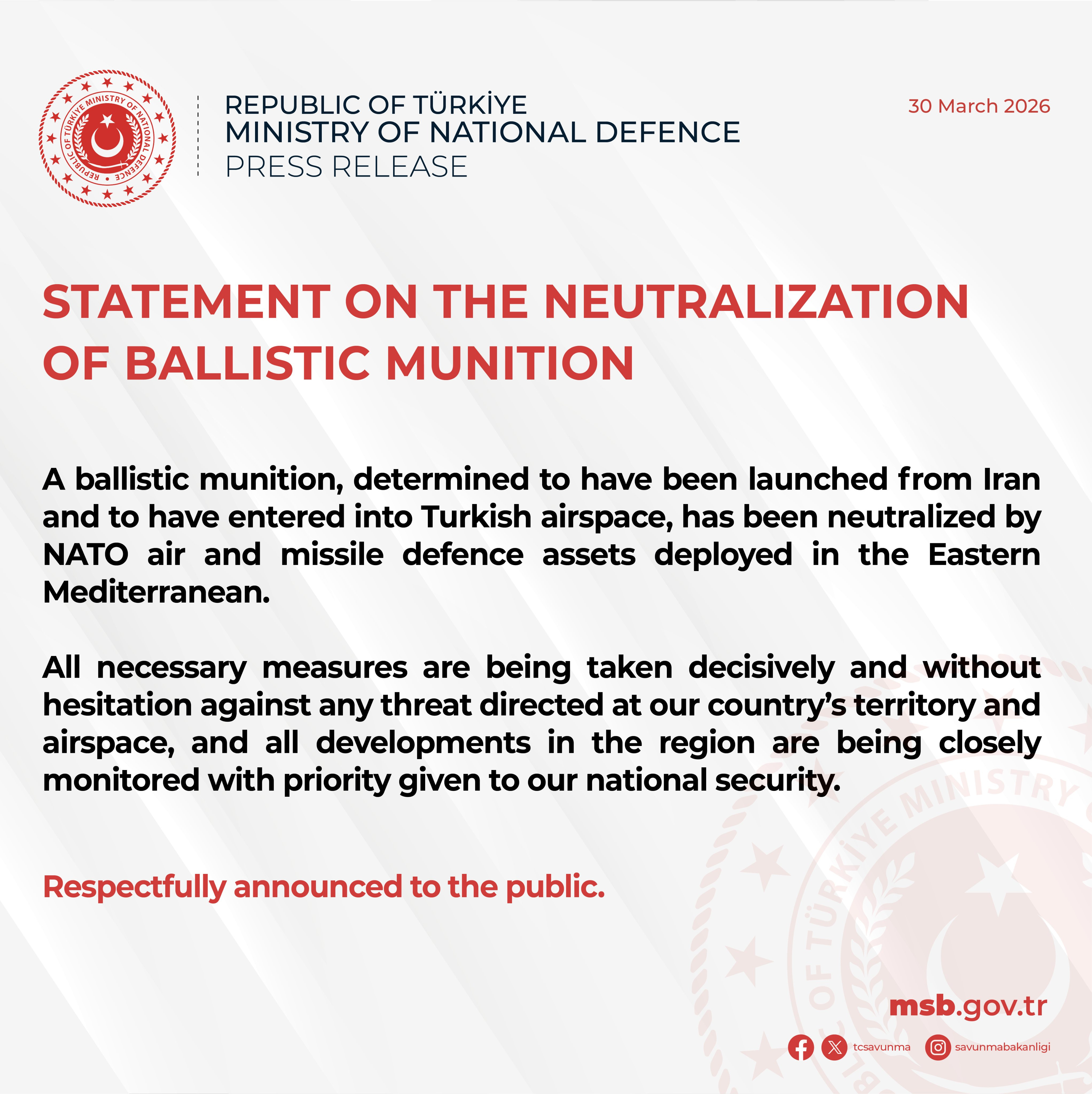
🛡️ NATO Air Defences Intercept Fourth Iranian Ballistic Missile to Enter Turkish Airspace
Turkey’s Ministry of National Defence has announced that a fourth ballistic missile fired from Iran and entering Turkish airspace has been intercepted and neutralised by NATO air and missile defence assets deployed in the Eastern Mediterranean. The ministry stated that all necessary measures are being taken decisively and without hesitation against any threat directed at Turkey’s territory and airspace, and that all developments in the region are being closely monitored with national security as the priority.
🇷🇺 Russia Summons Turkish Ambassador and Demands Ankara Publicly Condemn Ukraine Over Tanker Attack and Pipeline Strikes
Signs of strain in Turkey-Russia relations have become more visible following a series of incidents that have prompted Moscow to summon Turkey’s ambassador to the Russian foreign ministry. On 27 March, Deputy Foreign Minister Alexander Grushko called in Ambassador Tanju Bilgiç to draw his attention to a drone and UAV attack on a Turkish-owned oil tanker near the Bosphorus on 26 March, and to raise ongoing Ukrainian drone strikes on compressor stations feeding the Blue Stream and TurkStream gas pipelines in Russia’s Krasnodar region. Russia explicitly called on Turkey to issue a public condemnation of what it termed the criminal actions of the Kyiv regime and to take additional measures to secure regional energy supplies — a demand Ankara has so far declined to meet, with foreign ministry spokesman Öncü Keçeli referring only to contacts with relevant parties to prevent escalation without naming Ukraine. Turkish foreign ministry sources told Cumhuriyet that Turkey makes its own foreign policy decisions. The episode comes against a broader backdrop of cooling: Erdoğan and Putin have not spoken in four months despite a string of major international crises, and Russia went more than six months with only chargé d’affaires level representation in Ankara before its new ambassador finally presented his credentials on 26 March.
🕵️ Turkish Intelligence Captures Spy Suspect Who Handed Over Free Syrian Army Commanders to Assad — After 12 Years on the Run
Turkey’s national intelligence agency MİT has captured Önder Sığırcıkoğlu at the Syria-Lebanon border in a joint operation with Syrian intelligence, ending a twelve-year manhunt for a man convicted of abducting two Free Syrian Army commanders in 2011 and handing them over to the Bashar al-Assad regime — one of whom, Hüseyin Harmoush, subsequently died under torture. Sığırcıkoğlu had been sentenced to 20 years in prison in 2013 for unlawfully depriving persons of their liberty through coercion, threats, and deception, but escaped from Osmaniye open prison in 2014 and spent years hiding in Syria, Lebanon, and Russia. MİT tracked him over the years and, upon receiving intelligence that he was about to cross back into Syria, coordinated with Syrian intelligence to intercept him at the border. He has been handed over to Ankara’s public prosecutor’s office and counter-terrorism units.
🏥 Government Sells Off Land Under Existing Health Centres While Promise to Build 1,000 New Ones Goes Unfulfilled
A presidential decree has put 55 plots of land across 27 provinces up for sale, with some of the parcels having family health centres (ASM) built on them — prompting sharp criticism from the Birlik ve Dayanışma trade union, whose branch chairman Dr. Emrah Kırımlı asked why existing health centres are being sold off whilst a government pledge to build 1,000 new ones remains unfulfilled. Among the sites listed for sale are plots in earthquake-affected provinces including Kahramanmaraş and Hatay, where staff have been working in temporary containers for three years. Kırımlı noted that ASMs serve not only as primary care facilities but also as designated assembly points during earthquakes, and said the union had grown accustomed to rented ASM premises being sold or demolished, but had not expected state-owned sites to be put on the market.
Ruling Government (AKP, MHP and DEM coalition aka People’s Alliance)
🐺 MHP Appoints Businessman Özgür Bayraktar to Replace Resigned Deputy Leader Yönter
MHP has appointed Özgür Bayraktar, formerly Devlet Bahçeli’s chief adviser, as deputy leader responsible for research and strategy development, replacing İzzet Ulvi Yönter who resigned on 27 March in circumstances that drew attention given his cryptic pre-resignation social media post warning an unnamed “agent who has infiltrated MHP” that he was being watched and that money would not save him. Bahçeli attributed Yönter’s departure to a wish to pursue an academic career. Bayraktar is an Ankara-born businessman of Kırşehir origin with a background in physics engineering and American literature, a history of involvement in the Ankara Chamber of Industry and MHP party structures including three successive party congresses, and a former presidency of the Ülkü Ocakları educational foundation’s board. He is married with two children and speaks advanced English.
🕊️ Öcalan Declares Armed Struggle Definitively Over and Calls for Democratic Republic, After İmralı Meeting With DEM Party Delegation
Abdullah Öcalan has delivered his most emphatic statement yet on the peace process following a meeting with the DEM Party’s İmralı delegation on 27 March, declaring that the era of armed struggle has ended and that there is no going back. In a message relayed by DEM Party, Öcalan framed the current moment as a transition towards a Democratic Republic, saying that a successful conclusion to the process would leave the Republic twice as strong. He insisted his quarrel is not with the Republic itself but with its lack of democracy, describing assimilationist policies as a straitjacket imposed on the country and calling for Kurdish participation in the Republic on the basis of identity, freedom of expression and organisation, and women’s rights — freedoms he said belong to everyone, not only Kurds. Öcalan also offered a three-way analysis of the Iran war, identifying an American-Israeli axis, a British-led status quo axis, and a third line represented by the democratic coexistence model he advocates, arguing that the regional turmoil has only confirmed the importance and validity of the Turkish peace process. He called for a comprehensive legal framework to be established without delay, and said he wished to communicate his ideas to the wider public through appropriate channels. DEM Party’s delegation described the process as having reached a critical threshold and called on parliament to translate the commission report into inclusive legislation urgently.
Opposition Parties (CHP and others)
🚔 CHP Bursa Mayor Mustafa Bozbey Detained Along With Wife, Daughter and Brothers in 55-Person Corruption Sweep
CHP Bursa Metropolitan Mayor Mustafa Bozbey has been detained along with 54 others — including his wife Seden, daughter Side, and two brothers Ramiz and Ertan — in simultaneous dawn raids across Bursa, Istanbul, Balıkesir, and Diyarbakır on charges of running a criminal organisation, bribery, money laundering, and causing planning violations. The Bursa public prosecutor’s office alleges that Bozbey, together with former Nilüfer district mayor Turgay Erdem — already in pre-trial detention and named as the organisation’s leader — illicitly increased floor area ratios on construction projects in exchange for bribes during their time at Nilüfer Municipality, enriching themselves and project developers in the process. The operation named 59 suspects in total, with 55 detained and four — including one believed to have fled abroad — still being sought. The sweep represents the latest and most significant in a series of operations against CHP-run municipalities, and drew immediate attention given that Bozbey is one of the party’s most prominent metropolitan mayors.
⚖️ Uşak Mayor Yalım Remanded in Custody Along With Eight Others as CHP Suspends His Party Membership
Uşak Mayor Özkan Yalım has been remanded in custody on charges of running a criminal organisation, bribery, extortion, and bid-rigging, following his appearance before a magistrate after prosecution questioning. Eight others were also remanded, including his deputy mayor, finance director, chief of staff, mayoral driver, and his brother Mustafa Yalım, all on charges of facilitating bribery. Four further suspects were released under judicial supervision conditions. CHP simultaneously announced that Yalım’s party membership has been suspended pending a disciplinary process, with two lawyers appointed to examine the case before any final decision is taken, and the party said it would hear Yalım’s own account before reaching a conclusion.
⚖️ New Criminal Investigation Opened Against İmamoğlu Within Hours of His Courtroom Remarks
The twelfth day of the Istanbul Metropolitan Municipality trial continued with detained defendants’ testimonies, but attention shifted sharply to a parallel hearing in which İmamoğlu was being tried over his January 2025 “Turpun Büyüğü” press conference — a session that ended with Bakırköy public prosecutor’s office announcing a new investigation against him, opened on the spot, for allegedly insulting and threatening a public official in the course of his courtroom defence. İmamoğlu entered the courtroom to chants of “President İmamoğlu” and delivered a combative address, saying those who had signed off on what he called a fabricated case would drown in their own slanders, questioning whether it was he who ran a criminal organisation or the system that scripts cases using the same experts and prosecutors before rewarding them, and turning Erdoğan’s own “tentacles of an octopus” phrase back on the president with the remark “a person judges others by themselves.” He also publicly asked why journalists Alican Uludağ, İsmail Arı, and Merdan Yanardağ, along with trade union leader Mehmet Türkmen, remain imprisoned. The hearing was adjourned to 13 July, with the court ordering relevant files to be obtained from the prosecutor’s office. The new investigation was opened with what observers described as remarkable speed — within hours of his remarks leaving his mouth.
🗣️ İYİ Party Calls Peace Process ‘Apo Alliance’ and Mocks İmralı Compound as Future Retreat for Erdoğan and Bahçeli
İYİ Party spokesman Buğra Kavuncu has delivered a scathing attack on the government’s Kurdish peace process, seizing on reports that a residential compound has been constructed on İmralı island for Abdullah Öcalan to accuse the ruling coalition of legitimising a terrorist organisation leader whilst soldiers’ children died in unplastered houses. Kavuncu said the alliance of AKP, MHP, and DEM would go down in history as the “Apo Alliance,” and sarcastically suggested the İmralı compound was perhaps being built not only for Öcalan but as a venue where Bahçeli and Erdoğan could also visit for negotiations — adding that they should send the same architect who built the presidential palace. On the Istanbul Municipality trial, Kavuncu said the pattern of pre-emptive detention followed by post-hoc justification, combined with seizure of assets in cases not meeting the threshold for catalogue offences and the leak of investigation files to media and social media trolls before defendants’ own lawyers had seen them, makes clear the proceedings are political rather than judicial. He also questioned the credibility of a US ground offensive against Iran, describing reports of a 3,000 to 5,000-strong operation as unrealistic, and criticised Erdoğan’s meeting with BlackRock CEO Larry Fink as evidence that the party which campaigns against foreign financial interests in public is in practice the government most frequently found at the table with them.
Economy
📦 Israel’s Own Statistics Show Turkey Exported $176 Million to Israel in First Two Months of 2026
Israel’s Central Bureau of Statistics — access to which is blocked from Turkey — has published trade data showing that Turkish exports to Israel totalled $94 million in February 2026 alone, bringing the cumulative figure for January and February to $176 million. The figures were publicised by CHP parliamentary group deputy chairman Murat Emir, prompting the Trade Ministry to issue a denial, insisting that claims of continued trade with Israel are false. The data shows that the exports are dominated by industrially significant goods: machinery and equipment accounted for $44.7 million, base metals for $34.9 million, textiles for $19 million, stone, cement and glass products for $16.4 million, and plastics for $15.5 million. The figures contradict the government’s repeated assertions that trade with Israel has ceased.
⛽ Central Bank Analysis: Fuel Price Escalator Mechanism Could Shield Inflation by Up to 3.7 Points in High Oil Price Scenarios
Turkey’s Central Bank has published an analysis of the eşel mobil fuel price escalator mechanism — activated in March 2026 — finding that it significantly limits the pass-through of global oil price rises into domestic inflation by automatically cutting special consumption tax when international prices rise. Fuel accounts for 3.21 per cent of the consumer basket, but its inflationary impact extends well beyond that direct share through knock-on effects on transport, food, and other sectors, as well as its outsized influence on pricing behaviour and inflation expectations. The bank’s economists calculate that a 10 per cent rise in Brent crude would normally push inflation up by around one percentage point after twelve months, but that the escalator mechanism substantially reduces this. In a scenario where Brent averages $70 per barrel, inflation would rise 1.9 points without the mechanism but only 0.6 points with it; at $90 per barrel, the mechanism could suppress the inflationary effect by as much as 3.7 percentage points. The bank describes the tool as a valuable buffer against external shocks at a time when geopolitical risks are elevated and Turkey is pursuing a disinflation programme.
Thanks for reading this far, I will see you tomorrow. ☕
Every morning I perform the Herculean task of reading the entire Turkish press so you don’t have to. Some might call it a public service. I call it a public service. If you’d like to ensure this indispensable pillar of international journalism doesn’t collapse under the weight of its own genius and unpaid bills, consider Patreon.