

Politics
⚓🌍 Turkey Launches Offshore Energy Push in Somalia as Çağrı Bey Sets Sail
Turkey has taken a major step in its overseas energy strategy by dispatching the Çağrı Bey drilling vessel to Somali waters, marking the country’s first deep-sea drilling mission beyond its own maritime borders. Departing from Mersin ahead of drilling due to begin in April, the vessel symbolises what Energy and Natural Resources Minister Alparslan Bayraktar described as a “new era” in Turkey’s oil and gas exploration. Backed by intergovernmental agreements signed in 2024, the mission builds on earlier seismic surveys carried out by the Oruç Reis and reflects Ankara’s broader ambition to expand its energy footprint through partnerships in Somalia, Pakistan and Libya, with the longer-term goal of dramatically boosting Turkey’s oil and gas production capacity.
📄⚖️İmamoğlu Returns to Court in ‘Fake Diploma’ Case
Istanbul Mayor and CHP presidential candidate Ekrem İmamoğlu appears before a judge once again today in the fourth hearing of his high-profile “fake diploma” trial. The case stems from allegations of falsification following Istanbul University’s decision to annul his undergraduate degree, a move taken just one day before he was detained during the March operations targeting the Istanbul Metropolitan Municipality. Prosecutors are seeking a prison sentence of up to eight years and nine months, while the hearing—held at the Silivri (Marmara) Prison courthouse—follows recent developments in the administrative courts, which rejected İmamoğlu’s bid to suspend the diploma annulment, a decision that has further fuelled political and legal controversy around the case.
💷🏛️ Millions Flow to Washington as AKP’s US Office Expands
The AKP’s officially registered US representation, operating as Ak Party Representation to the United States LLC, channelled substantial sums from Turkey into Washington last year, according to filings under the US Foreign Agents Registration Act (FARA). Records show that nearly $1.35 million was transferred from the AKP headquarters in Ankara during 2025, with more than $720,000 spent specifically on construction and renovation works for its Washington properties. The organisation, which is a US taxpayer, also paid significant federal taxes and owns two prime buildings near the White House, purchased outright in recent years for a combined value of $9.3 million. The US operation is overseen by Halil Mutlu, a cousin of President Recep Tayyip Erdoğan, underscoring the political sensitivity surrounding the funding and expansion of the party’s presence in the American capital.
🔥🗣️ Erdoğan Aide Clashes with Former AKP MP Over Gürlek Appointment
A sharp public row has erupted within conservative political circles after former AKP MP Hüseyin Kocabıyık harshly criticised the appointment of Akın Gürlek as justice minister, questioning both his suitability and constitutional record. The comments prompted an unusually forceful response from Oktay Saral, a senior adviser to President Recep Tayyip Erdoğan, who accused Kocabıyık of moral impropriety and political hypocrisy. Saral dismissed the criticism as “cheap polemics” and “personal bitterness”, warning that those who once advanced their careers “in the shadow of this cause” should not now resort to insults and insinuations. The exchange highlights growing tensions within AKP-linked ranks as recent cabinet changes continue to reverberate through Ankara’s political scene.
🚨🇪🇺 EU–Turkey Economic Ties Flash Red as ‘Transactional’ Model Falters
Relations between Turkey and the European Union are entering a more fragile phase, with the economic pillar now showing clear signs of strain. While political decision-makers on both sides appear content to manage the status quo, much of Turkey’s business community no longer sees the relationship as sustainable “business as usual”. The long-standing give-and-take approach — sidelining democratic standards in exchange for cooperation on issues such as migration — is increasingly unworkable amid global turbulence, new EU trade deals with India and Latin America, and protectionist shifts in European public procurement. Brussels’ recent signals, including Commissioner Marta Kos’s carefully limited Ankara visit, suggest little appetite for a strategic reset. As a result, responsibility is drifting towards business actors, who are urged to move beyond complaint and actively demonstrate, in European capitals, the mutual economic costs of exclusion and the tangible gains of a more inclusive EU–Turkey partnership.
🤝🇬🇷 Greek PM Mitsotakis on Erdoğan Talks: “We Want a Calm and Functional Relationship”
Greek Prime Minister Kyriakos Mitsotakis has reflected on his meeting with President Recep Tayyip Erdoğan in Ankara, describing it as frank, wide-ranging and constructive. Mitsotakis said the two leaders openly discussed both the issues that bring Greece and Turkey closer and those that continue to divide them, stressing that while disagreements remain “real and significant”, they are now addressed without generating tension. Emphasising open channels of communication and a shared reference to international law, Mitsotakis noted that Greece is seeking neither confrontation nor inertia, but rather a normal, calm and functional relationship with Turkey, grounded in national interests. He added that in an increasingly volatile international environment, Greece is choosing stability, continuing structured dialogue and expanding areas of practical cooperation with its neighbour.
⚠️🇩🇪✈️ Germany Issues Travel Warning for Turkey: Free Speech Risks and Regional Safety Concerns
Germany’s Federal Foreign Office has updated its travel advice for citizens planning to visit Turkey, warning that opinions protected as freedom of expression in Germany may be treated as criminal offences under Turkish law. According to the advisory, travellers could face arbitrary detention or travel bans under Turkey’s “disinformation” legislation, including over social media posts or even likes. German authorities also urge citizens to avoid areas close to the Iraqi, Syrian and Iranian borders, specifically naming Şanlıurfa, Mardin, Şırnak and Hakkari as high-risk provinces. The warning further advises vigilance against counterfeit US dollars and euros in circulation, underlining that legal and security conditions differ significantly from those in Germany.
🪖🕳️ What Happened to the PKK’s Weapons in Four Major Caves?
Following the symbolic disarmament linked to the İmralı Process, Ankara is still grappling with what became of the PKK’s remaining arsenal. According to claims leaked from a senior-level briefing and reported by journalist Nuray Babacan, the Turkish Armed Forces allegedly seized large quantities of heavy weapons and ammunition from four major caves abandoned by the PKK, but chose not to disclose this publicly to avoid undermining the process. Other allegations circulating in political and security circles suggest that a significant portion of PKK weapons was transferred to the YPG’s inventory in Syria, to be formally registered and handed over to central authorities under recent agreements — a move Ankara is said to tacitly support. Alternative scenarios discussed include an Iraq-based mechanism under Erbil, Sulaymaniyah and Baghdad supervision, or claims that some weapons were sent to Iran’s PJAK. Despite positive signals, Ankara remains cautious, with no full confidence yet over the fate of the weapons or the reliability of their transfer.
🚨🟥 Kızılcagün Platform Launched in Opposition to the “Terror-Free Türkiye” Process
A group of politicians, retired officers, martyrs’ relatives and veterans has formed the Kızılcagün Platform in Ankara, rejecting the renewed İmralı process with the slogan “No negotiations with terrorists — only struggle.” Founded by Doğru Party leader Rıfat Serdaroğlu, retired Special Forces colonels Orkun Özeller and Alican Türk, and Pakize Akbaba, head of the Martyrs’ Mothers Association, the platform says it is independent of all political parties and focused on what it calls the survival of the Turkish state. Speaking at the group’s first panel, Özeller argued that those shaping policy pay no personal price, while the true cost is borne by ordinary families who lose their children, insisting that militant leaders should neither be legitimised nor engaged in dialogue.
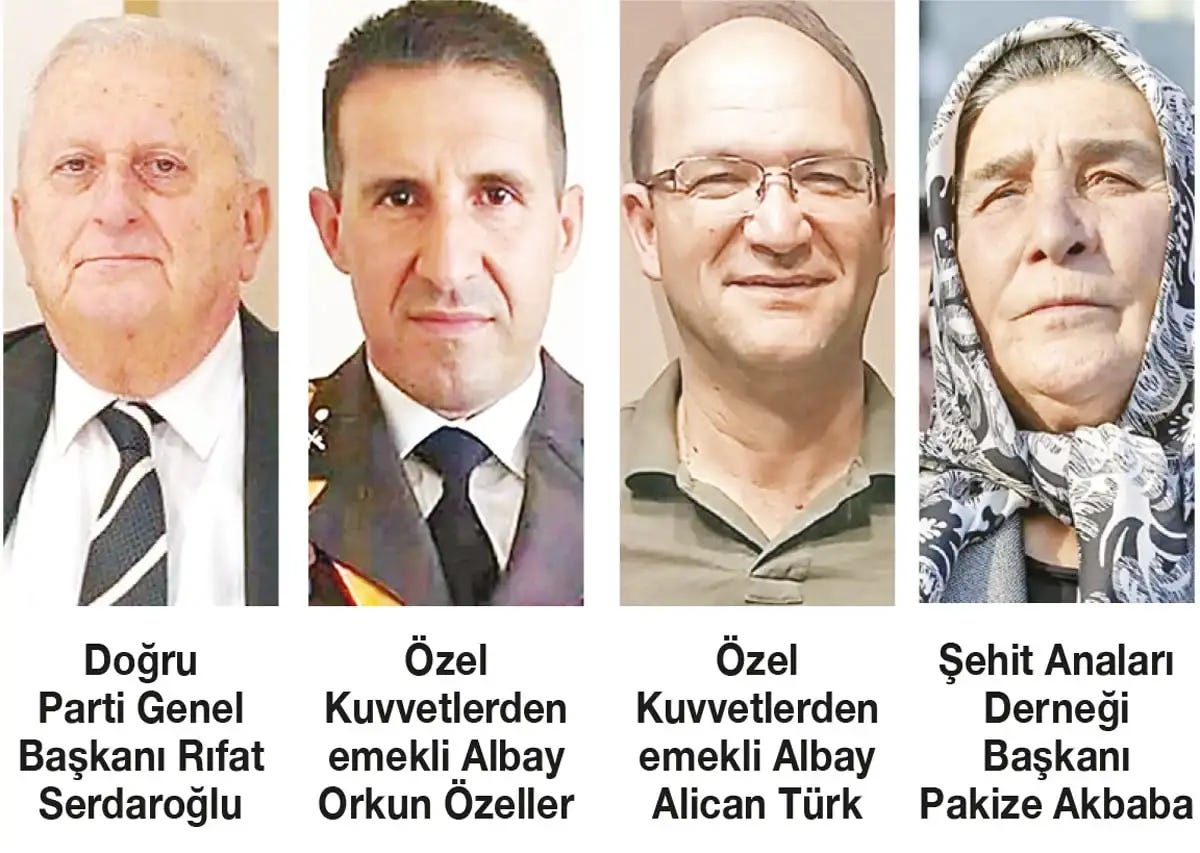
“Rıfat Serdaroğlu – Chairman of the Doğru Party
Orkun Özeller – Retired Colonel, Special Forces
Alican Türk – Retired Colonel, Special Forces
Pakize Akbaba – Chair of the Martyrs’ Mothers Association”
🚨 Earthquake Panic in Istanbul
A late-night alert from a widely used earthquake warning app sent millions of Istanbul residents into a brief panic after it warned of a magnitude 4.0 quake with moderate shaking expected, triggering a flood of anxious social media posts questioning whether an earthquake had occurred; shortly afterwards, Turkey’s Disaster and Emergency Management Authority (AFAD) clarified that the tremor was in fact much smaller, confirming a magnitude 2.6 earthquake at 00:18 in Çatalca, at a depth of 9.75 kilometres, with no damage reported.
Economy
🏥💸 Contractors Come First in Turkey’s Healthcare Spending
New budget figures show that city hospitals built under public–private partnership schemes continue to dominate healthcare spending, with the Health Ministry paying 22.2 billion TL to contractors for 18 city hospitals in January 2026 alone, exceeding the 18.4 billion TL spent on public health protection in the same month. Despite earlier assurances that these projects would not burden the public purse, city hospitals have become a major drain on the budget, outstripping funding for core services such as family medicine, emergency care, addiction treatment and mental health, and reinforcing criticism that healthcare priorities increasingly favour construction firms over patient care.
🏠💷 Turks Now Buying More Property Abroad Than Foreigners Buy in Turkey
New central bank data show a striking reversal in property investment flows in 2025: for the first time, Turks spent more on buying real estate overseas than foreigners invested in Turkish property. While foreign buyers purchased a net $2.34 billion worth of property in Turkey, Turkish residents bought $2.68 billion abroad, resulting in a $332 million net foreign currency outflow. Foreign purchases in Turkey fell by 17% year-on-year, while Turks’ overseas acquisitions surged by more than 24%, reflecting growing concerns over economic stability, a desire for financial diversification and lifestyle planning. Experts warn that official figures likely represent only “the tip of the iceberg”, as significant volumes of overseas property investment may occur through unofficial or indirect financial channels not captured in balance-of-payments data.
💸🛍️ Exporters Cry Foul Over High Prices: £150 Abroad, £430 at Home
Turkey’s exporters have openly rebelled against the country’s soaring cost of living, warning that the price gap with Europe has become unsustainable. Turkey Exporters Assembly (TİM) President Mustafa Gültepe said Turkey is now 50–60% more expensive than Europe, to the point where travelling abroad to shop can feel cheaper than buying at home. He cited examples of products sold for the equivalent of £150 abroad being priced at around £430 in Turkey, blaming a mix of low exchange rates, high inflation and opportunistic pricing. Economist İris Cibre backed this criticism, noting that the gap cannot be explained by currency effects alone, as the euro-denominated price is nearly three times higher in Turkey — a difference she described bluntly as profiteering rather than economics.
🏦📅 Sale Date Set: Turkey’s Deposit Insurance Fund Puts Bank Pozitif on the Block
Turkey’s Savings Deposit Insurance Fund (TMSF) has confirmed the timetable for the sale of Bank Pozitif Kredi ve Kalkınma Bankası, which it has managed as trustee since March 2025 following an illegal betting investigation. Under the updated schedule, the tender for the transfer of 97% of the bank’s shares will take place on 17 February 2026 at the TMSF headquarters in Şişli, Istanbul. Investors must submit sealed bids by 16 February at 7pm, with the auction to follow at 2pm the next day, after the review and site-visit period was extended to allow more detailed due diligence.