

⚖️ Justice System and Everyday Life in Türkiye
Istanbulites take note: roads to close in three districts for Europa League final
Some roads in Istanbul have been closed to traffic this evening for the UEFA Europa League final, which the city is hosting at Tüpraş Stadium. The match between Germany’s Freiburg and England’s Aston Villa will begin at 22:00, with several roads in the Beşiktaş, Beyoğlu and Şişli districts closed to traffic from 11:00 until the end of the match. In Beşiktaş, the closed roads include Yıldız Posta Caddesi, Barbaros Bulvarı, Çırağan Caddesi, Dolmabahçe Caddesi, the Sait Çiftçi turn-offs, Nüzhetiye Caddesi and Süleyman Seba Caddesi, with alternative routes including Yıldız Caddesi, Yenidoğan Sokak, Hoş Sohbet Sokak, Vefa Bayırı Sokak, Orta Bahçe Caddesi, Ihlamur Dere Caddesi, Ayazma Deresi Caddesi, Türkgücü Sokak, Emirhan Caddesi, Ihlamur Yıldız Caddesi, Muallim Naci Caddesi and Dereboyu Caddesi. In Beyoğlu, the closed roads are Meclis-i Mebusan Caddesi, Kemeraltı Caddesi, Galata Bridge, Tersane Caddesi, Dolmabahçe Gazhane Caddesi, İnönü Caddesi, Prof Dr Bedri Karafakioğlu Caddesi, Mete Caddesi, Sıraselviler Caddesi and Asker Ocağı Caddesi, with alternative routes including Refik Saydam Caddesi, Tarlabaşı Bulvarı, Yedikuyular Caddesi, Piyalepaşa Bulvarı, Bahriye Caddesi, Irmak Caddesi, Kurtuluş Deresi Caddesi, Dolapdere Caddesi, Kadiriler Yokuşu Sokak, Boğazkesen Caddesi and Yeni Çarşı Caddesi. In Şişli, the Dolmabahçe Bomonti Tunnel, Taşkışla Caddesi, Kadırgalar Caddesi, Maçka Caddesi, Bayıldım Caddesi and Mim Kemal Öke Caddesi will be closed, with alternative routes including Villa Caddesi, Cumhuriyet Caddesi, Halaskargazi Caddesi, Vali Konağı Caddesi, 19 Mayıs Caddesi, Hakkı Yeten Caddesi, Teşvikiye Caddesi, Rumeli Caddesi, Büyükdere Caddesi, Hasret Caddesi, Akar Caddesi and Nişantaşı Ihlamur Yolu Sokak.
Internationally-wanted drug baron caught in Istanbul
A foreign-national suspect wanted internationally by Germany via a “diffusion message” has been detained in the Şişli district of Istanbul, with the suspect found to have engaged in drug trafficking across different countries via messaging apps. Teams from the Istanbul Police Directorate’s Narcotic Crimes Combat and Intelligence Branch, working in coordination with the National Intelligence Organisation (MİT), identified that the foreign national V.B. had been trading drugs through certain messaging apps and carrying out drug shipments at international level. Continued work pinpointed the address in Şişli at which the suspect — wanted by Germany via a “diffusion message” — was staying. V.B. was caught in an operation carried out this morning and taken into custody, before being transferred to police premises.
Second hearing in case of teacher Fatma Nur Çelik’s killing
Furkan Samet Bakalım (17), the detained teenage suspect who killed his teacher Fatma Nur Çelik with a knife at a high school in Istanbul’s Çekmeköy and wounded six other people, is to appear before a judge for the second time in a case in which he is facing up to 126 years in prison. At Borsa İstanbul Vocational and Technical Anatolian High School, the student had wounded teachers Fatma Nur Çelik (44) and Zeynep Aybars (52) and six pupils with a knife; the injured were taken to hospital, but teacher Çelik could not be saved despite all efforts. Bakalım was detained at the scene of the attack and then formally arrested by the on-duty Penal Court of Peace and sent to prison. In the indictment drawn up after the investigation was completed, prosecutors are seeking up to 126 years in prison for Bakalım — for the act against Çelik, on a charge of “premeditated killing with monstrous feeling of a woman because of the public duty she was performing”, and for the acts against the six wounded victims, on charges of “attempted premeditated killing with monstrous feeling of a child” and “attempted premeditated killing with monstrous feeling of a person because of the public duty being performed”. The first hearing of the case, originally to be heard at the 2nd Juvenile High Criminal Court, was held on 24 April in the larger 19th High Criminal Court chamber due to the physical inadequacy of the original courtroom; with the suspect’s detention extended and the hearing adjourned so that the suspect, the witnesses and the six wounded children could be heard, the second hearing is to be held today at the 2nd Juvenile High Criminal Court.
‘Full Justice’ march for Mattia Ahmet Minguzzi: ‘We’re searching for justice with a candle’
A “Full Justice March” has been held for Mattia Ahmet Minguzzi, who lost his life last year in a knife attack in Istanbul’s Kadıköy, with the procession running from İncirli to Minguzzi’s grave in Bakırköy in the evening. Families who have lost loved ones in similar incidents joined together for the demonstration, including the relatives of Atlas Çağlayan, who was stabbed to death in a fight in Güngören; amateur footballer Kubilay Kaan Kundakçı, killed in an armed attack in Ümraniye; and Abdülbaki Demirel, who was stabbed to death in a fight between two groups in Büyükçekmece. Throughout the march, the families called for justice, harsher penalties and faster judicial proceedings. Minguzzi’s aunt, Binnur Semiz, said that had her nephew Ahmet’s death been pursued seriously enough, the incident in Kahramanmaraş could have been prevented, adding: “I need justice. We are searching for justice with a candle.” His mother, Yasemin Minguzzi, voiced her anger at the trial, saying that everything that could be said had been said but that the family was incredibly angry with the judge and would not let any of the four go: “We will keep up the struggle. We are together, all of us. Millions of people stand behind us. We have all become family, a vast family.” She said she did her best to make the voices of victims’ families heard, but there were so many she did not want them to be broken — noting that Abdülbaki’s case had not been heard about and that she had deliberately gone to the family’s home both to offer her condolences and to amplify their voice, with the news only emerging in the media after her visit; she said she would never stop, and that the law would, one way or another, sooner or later be passed. Atlas Çağlayan’s mother, Gülhan Ünlü, who also took part in the march, said they had been left having to visit their children at the cemetery and called for justice: “We have bright children whom today we are having to visit like this. We have only one wish: justice. But not justice that comes late — justice in good time. And I want to say this too. As we always express, it is not only the perpetrator of the act who is the murderer; the instigators and the other killers are also still outside. Two of Ahmet’s killers are outside, four of Atlas’s killers are outside. We say justice. For justice we will always stand behind our children. We will always be in pursuit of it, so that justice is done.”
TÜİK maps crime in Türkiye for the first time
Türkiye’s Statistical Institute (TÜİK) has, for the first time, mapped out the country’s experience of crime through its inaugural “Crime Victimisation Survey”, with the picture showing cyber-crime and fraud to the fore — and many offences going unreported to the authorities. The 2025 Türkiye Crime Victimisation Survey published by TÜİK produced striking results on crime experience and the perception of security in the country, finding that the most widespread victimisations over the past year were harassment, IT crimes and consumer fraud. The survey was carried out between 6 October and 19 December 2025 in 21,500 households, examining citizens’ perception of security and their experience of victimisation over the past one to three years; it assessed both household crimes such as vehicle theft and burglary and personal offences such as fraud, IT crimes, assault, threats, bribery and harassment. On security measures taken at home, armoured/steel doors led the way at 70.7 per cent, followed by security cameras at 35.5 per cent and shutters or grilles on windows at 28 per cent, while burglar alarms (4.7 per cent), guard dogs (4.8 per cent) and pepper spray/electric shock devices (5.5 per cent) were the least common. Firearms and guard dogs were more common in rural settlements, while shutters or grilles on windows were more common in moderately dense urban settlements compared with other places. Looking at the prevalence rate among those aged 15 and over — the share who had been victims at least once in the past year — non-sexual harassment topped the list at 4.6 per cent, followed by IT crimes at 3.5 per cent and consumer fraud at 2.8 per cent, while robbery (0.1 per cent), vehicle theft (0.2 per cent) and theft of personal items from a vehicle (0.6 per cent) had the lowest prevalence rates. On the rate of reporting the most recent victimisation to the authorities, vehicle theft topped the list at 81.3 per cent, followed by motorcycle/moped theft at 68.4 per cent and assault and injury at 53.3 per cent, while bribery (5.1 per cent), sexual harassment (11 per cent) and non-sexual harassment (14.7 per cent) had the lowest reporting rates. In terms of the total value of items stolen or material loss in the most recent victimisation in 2025, the largest share for every offence fell in the “24,999 lira and below” bracket; in burglaries and consumer fraud, “100,000 lira and above” came second, while in other offences “between 25,000 and 99,999 lira” was the second most common range. Looking at the type of item stolen in the most recent victimisation, in 16.6 per cent of burglary incidents nothing was taken from the home, while in 15.5 per cent it was electronic/electrical goods and in 14.9 per cent jewellery, watches or gold; in other thefts, the stolen item was a wallet/bag/suitcase or briefcase in 19.4 per cent of cases and a mobile phone in 15.2 per cent.
🏛️ Politics
Erdoğan and EU Commission chief von der Leyen hold phone call
President Recep Tayyip Erdoğan has held a telephone call with European Commission President Ursula von der Leyen, in which the two discussed Türkiye–EU relations and regional and global developments, with Erdoğan stressing the importance of preserving the ceasefire and reopening the Strait of Hormuz. According to a statement from Türkiye’s Directorate of Communications, the call also touched on the ongoing conflict process in the region, with Erdoğan stating that Türkiye was striving to preserve the ceasefire and secure peace, and that the Strait of Hormuz must be reopened as soon as possible. He said Israel wished for the conflicts in the region to continue and was continuing to commit violations of international law, including piracy, making it essential to step up international pressure on Israel. With the conversation focusing on the resolution of items on the bilateral agenda in order to deepen economic integration, Erdoğan said that the tensions in the region had once again demonstrated the strategic importance of relations between Türkiye and the European Union, that it would be beneficial for Türkiye to be included in particular in Europe’s security strategy initiatives, that the Customs Union needed to be updated, and that it was important to develop cooperation in every area.
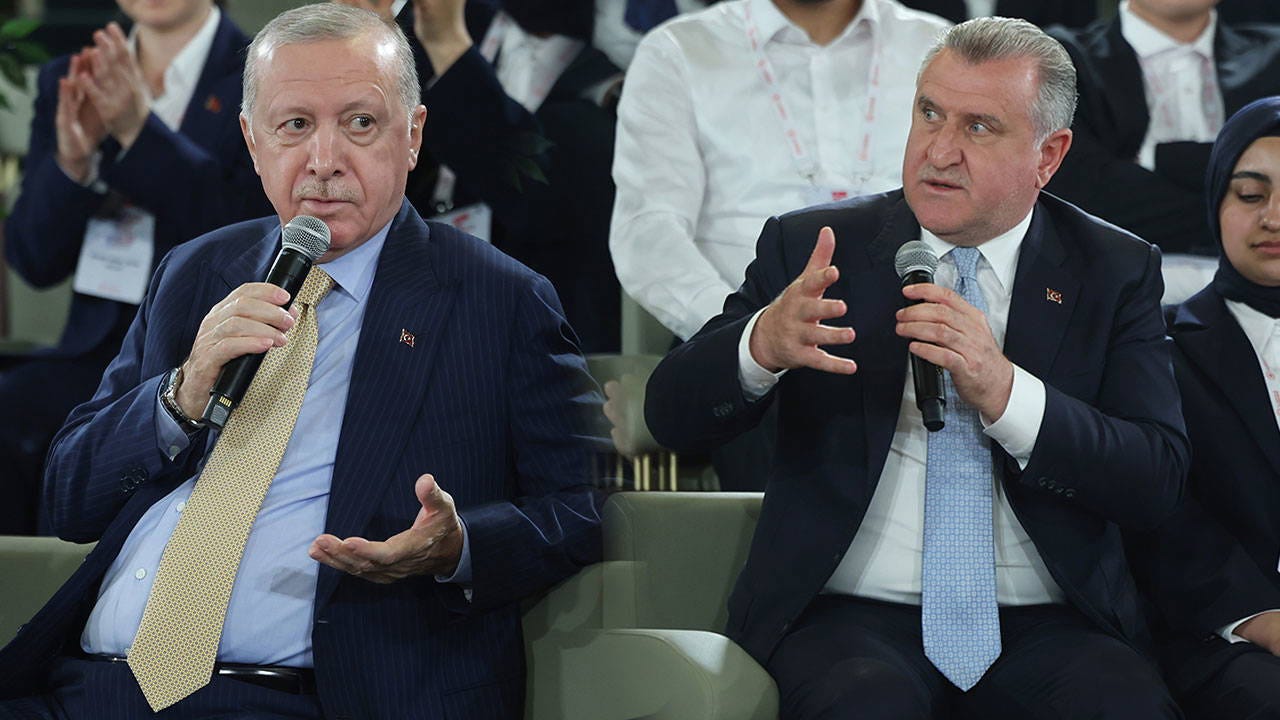
Erdoğan corrects Sports Minister Bak: ‘Don’t say “we could surprise” — say “we will win”’
A striking football exchange took place between President Recep Tayyip Erdoğan and Türkiye’s Youth and Sports Minister Osman Aşkın Bak as they met young people and national athletes at the Presidential Complex as part of the events for 19 May Commemoration of Atatürk, Youth and Sports Day. During the gathering, a young person asked about the prospects of the Turkish national football team — which has just clinched its World Cup ticket after a 24-year drought — at the tournament. Minister Bak took the question, saying the side had landed a marvellous generation with talented names such as Arda Güler, Hakan Çalhanoğlu and Kenan Yıldız, and that they wished to come top of their group. His prediction on the tournament — in which strong favourites such as Spain, Argentina and France are present — that “We could advance to the round of 16, even the quarter-finals, and pull off a surprise” was met with intervention from Erdoğan. Cutting in, the president addressed Bak directly: “Don’t say ‘we could surprise’ — you should say ‘we will win’.” Following Erdoğan’s bold intervention, Bak duly corrected himself: “We will win, sir, all right.”
Defence Ministry: Patriot rotation to be completed in June
Türkiye’s Ministry of National Defence (MSB) has announced that one of the additional Patriot air defence systems deployed in Türkiye will be taken over by Germany, with the rotation to be completed in June and the system planned to remain on duty for around six months. Speaking after a weekly press briefing held at the Doğanbey Firing and Exercise Area in Seferihisar in connection with the EFES-2026 Combined, Joint Live-Fire Field Exercise, the ministry replied to journalists’ questions. Asked about Türkiye’s proposal to NATO for a military fuel pipeline, it said the NATO Fuel Pipeline Project was a standalone project within a capability package prepared to strengthen the energy supply of allies on NATO’s eastern flank using NATO’s common funds, and that approval work was still under way at NATO. The project, it said, was important in the light of recent developments in the Strait of Hormuz in reducing the alliance’s dependence on maritime fuel transport and enhancing NATO’s fuel sustainability and interoperability, and was “five times more cost-effective than its alternatives” and, if approved, would be operationalised in a much shorter time, ensuring the economic and effective use of NATO common funds composed of allies’ contributions. On the air defence systems stationed in Türkiye, the ministry said matters were planned in coordination with allied countries and regularly assessed within the current security environment, adding: “In addition to the Spanish Patriot air defence system on duty in our country, one of the two additional Patriot systems assigned by NATO due to the conflicts between the US, Israel and Iran will be replaced by Germany. The replacement is planned to be completed in June, and the system is envisaged to remain on duty for around six months. The process will continue in coordination with allies in line with current security assessments.” On relations with Germany, it stressed that Türkiye’s strong and experienced army, its active position within NATO, its developing defence industry infrastructure and its geopolitical position of critical importance between Europe, the Black Sea, the Caucasus and the Middle East made it an indispensable ally for regional security, and that European countries were placing increasing importance on deepening relations in defence, security and strategic cooperation, evaluating Türkiye’s strategic role in the future of the European security architecture more strongly. On Libyan and Syrian participation in EFES-2026 hosted by Türkiye, it said 502 personnel — 331 from the east of Libya and 171 from the west — were training jointly with the Turkish Armed Forces, and that the process begun with Türkiye’s support in Flintlock-2026 was continuing with the Libyan army’s first participation in an exercise outside Libya. It noted that Libyan personnel, taking part under the Libyan flag “as a single Libya”, were being trained in fields including boat handling, mines/IEDs, fortifications and survival, special forces operations, underwater offence and defence (SAT/SAS), first aid and medical treatment, amphibious operations, mobile electronic and communications systems (MEBS) and combat wreckage search and rescue, with the Turkish Armed Forces taking concrete steps in line with the “One Libya, One Army” goal. It added that, as part of Türkiye’s support for Syria’s restructuring process, a core element of the Syrian Army was also participating in EFES-2026 — its first such exercise outside Syrian territory — and that training support to the Syrian army would continue.
Turkish Defence Ministry warns Israel: ‘Release our citizens’
Türkiye’s Ministry of National Defence (MSB) has called on Israel to release Turkish citizens detained following its intervention against the humanitarian aid Sumud Flotilla in international waters, branding the action “piracy”. At the weekly press briefing held in Seferihisar as part of the Distinguished Observers’ Day of the EFES-2026 exercise, the ministry shared a wide range of critical topics, from regional developments to the fight against terrorism and from border security to the domestic defence industry. On Israel’s intervention against the “Global Sumud Flotilla”, which was aiming to deliver humanitarian aid to Gaza, the ministry said: “A new act of piracy has been committed against the Global Sumud Flotilla — formed to show solidarity with the people of Palestine and to deliver aid to Gaza — through the intervention of Israeli forces in international waters. Israel must immediately release our citizens and all participants who have been detained.” It stressed that the international community must take greater responsibility in stopping Israel’s lawless actions. On counter-terrorism operations by the Turkish Armed Forces, the briefing said five PKK terrorists had surrendered in the past week, that 218 people had been caught trying to cross the border illegally — three of them members of the terrorist organisation — and that 976 others had been prevented from crossing, taking the total number of people prevented since 1 January to 30,170. The ministry welcomed the decision to extend the 45-day ceasefire between Israel and Lebanon, calling on Israel to abide by the spirit of the ceasefire. The briefing also marked 19 May Commemoration of Atatürk, Youth and Sports Day, with those who lost their lives in the Circassian exile of 21 May 1864 and the Crimean Tatar Turkish exile of 18 May 1944 commemorated in remembrance. The statement closed with an emphasis that the Turkish Armed Forces would continue to be the guarantor of regional and global peace, and with congratulations on Eid al-Adha across the Muslim world.
Turkish intelligence chief Kalın meets Syrian president Sharaa
The head of Türkiye’s National Intelligence Organisation (MİT), İbrahim Kalın, has met Syrian President Ahmed al-Sharaa in the Syrian capital Damascus. Kalın travelled to Syria for talks and met Sharaa at the People’s Palace in Damascus, where they discussed the latest developments in the region and ways to strengthen cooperation and coordination between the two countries. Syrian Foreign Minister Asaad Hassan al-Shaibani and Syrian General Intelligence Chief Hussein al-Salameh also attended the meeting.
‘PKK obstructing cave handovers, opening new galleries in some areas’
The PKK is alleged to be obstructing the handover of caves and, instead of withdrawing from certain areas due to winter conditions, has reportedly opened new galleries in some places — adding fuel to ongoing debates about “blockages” in the resolution process and to MHP leader Devlet Bahçeli’s recent calls. Nefes columnist Nuray Babacan brought the disputes and claims around the process to her column today. According to her piece, while the political headings of the opening are now more clearly known, there remains considerable work to be done in the “disarmament, sifting and surrendering” process under way across the border on Syrian and Iraqi soil — and Bahçeli’s remarks that Öcalan should communicate directly with the organisation are said to be closely linked to the cracks emerging in this area. According to the information obtained, resistance has been encountered in the handover of PKK caves; no new step has been taken since the autumn, with winter conditions reportedly being used as a pretext, while information that new galleries had been opened by the PKK in some areas has become the subject of serious investigation. Activity in the Gara region in northern Iraq is said to be particularly striking — Gara being known, on account of its geography, as an area in which natural caves and shelters used by the PKK for sheltering, logistics and training are heavily concentrated.
Identities of 166 Turkish ISIS members transferred to Iraq emerge through letters
A revived letter exchange running through Türkiye, Iraq and international humanitarian mechanisms has re-established contact between ISIS detainees held in Iraq and Syria and their families — a process that has now largely clarified the identities of 166 Turkish citizens transferred to Baghdad. Türkiye and Baghdad have restarted the practice of correspondence between detained male and female ISIS militants and their families, “as required by international law of war”; letters sent by ISIS militants transferred from Syria to Baghdad have reached their families. Delivered to the International Committee of the Red Cross, the letters were coordinated in Türkiye through the Turkish Red Crescent and in Iraq and Syria by local Red Cross officials. Through the correspondence, the names of the Turkish-citizen ISIS members transferred from prisons in Syria to Iraq have also largely become clear. Under the 1949 Geneva Conventions, those held under “international humanitarian law” have the right to communicate with their families, and the Turkish Red Crescent, as part of the International Red Cross and Red Crescent Movement, plays a humanitarian intermediary role in delivering letters and managing communication in the framework of maintaining family ties. Ankara had ended the practice of correspondence with the families of ISIS members held in camps under Kurdish administration in Iraq and Syria in 2021 on “security grounds”. Within the framework of negotiations conducted along the Ankara–Baghdad–Washington line, the right of militants to communicate with their families under the Geneva Conventions has now been reinstated; first-degree relatives have received letters from ISIS members held in prisons in the Iraqi capital Baghdad and in northern Syria, as well as from female detainees at Al Roj and Rusafa. In this framework, the identities of the 166 Turkish citizens transferred from Syria to Baghdad and still held in Iraq have largely come to light. Following the Syrian government’s military operation to retake control of north-eastern Syria, the decision was taken to transfer ISIS members to Iraq; the transfer process, which began on 21 January 2026 and was completed on 12 February, saw a total of 5,700 ISIS militants, including 166 Turkish citizens, moved to prisons in Iraq. Among them is İlyas Aydın, born in Istanbul Fatih in 1988, who had been captured in Deir ez-Zor during the unravelling of ISIS by the then Kurdish forces and held at a prison in northern Syria; news of Aydın’s transfer to Iraq was also reflected in correspondence on the organisation’s closed communication platforms. Said to operate under the code name “Abu Ubeyde” in ISIS’s Türkiye structure, Aydın is alleged to be the organisation’s “Istanbul Emir”, overseeing cell structures in Türkiye, managing radicalisation processes and providing coordination with the centre in Syria, with files including an attack on the police station in İzmir’s Balçova district. Ankara has requested the extradition of the 166 Turkish-citizen ISIS militants transferred from northern Syria to Iraq; however, Baghdad is reluctant to extradite seven ISIS members found to have taken part in “genocide and massacre” crimes in Iraq.
🗳️ Opposition Parties (CHP and others)
Day 40 of İBB trial: European delegation arrives to observe proceedings
The 40th day of the İBB trial has begun at Silivri with the defence of the detained former general manager of the municipality’s Kültür A.Ş. cultural company, Serdal Taşkın, with a delegation from the European Greens Party — including eight MPs — observing the proceedings in person. The 40th hearing of the case, conducted by the Istanbul 40th High Criminal Court on allegations of “fictitious tenders” and “rigging procurement” at İBB affiliates, is being held at the Silivri Marmara Closed Prison complex; among the defendants is CHP presidential candidate and detained İBB Mayor Ekrem İmamoğlu, with defendant statements continuing under the gaze of international observers. Halk TV reporter Gamze Altunay is following developments from Silivri. In his defence, Taşkın rejected the “tender rigging” and “public loss” allegations, arguing that the tenders were conducted transparently and in accordance with the law, that of 19 sub-contractor agreements signed by the institution only 11 with 9 firms had been made the subject of the charges while the remaining work was content-wise identical, and that the accusations rested on no concrete evidence but on abstract statements. He said Kültür A.Ş. was a commercial joint stock company, deemed a “merchant” under the Turkish Commercial Code, pursuing profit, subject to the Court of Accounts and operating within the exceptions of the Public Procurement Law. He noted that the main tender in 2020 had been won for 61 million lira and rejected the claim that the advertising spaces had been split up, saying their division into rackets, LED screens and megalights had been aimed at “increasing competition and profit”, and that the per-square-metre dollar-based price in his period (82 USD) was more than double that of a similar 2012 tender (40 USD), arguing no public loss had occurred but rather high revenue had been generated. On a 2020 tender for 100 overpass advertising spaces, he said Kültür A.Ş. had won the work for 97.5 million lira and then transferred operating rights to BVA Reklam for 108 million lira, with five firms participating in a transparent process; despite the advertising sector being almost at a standstill due to the pandemic, 10.5 million lira in profit had been earned, while the civilian inspector’s report finding “loss from profit” had failed to take account of pandemic difficulties and the 10 per cent municipality quota. Returning to the scientific definition of loss as income falling below expenditure, Taşkın said that if the civilian inspector had looked at overpasses in Ankara, the Çanakkale, Osman Gazi and Yavuz Sultan Selim bridges, or city hospitals, he would have seen what loss really was — or at least the millions of lira lost at airports where, due to a 98 per cent forecast miss, the state paid the contractor though not a single passenger disembarked. Reacting to having spent 14 months in detention on a claim of “loss from profit”, he reminded the court that Council of State rulings had found such reports to be subjective and requested his acquittal. Taşkın said he had been asked no questions at the prosecutor’s interrogation about the acts attributed to him; he was arrested on 23 March 2025 and 14 months later there was still no concrete evidence against him, recalling that he had learnt from the news while in Erzincan on 19 March that Ekrem İmamoğlu and his colleagues had been detained, that seeing his own name on the list he had gone without delay to a bookshop in the city centre and called the police themselves to tell them where he was. He claimed that exonerating evidence had not been included in the indictment, that no concrete evidence had been shown to him in the police and courthouse interrogations, only the statements of witnesses and anonymous witnesses, and that while properties he had acquired after 2019 were questioned, the documents on the sales that were the source of those assets had not been added to the file — adding that he had bought the new properties with the proceeds of a hotel he previously owned and a plot of land he had sold for 751,000 dollars in 2020, and that he would submit the documents to the court. Reminded that he had been remanded on grounds of “evidence not yet collected” and “risk of flight”, he said he laughed off the suggestion of flight risk given that he had himself notified the police of his location, criticising the absence of any data in his favour from the indictment and demanding his release. Taşkın also said that the open-to-all tender had been won by Kültür A.Ş. for 61 million lira and that, one month later, the work had been sub-let for 66.666 million lira, generating annual profit of 6.666 million lira — around one million dollars at the time’s exchange rate. Earlier in the day, the defence of the lawyer of businessman Murat Kapki — who in a previous hearing had withdrawn his “effective remorse” statements claiming he had been steered by the prosecutor’s office — was due to be heard, but the lawyer declined to make a defence; in the previous session Kapki had alleged that 100,000 dollars had been demanded of him under the heading of “investigation follow-up” and had apologised to Beyoğlu Mayor İnan Güney — whose case has been merged with the İBB file — saying “I know nothing about you, may you forgive me my rights”. Necati Özkan, one of the detained defendants and the campaign director for İmamoğlu, marked his second birthday in prison in the courtroom, with technical and legal examinations continuing in the case involving 414 defendants. The 40th day attracted considerable international interest, with a high-level delegation led by European Greens Party (GYP) co-chair Vula Tsetsi and committee member Joanna Kaminska arriving in Silivri to follow the hearing; the delegation, which includes eight MPs from Germany, is expected to make a press statement in the prison car park during the lunch break. At the opening of the hearing İmamoğlu addressed the tense moments in the courtroom the previous week, saying the process being conducted via families had worn him down emotionally and explaining his earlier conduct: “Perhaps my tone was high, perhaps it disturbed you. But when family becomes the issue, a person’s sensitivity changes. The reaction I had was the result of moral cramping and a feeling of suffocation.” In the 39th session, Murat Kapki had been granted additional time to present his defence after withdrawing his “effective remorse” statements; he had alleged that in October 2024 a man named Çetin Ayaz had come to him saying he knew of a confidential investigation into his companies, and in January had asked for 100,000 dollars in return for following the matter — yet despite raising this in his statement, the question had not been put to Çetin Ayaz, while of Güney he had now said: “I know nothing about you, may you forgive me my rights.”
‘Imamoğlu’ chants ring out at Culture and Tourism Ministry festival
Chants in support of detained Istanbul Metropolitan Mayor Ekrem İmamoğlu echoed across the Eskişehir leg of the Culture Road Festival organised by Türkiye’s Ministry of Culture and Tourism. During a concert open to the public in the city square — held as part of the festival staged in many cities across Türkiye under the ministry’s lead and attended by thousands — young people in the crowd began chanting about İmamoğlu, the CHP presidential candidate currently being held in Silivri. Chants of “President İmamoğlu” quickly rippled across the festival area as other citizens nearby joined in. Footage of the moments went viral on social media.
💰 Economy
Turkish first: solar and wind overtake coal
Electricity generated from solar and wind energy in Türkiye overtook that produced from coal for the first time in April, marking a historic milestone in the country’s electricity generation. As renewables’ share of generation rose, the proportion of total electricity output from renewable energy reached 71 per cent in April — the highest level in recent years. According to data from Energy Markets Operating Company (EPİAŞ), wind energy’s share of total electricity generation in April stood at 9.7 per cent and solar energy’s at 13.1 per cent, taking the combined share of the two sources to 22.8 per cent and surpassing the share of coal-fired power plants in total output for the first time in Türkiye’s history; coal’s share over the same period stood at 21 per cent. The development signalled that, while the share of fossil fuels in Türkiye’s electricity generation was declining, the weight of renewable energy sources was rising. Rainfall above seasonal norms also brought an increase in hydroelectric generation, which came in 27 per cent above the average of the past eight years and 60 per cent above the same period a year earlier. In the first four months of 2026, water flowing into the main basin dams reached its highest level in eight years, including the long-term average, with 95 per cent of the total water flowing into the main basin dams over the past year arriving in the first four months of this year. Natural gas and imported coal stood out among the sources whose share in generation fell in April, with natural gas declining to 7.7 per cent and imported coal to 8.6 per cent compared with the same period a year earlier; imported coal’s monthly share of 8.6 per cent was its lowest level in nine years. Çağlar Çeliköz, an energy analyst at the energy think tank Ember, said in his assessment that renewable energy production in Türkiye had reached historic levels in April, and that sustaining growth in wind and solar was important. He noted that one of the most striking pieces of data in Türkiye’s energy transition in recent years had been recorded in April, and that behind this development lay both the momentum captured in wind and solar — which accounted for 89 per cent of the increase in installed capacity over the past five years — and hydroelectric generation 27 per cent above the eight-year average thanks to rainfall above seasonal norms. Çeliköz cautioned that the rise in hydroelectric output could vary depending on climatic conditions and could create uncertainty about generation levels in coming years, drawing attention to the importance of wind and solar investments for the permanence of the development and concluding that Türkiye needed to step up the momentum it had achieved in wind and solar and ensure source diversity in renewable electricity generation.