

Justice System and Everyday Life in Türkiye
🚨 Six detained over clashes at METU Spring Festival concert
Six suspects have been taken into custody over their alleged involvement in incidents at a concert held during Middle East Technical University’s (METU) Spring Festival, according to the Ankara Chief Public Prosecutor’s Office. A statement said an investigation had been opened on its own initiative into events at METU Stadium on 6 May, on charges of “denigrating the symbols of state sovereignty”, “aggravated intentional injury”, “threat” and “insult”. Teams from the Ankara Provincial Security Directorate’s Security Branch identified the six suspects after reviewing footage circulated by print and broadcast media as well as social media. In a statement on social media, the General Directorate of Security said the Turkish flag was “the greatest symbol” of the nation’s will for independence, the struggle waged for the homeland, and the sacred trust safeguarded by past generations at the cost of their lives, eternally embodying the memory of the country’s martyrs, the unmatched sacrifice of its veterans and the unyielding spirit of independence of its people. The directorate identified the detained suspects by initials as İ.K, M.E.Y, O.A, M.F.G, C.E and B.D, and confirmed that judicial proceedings had been initiated.
✈️ Ankara Governor’s Office warns of loud noise from planned test flights
Ankara Governor’s Office has announced that planned test flights will be conducted in the skies above the Turkish capital on Friday 8 May, with some aircraft set to break the sound barrier and produce a high level of noise. The flights will be carried out in a planned and controlled manner between 13:00 and 17:00, with the aircraft following routes set out under a NOTAM (Notice to Airmen) and using Esenboğa Airport for landing. The governor’s office urged residents not to panic or be alarmed by the noise.
Politics
🤝 Türkiye and Algeria sign raft of agreements at first strategic council
Türkiye and Algeria have signed a wide-ranging package of bilateral agreements during the inaugural meeting of the High-Level Strategic Cooperation Council, co-chaired by Presidents Recep Tayyip Erdoğan and Abdelmadjid Tebboune following their one-on-one talks. Erdoğan and Tebboune themselves signed the Joint Declaration of the Council’s First Meeting. Foreign Minister Hakan Fidan signed two further texts with his Algerian counterparts: a Memorandum of Understanding on cooperation in postal and telecommunications services with Algeria’s Minister of Posts and Telecommunications Ahmed Attaf, and an Agreement on International Passenger and Goods Transport with Algeria’s Interior, Local Authorities and Transport Minister Said Sayoud. Family and Social Services Minister Mahinur Özdemir Göktaş and Attaf signed a Memorandum of Understanding on the welfare of independence veterans and the rightful heirs of those killed. Interior Minister Mustafa Çiftçi and Sayoud signed an Agreement on the Mutual Recognition and Exchange of Driving Licences as well as a Memorandum of Understanding on disaster and emergency management cooperation. Industry and Technology Minister Mehmet Fatih Kacır and Algerian Industry Minister Yahia Bachır signed both a Memorandum of Understanding between their respective ministries and a separate cooperation memorandum on standardisation, conformity assessment and training. Agriculture and Forestry Minister İbrahim Yumaklı and Algerian Agriculture, Rural Development and Fisheries Minister Yasine El Mahdi Oualıd signed an agreement on cooperation in plant protection and plant quarantine. Trade Minister Ömer Bolat and Algerian Foreign Trade and Export Promotion Minister Kemal Razik signed a Joint Declaration on launching negotiations for a Preferential Trade Agreement. Presidential Communications Director Burhanettin Duran and Attaf signed a Memorandum of Understanding on cooperation against disinformation in the media. The head of the Presidential Investment and Finance Office, Ahmet Burak Dağlıoğlu, and the Director General of Algeria’s Investment Promotion Agency, Omar Rekkache, signed an MoU on cooperation in the promotion of investment. The General Director of TRT, Zahid Sobacı, and Algeria’s Ambassador to Türkiye, Boumediene Guennad, signed two memoranda between Algeria’s Public Radio Establishment (EPRS) and TRT covering cooperation in television and in radio respectively.
⚖️ Turkish justice minister: ‘Concordato’ system being abused, new rules on the way
Türkiye’s Justice Minister Akın Gürlek has signalled that the country’s concordato (debt restructuring) procedure is being abused by some companies in ways that paralyse the system, and that work is under way on new legislation to overhaul the process. Speaking at a consultation meeting with MPs from the Aegean region at Ankara’s Hâkimevi, Gürlek said the concordato had originally been designed to give business owners and industrialists a chance to survive — a step before bankruptcy — but that this process was now being misused. He explained that companies were obtaining concordato rulings on the basis of an expert report and then locking up the system, and signalled that the ministry was considering allowing the procedure to be invoked only once: if the company can revive itself, it will live on; if not, it will be declared bankrupt. Gürlek also addressed planned changes to electronic notification (e-Tebligat), noting that the relevant bill remained on the parliamentary agenda and that under the new arrangement notifications will be deemed served within five days. He confirmed that work on Türkiye’s 12th Judicial Package was continuing, stressing that the needs of different regions and proposals from MPs were highly important and that the package had not yet reached its final form. On identity verification on social media, Gürlek said discussions were being held with the platforms and that a transition period was envisaged for users to log in via their identity. The minister also said work was continuing to bring the “Office for the Effectiveness of the Judiciary” and the “Alo Adalet” hotline into alignment.
🎙️ Justice Minister: Muhittin Böcek’s son and Özkan Yalım give ‘effective remorse’ statements
Türkiye’s Justice Minister Akın Gürlek has confirmed that Gökhan Böcek, the son of suspended Antalya Metropolitan Mayor Muhittin Böcek, and Özkan Yalım, the former mayor of Uşak, have given statements under the country’s “effective remorse” provisions to the Istanbul Chief Public Prosecutor’s Office. Speaking on TGRT Haber, Gürlek shared his assessment of the ongoing investigation, saying he had heard that Yalım had made a statement under the effective remorse provisions and that Gökhan Böcek’s statements had also been taken. The minister cautioned, however, that those who invoke the provisions are not automatically released from custody, stressing that anyone seeking to benefit from them must be sincere and disclose everything they know — noting that those giving such statements often conceal certain information, particularly about themselves. He underlined that the authorities must be satisfied that the statements are made in good faith, adding that the discretion lies entirely with the prosecutor’s office, which can choose either to release the suspect or to keep them in custody if it does not give credit to the statements.
🇨🇾 CTP’s first female leader İncirli signals readiness to govern Northern Cyprus
Sıla Usar İncirli, the first female leader of the Republican Turkish Party (CTP) in the Turkish Republic of Northern Cyprus (TRNC), has signalled her party’s readiness to govern, telling reporters in Ankara — including Gazete Pencere — that early elections must be held by October at the latest and that Turkish Cypriots are seeking to be rid of what she described as a corrupt structure in government. Speaking alongside CTP Foreign Relations Secretary Fikri Toros, the medical doctor turned politician argued that CTP would come to power and that Türkiye, regardless of which government takes office in the TRNC, would work with it. Recalling that previous CTP leader Tufan Erhürman won the presidential election last October with 63 per cent of the vote, İncirli criticised the current three-party coalition for trying to cling on rather than going to the polls in spring, and said voters wanted a new government focused on economic and social problems and the people’s welfare. She argued that Turkish Cypriots must have a strong “founding state” structure in the north before any agreement with the Greek side, and that this required a new government to address the economic crisis and clean up corruption, dismissing efforts to “delay our coming to power” and insisting that change was inevitable. Asked about ties with Ankara, İncirli pointed out that CTP had been in coalition government before and would once again work in consultation with the Turkish state, expressing confidence that Ankara would respect the will of the Turkish Cypriots. She reiterated CTP’s support for a federal solution based on two founding states, two communities, two zones and political equality, framing this as serving both the Turkish Cypriot struggle for existence and Türkiye’s own security and interests, including its rights over hydrocarbons, energy corridors, trade routes and maritime jurisdiction areas. İncirli warned that the current status quo had created a “security asymmetry” that posed risks to both Turkish Cypriots and Türkiye, citing the France–Greek Cypriot Administration defence cooperation agreement and the United States’ military approach, and described Türkiye’s deployment of F-16 aircraft and an air defence system to the north as an inevitable precaution. Looking ahead, İncirli expects a 5+1 process — bringing together the Turkish and Greek Cypriot sides with guarantor powers Türkiye, Greece and the United Kingdom — to begin around July, ahead of UN Secretary-General António Guterres’ departure, with political equality, rotating presidency and a “one favourable vote” mechanism that requires the consent of at least one Turkish Cypriot for any decision in federal bodies as the party’s red lines. Other principles she attributed to Erhürman included a fixed end date for negotiations and a guarantee that, in the event of failure due to the Greek side leaving the table, isolation of the Turkish Cypriots would not resume. Insisting that “a solution in Cyprus does not mean moving away from Türkiye”, İncirli argued that international pressure would be needed if the Greek side continued to obstruct a settlement, warning that being seen as the intransigent party would not serve them. CTP Foreign Relations Secretary Fikri Toros added that what would motivate the Greek Cypriot community to compromise was geopolitics — security, energy and shared interests in the Eastern Mediterranean — and that with a Cyprus settlement and the resolution of the political dispute over maritime jurisdiction areas, Cyprus would become the nucleus of a regional energy project, with US efforts to build a power presence in the region requiring the resolution of the Republic of Cyprus’s problems with Türkiye, and the EU membership benefits the Republic currently fails to fully realise serving as a further incentive — even, he added, “compulsion”. On Türkiye’s recent entry ban on Turkish Cypriot academic Semih Çavuşoğlu under the so-called N82 code, İncirli described Çavuşoğlu as someone known to her personally and said such bans had been imposed on trade unionists, politicians, journalists and academics — none of whom posed any security risk to Türkiye — straining ties between Ankara and the TRNC; she said the practice had begun in 2020 in the wake of the Ersin Tatar–Mustafa Akıncı presidential race, and put it down to a major misunderstanding that she expected to be brought to an end.
🖋️ Detained journalist İsmail Arı writes from prison: ‘Am I more guilty than the Kızılay chief who sold tents during the earthquake?’
Detained BirGün reporter İsmail Arı has used a piece written from prison to draw a sharp comparison between his own pre-trial detention and the closure of the investigation into Türkiye’s Red Crescent (Kızılay) over the sale of tents during the 6 February earthquakes. In the article published in BirGün, Arı wrote that doing journalism in this country was “a greater crime than selling tents during an earthquake while people freeze in the cold”. Recounting his arrest, Arı said that during the religious holiday officers had simultaneously turned up at all his relatives’ doors in Tokat, taking him into custody at the home he was visiting and detaining him before the holiday was even over — his crime, he said wryly, being to practise journalism in Türkiye. Visitors at the prison, he wrote, kept reminding him of his Kızılay reports, prompting him to revisit the question of what had happened to the institution’s leadership. Recalling that one of the most controversial chairs of the roughly 160-year-old Red Crescent, Kerem Kınık, had been brought to the end of his road by the scandal in which it emerged that tents in Kızılay’s warehouses had been sold rather than dispatched to the disaster zone after the 6 February 2023 earthquake, Arı noted that numerous criminal complaints were filed against Kınık and other Kızılay officials over the tent sales to the Ahbap charity. The complaints were combined at the Ankara Chief Public Prosecutor’s Office and the file was bounced first to the West Courthouse, then to Istanbul, and after a long delay back to Ankara, where some three years after the disaster it was closed without being turned into a prosecution. More striking still, he wrote, the statements of Kınık and other Kızılay officials had not even been taken — meaning, in effect, that selling tents during an earthquake had been deemed not a crime, opening the way for similar sales in any future disaster. The same authorities who could not, or would not, take the Kızılay leaders’ statements, he argued, had thrown him into prison on a charge that does not even carry a custodial sentence — proof, he said, that journalism is treated more harshly than tent sales during a disaster, and asking pointedly: “Is this justice?” Arı called for all decisions of non-prosecution issued over the past 15 years to be reviewed one day, arguing this was the only way confidence in justice in the country would grow, and asking whose work it was that 80 per cent of society now said they had no trust in the justice system.
🦠 Türkiye’s medical association chief: ‘No global pandemic risk’ from hantavirus
The chair of the Turkish Medical Association (TTB), Prof Dr Alpay Azap, has played down the threat posed by recent hantavirus cases that have made international headlines, telling ANKA News Agency that there is “absolutely no risk” of a major global pandemic. An infectious diseases and clinical microbiology specialist, Azap explained that hantavirus is a long-known family of more than 40 viruses, around 20 of which cause illness in humans, primarily found in rodents and first identified in humans during the Korean War — when, he noted, Turkish soldiers serving in Korea also fell ill and died from hantavirus-related cases. The main route of transmission, he said, is through inhaling dust contaminated with rodent urine and secretions, with infection also possible through contaminated food, rodent bites or contact between rodent excretions and open wounds on the skin. Azap stressed that human-to-human transmission is highly limited and has only been suspected for one of the 20 disease-causing types, with most cases tracing back to a common rodent-contaminated source. Turning to the recent cluster aboard a cruise ship — the Dutch-flagged MV Hondius, sailing from South America towards the Canary Islands with 149 passengers and crew from 23 countries, where eight cases were reported (five confirmed as hantavirus, three suspected, and three resulting in death) — Azap said the strain identified was the “Andes” type carried by South American rodents, and that the cases most likely originated from a common source rather than spreading person to person. He noted that hantavirus types vary by geography: those carried by rodents in the Americas can cause severe “hantavirus pulmonary syndrome” with respiratory failure, while strains seen in Europe and Asia mainly affect the kidneys, with mortality between one in a thousand and 3 per cent. Azap underlined that both the European Centre for Disease Prevention and Control and the US Centers for Disease Control and Prevention currently classify the outbreak risk as very low, and there was no cause for panic. With no effective drug or vaccine available, treatment is supportive — including dialysis where kidney failure develops — and most patients recover spontaneously once they get through the critical period. The main means of protection, he said, is to avoid contact with rodents, particularly when cleaning rural homes or upland houses, where one should avoid sweeping in a way that raises dust, dampen surfaces first, ventilate the area and, where possible, wear a mask. Both the severe pulmonary form and the kidney-affecting form seen in Türkiye begin with flu-like symptoms — high fever, muscle and joint pain, headache, nausea, vomiting and diarrhoea — with the kidney form potentially progressing to low blood pressure, kidney failure, fluid build-up and altered consciousness; diagnosis can be made readily by PCR test, and the great majority of patients recover with supportive care. According to TTB data, Türkiye recorded hantavirus cases and deaths between 2009 and 2025, with the highest annual figure of 58 cases logged in 2010; recent years have seen between 10 and 17 cases annually, with 12 cases reported in 2025 and no deaths, and a total of 14 hantavirus-related deaths recorded over the 16-year period.
Ruling Government (AKP, MHP and DEM coalition aka People’s Alliance)
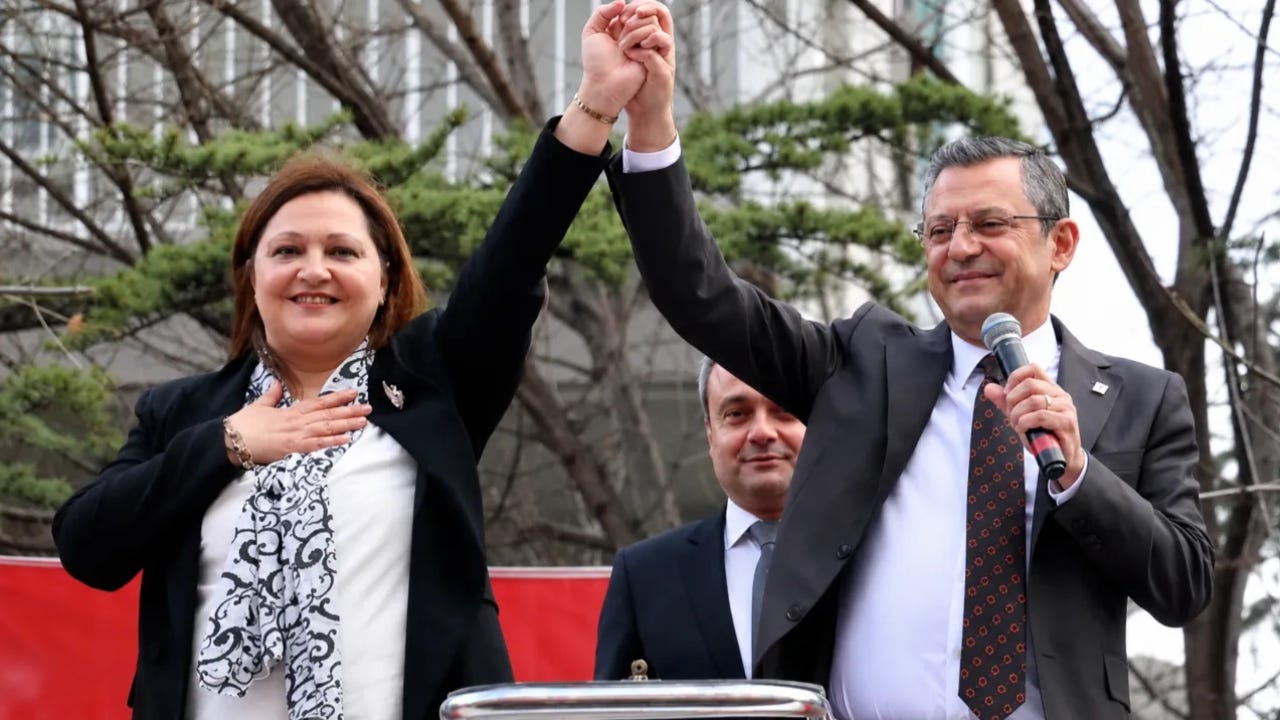
🔁 Afyonkarahisar Mayor Köksal to defect to AKP — six months after vowing to stay
Burcu Köksal, the mayor of Afyonkarahisar, is set to resign from CHP and join the ruling AKP on 12 May, in a move that has cast a fresh light on her own remarks from just six months ago when she dismissed identical rumours. At the time, Köksal had appeared on a programme on the pro-government TGRT channel to bat away suggestions that she might defect to Zafer Party, İYİ Party or AKP, attributing the claims to “trolls” and saying it seemed a certain quarter did not want to accept her in the CHP. “I am a CHP member from birth,” she had insisted. “They threw me out of the door, and I came back in through the chimney. I am one of the fixtures of the party.” She had recalled that even before the 31 March elections — when, she said, she had been told to “find yourself either another job or another party” — she had not abandoned her party, would continue her struggle within CHP, and would call right “right” and wrong “wrong”. Her switch to the AKP was first flagged this Wednesday by pro-government journalist Sinan Burhan; after a prolonged silence in which she also did not answer the phone to CHP officials, Köksal yesterday confirmed the move in a conversation with Barış Yarkadaş, saying she would join the AK Party at an extended provincial chairs’ meeting on Tuesday, that there was no threat or pressure behind her decision, and that she was not the subject of any investigation.
🕵️ DEM Party MP Beştaş to Justice Minister: ‘You should be the one finding the evidence’
DEM Party Erzurum MP Meral Danış Beştaş has called on Türkiye’s Justice Minister Akın Gürlek to actively pursue evidence in unsolved killings, telling him: “You will be the ones finding the evidence — you will investigate, and you will press on, opening up those paths.” Speaking at a press conference in parliament, Beştaş said that according to 2021 official figures, of the eight million case files at chief public prosecutors’ offices, 47 per cent were classified as having unidentified perpetrators, arguing that throughout history the Turkish judiciary had protected certain people while handing down undeserved sentences to others, with massacre trials ending in acquittals and perpetrators “rewarded with impunity”. She criticised the dismissal of the Dargeçit JİTEM case on grounds of statute of limitations and decisions in cases such as Madımak, Musa Anter and Kızıltepe JİTEM, insisting that under Article 77 of the Turkish Penal Code crimes against humanity could not be subject to such limitations. Citing 1 May 1977, the Madımak case, Roboski, Maraş, Çorum and the Ankara Gar bombing among many examples, she described Türkiye as a country that had not even found the killer of one of its own MPs, recalling the killing of Mehmet Sincar in Batman in 1993 without an effective investigation, and arguing that the failure to identify those responsible for figures including bar association chairs, MPs and journalists Abdi İpekçi and Uğur Mumcu was no coincidence — adding the names Nadira Kadirova and Yeldana Kahraman as further cases in which no proper investigation could be claimed. Beştaş criticised Gürlek’s statement that “if new evidence emerges, we will reopen the files”, saying those who had concealed the evidence would not bring it back to light without a clear will to fight impunity, and that the evidence had already been destroyed or made to disappear by someone. She argued that a single department was not enough and that independent investigation commissions should be established, that obstacles to prosecuting public officials should be lifted, and that parliamentary oversight should be ensured. Beştaş also invoked the names of Rojvelat Kızmaz, Rojin Kabaiş and Rabia Naz, calling for all files of unsolved killings to be reopened.
Opposition Parties (CHP and others)
🌳 New İBB raid: 30 detention orders over Ağaç ve Peyzaj A.Ş. tender allegations
Türkiye’s Istanbul Chief Public Prosecutor’s Office has announced a fresh operation in the wider Istanbul Metropolitan Municipality (İBB) corruption investigation, this time focusing on the affiliated company Ağaç ve Peyzaj A.Ş., which is alleged to have been used to “operate a fictitious tender system in violation of procedure” and rig procurement contracts. According to the statement, the operation was carried out by the Financial Crimes Combat Branch on 8 May 2026, with detention orders issued for 30 suspects; 29 have already been taken into custody, while efforts are continuing to apprehend a final suspect said to be abroad. Those detained include İBB Deputy Secretary General Oktay Özel, İBB legal adviser Eren Sönmez, former and current Park and Gardens department heads Yasin Çağatay Seçkin and Tuğba Ölmez Hancı, Kentsel Ekolojik Sistemler branch manager Nilgün Cendek, several İBB engineers and an architect (Esra Köymen, Tolga Kılıç, Mustafa Atlı, Sezer Ada Ateş), Ağaç A.Ş. former deputy general manager Muammer Ali Özdil, current deputy general managers Aytekin Karaarslan and Metin Aras, the company’s purchasing manager Selim Marangoz and several departmental chiefs (Fatih Temür, Murat Cirik, Fatih Yağcı), as well as a string of company partners, including Ahmet Kocadağ (Tibetoğlu İnşaat), Cezair Aday (Vadi Peyzaj), Süleyman Uzun (Sas Peyzaj), Adnan and Hakan Cullanmak (Zirve Harita), Ayhan Subaşı (Ayhan Subaşı Ltd), Ünal Aksoy (Parametre Mühendislik), Ekrem Ofluoğlu (İstanbul Teknik), Binali Sarıtaş (Sarıtaş Yapı), Murat and Derya Dağdeviren (Seka Peyzaj), Orhan Yoldaş (Çatak İnşaat) and Yunus Doğan (TYT İnşaat). According to journalist Ceylan Sever, Yasin Çağatay Seçkin — whose father died yesterday — was released after speaking with the prosecutor’s office during the detention to attend the funeral, and is expected to appear at the courthouse on Monday when transfers from the police take place. Sever also noted that one of those detained, Fatih Yağcı, was among the 18 people released on 3 April during a monthly review of detention in the main case heard at Silivri.
⛏️ YRP MP warns shale gas drilling will ‘poison the soil and trigger earthquakes’
Doğan Aydal, deputy chair of Türkiye’s Yeniden Refah Party (YRP), has issued a sharp warning over the Ministry of Energy and Natural Resources’ attempts to extract shale gas through hydraulic fracturing in the Diyarbakır, Erzurum and Thrace regions, arguing that the process will poison farmland and water resources and increase the risk of earthquakes. In a written statement, Aydal said the ministry had been trying to extract shale gas since 2012 without producing any commercial results in the 14 years since, and that no active, commercially viable shale gas production existed in Türkiye. He noted that TPAO had entered into agreements with foreign partners — TransAtlantic Petroleum and Continental Resources, Valeura Energy, Stellar Energy Advisors Limited, Shell and ExxonMobil — to extract shale gas, with work focused on the Diyarbakır Basin around Silvan and Bağdere; production trials and exploratory drilling are under way at wells including Katin-6, Derin Barbeş-1 and Derin Barbeş-3, with the Energy Minister having indicated that 24 wells will be drilled in the area, while Trakya and Erzurum are also said to hold shale gas potential. Pointing to evidence from the United States, Aydal said the US Geological Survey had recorded 50 earthquakes above magnitude 3 in 2009, 87 in 2010 and 134 in 2011 in production areas — six times the figure of the early 2000s — and warned of the possibility of larger quakes in their wake. He cited Columbia University seismologists attributing magnitude-4 quakes around Youngstown, Ohio in 2011 to hydraulic fracturing, and the University of Memphis Earthquake Research Centre’s view that water pumped under pressure from wells lubricates faults in the area, with similar increases reported in fracking regions of Texas. Aydal challenged the figure of around 650 billion cubic metres of shale gas attributed to the area, noting that it had been put forward not by TPAO but by Americans who had carried out no significant ground work in the region, and called on the state, political parties and local people to investigate carefully why these companies are returning after 14 years of failure. He warned that without preventive action, foreign companies would take the lion’s share of any gas produced, while Türkiye would be left with the indirect harm caused by chemically contaminated soil and water — and damage from a rising number of earthquakes that could reach incalculable proportions.
Economy
🏭 Türkiye’s industrial output sounds alarm bells
Türkiye’s industrial production fell by 0.8 per cent month-on-month and 1.1 per cent year-on-year in March, according to data released by the Turkish Statistical Institute (TÜİK), pointing to a continuing weak picture across the sector. On a calendar-adjusted annual basis, industrial output was down 1.1 per cent compared with the same month a year earlier, while the unadjusted index fell 3.3 per cent year-on-year. Looking at the sub-sectors annually, mining and quarrying contracted by 5.6 per cent and manufacturing industry by 1.3 per cent, while electricity, gas, steam and air conditioning production and distribution rose by 5.8 per cent. On a seasonally and calendar-adjusted monthly basis, mining and quarrying fell by 1.6 per cent and manufacturing industry by 1.1 per cent compared with the previous month, while electricity, gas, steam and air conditioning production and distribution rose by 3.9 per cent.