

⚖️ Justice System and Everyday Life in Türkiye
Indictment accepted over Kahramanmaraş school attack: charges against İsa Aras Mersinli’s parents confirmed
The investigation into the school attack in Kahramanmaraş carried out by 16-year-old İsa Aras Mersinli, in which nine pupils and a teacher were killed and 15 pupils injured, has been completed, with an indictment accepted charging his father, Uğur Mersinli, with “killing with possible intent” and his mother, Peyman Pınar Mersinli, with “causing death and injury through conscious negligence”. The Kahramanmaraş Chief Public Prosecutor’s Office announced that the investigation into the armed attack of 15 April 2026 at the Ayser Çalık Secondary School in the Onikişubat district had been completed as of 20 July. İsa Aras Mersinli carried out the attack using five firearms and seven magazines said to belong to his father. Uğur Mersinli, a chief police inspector, was detained in the investigation and remanded in custody on 16 April, while Peyman Pınar Mersinli, a Turkish language and literature teacher, was released after initial proceedings. A further detention order was issued for her on 22 April, and she was detained on her way back from visiting her husband at the prison in Elazığ, before being remanded in custody on a charge of causing death by negligence by a court to which she was connected via the SEGBİS video-link system. The prosecutor’s office prepared an indictment charging Uğur Mersinli with killing with possible intent and with violating Law No. 6136 on firearms, and his wife with causing death and injury through conscious negligence. Proceedings began with the acceptance of the indictment by the Kahramanmaraş 3rd Heavy Penal Court.
Ahbap Association investigation: nine people including Oğuzhan Uğur remanded in custody
Nine suspects, among them Oğuzhan Uğur, have been remanded in custody in the investigation into allegations that donations collected in the name of the Ahbap Association were transferred to suspects’ accounts. Proceedings at the magistrate’s court were completed for the 10 suspects detained in the investigation conducted by the Istanbul Chief Public Prosecutor’s Office and taken to the Istanbul courthouse in Çağlayan, with the court ordering the arrest of Oğuzhan Uğur, Gülgün Öztürk, Suzan Düşküner, Emir Taşar, Emre Kartaloğlu, Hüseyin Küçük, Fatih Eke, Muharrem Karataş and Ersin Gökgün, and judicial supervision for Özgür Ömer Güner. The financial crimes branch of the Istanbul Police Directorate had been working under the coordination of the prosecutor’s office on offences of forming an organisation to commit crime, aggravated fraud and laundering assets derived from crime; MASAK financial intelligence reports on the association’s employees, examinations of account movements and technical and physical surveillance were said to have found high-value money movements inconsistent with the suspects’ financial profiles, large transfers between them, substantial sums moved into gambling accounts and lost through betting, and numerous chained title-deed transfers among them over a short period. Seventeen suspects linked to the association’s members and employees, including its founder, the singer Haluk Levent, were detained in an operation on 12 July, with nine more caught subsequently; one was released after police questioning, while of the 25 referred to the courthouse, 14 including Levent were remanded in custody and 11 placed under judicial supervision. A further 17 suspects were detained in simultaneous operations by the Istanbul Provincial Gendarmerie Command’s anti-smuggling and organised crime branch in Istanbul, İzmir, Kocaeli and Muğla; of the 12 referred to the courthouse, four were remanded and eight placed under judicial supervision, bringing the total number in custody to 18. The assets of the association and of some suspects were seized. Ten people including Uğur were then detained, gave statements to prosecutors at the Çağlayan courthouse, and nine were referred to the magistrate with a request for arrest on charges of abuse of trust in the course of duty and laundering assets derived from crime, while Güner was sent with a request for judicial supervision.
New claim in Rojin Kabaiş case: “evidence has been suppressed”
The family of Rojin Kabaiş, the university student who disappeared in Van in 2024 and whose body was found on the lakeshore, has alleged significant shortcomings in the investigation, with her father, Nizamettin Kabaiş, claiming evidence has been suppressed because no DNA samples were taken from her clothes and no diatom test was carried out. Kabaiş, a 21-year-old studying pre-school teaching at Van Yüzüncü Yıl University, went missing in 2024, and her body was found by the lake after searches. The family refused to accept the suggestion of suicide and began a legal campaign, with her father alleging negligence and the suppression of evidence. While the investigation continued, the family learnt that no DNA samples had been taken from the clothes she was wearing that day and that no diatom test — used to determine whether a suspicious death resulted from drowning or whether the person was placed in the water after being killed — had been carried out, and they requested these through their new lawyer. Speaking to the İHA news agency, Kabaiş said things that should have been done earlier had not been, that much would come to light thanks to their lawyer, and that they had been shocked to find the diatom test had not been done at the time, which he said amounted to a cover-up; he called on the Justice Minister to intervene over any misconduct in office, asking why the tests were being requested only two years later and citing questions over how many white vehicles entered and left the village, his daughter’s roommate’s statement and camera recordings. He said they had been told a rotating camera at the scene was broken and had let the matter go, but that the university had sent a letter before their visit to the Justice Minister stating it had no broken cameras — in which case, he asked, where was the footage, and if it was broken, why was no record drawn up. Things not done at the time were being done two years on, he said, adding that most of the camera recordings in Mollakasım had been erased and that the case would have been solved had the work been carried out promptly: it could have been established whether the body came from the water or was left there, given the many villas and cameras in the area. Kabaiş said many officials in Van did not want the case solved, that different accounts were given to the Justice Minister and to the family, and that matters had reached a final point; he said he would set out the shortcomings on another visit to Ankara, that prosecutors had told him earlier officials had failed to examine these things and that it was not their fault, and that he would speak out publicly against any cover-up, appealing to the President if necessary.
Journalist Alican Uludağ detained
The journalist Alican Uludağ has announced on his social media account that he is being detained, with no official statement so far on the grounds for the action. In a post on the social media platform X, Uludağ said he was being taken into custody. His post gave no information on the reason, and no explanation has yet been issued by the authorities. Uludağ had previously been remanded in custody on charges of publicly insulting the president, publicly disseminating misleading information, and publicly denigrating the government of the Republic of Türkiye and the state’s judicial organs, and was released on 21 May after spending around three months in Silivri prison.
🏛️ Politics
President Erdoğan: King Charles III’s mosque visit is most valuable
President Recep Tayyip Erdoğan has described King Charles III’s visit to the Cambridge Central Mosque as most valuable, saying it was especially significant at a time when anti-Islamic sentiment and cultural racism were rising globally. Erdoğan issued a written message on the King’s visit to the mosque and its complex, described as Europe’s first environmentally friendly mosque. Recalling that the mosque opened for worship around seven years ago, he said he was greatly pleased that it had hosted such a meaningful visit, and remarked that the mosque had, from the laying of its first brick, been a symbol of solidarity against discrimination and of respect against hatred, and was successfully fulfilling that mission. Erdoğan drew attention to the importance the King attached to people of different cultures, origins and faiths living together in peace, stressing that his efforts in this regard were well known. He said he found the visit most valuable at a time of rising anti-Islamic sentiment and cultural racism worldwide, conveyed his greetings to the friendly British people through the King, said he would be pleased to host him in Türkiye, and extended his respectful greetings to members of the Muslim community living in Britain, foremost among them Turkish citizens.
Vice-President Yılmaz: Cyprus will never be a Greek island
Vice-President Cevdet Yılmaz has said that the international community must now accept that the Turkish Cypriots own these lands as much as the Greek Cypriots do, declaring that Cyprus will never be a Greek island, in a speech at the 20 July Peace and Freedom Day ceremony in the Turkish Republic of Northern Cyprus (TRNC). Speaking at the ceremony on Dr Fazıl Küçük Boulevard, Yılmaz conveyed the greetings of President Recep Tayyip Erdoğan, the government and the Turkish nation, remembered those who died in the Turkish Cypriot struggle for freedom and paid tribute to the veterans. He remembered the then prime minister Bülent Ecevit, his deputy Necmettin Erbakan, Alparslan Türkeş and other statesmen involved in the 1974 operation, along with Dr Fazıl Küçük and the TRNC’s founding president Rauf Denktaş, saying the struggle they led was crowned by Türkiye’s decisive intervention on 20 July 1974, through which Türkiye fulfilled the historical, legal and humanitarian responsibility placed on guarantors by the 1960 Treaty of Guarantee, ending 11 years of suffering between 1963 and 1974. Yılmaz said the 52 years since had demonstrated the justice of Türkiye’s intervention and the importance of its guarantorship, with the presence of the Turkish Armed Forces underpinning more than half a century of peace and stability. He said attempts to dominate the whole island by eliminating the Turkish Cypriots had been thwarted, and that Türkiye was closely monitoring the activities of circles seeking to exploit recent regional tensions to make Cyprus part of new military formations; he condemned what he called Greek Cypriot lobbying and disinformation efforts through European institutions, saying those who believed they could now achieve through alliances in the Eastern Mediterranean what they had failed to do by force were gravely mistaken, and that drawing Cyprus into regional rivalries would provide security to no one. Yılmaz said long-running negotiations had proved fruitless because the Greek Cypriot side would not share governance and wealth or accept the Turkish Cypriots as equal partners, and that UN Security Council decisions and the Greek Cypriot side’s admission to the European Union — which, he said, had forfeited its claim to be a fair party by admitting it in violation of its own principles — had entrenched this, while the Turkish Cypriots faced unjust isolation and embargoes. Saying the TRNC had maintained its existence with determination for 43 years, he argued that a basis for cooperation resting on the existence of two peoples, two democracies and two states would benefit regional peace, that approaches reducing the Turkish Cypriots to minority status would produce no solution, and that a just and lasting settlement lay through recognition of the sovereign equality and equal international status of two states; he invited the international community to hear the Turkish Cypriot voice and end the isolation. Yılmaz noted the TRNC’s growing international visibility and its representation in the Organisation of Turkic States, the Organisation of Islamic Cooperation and the Economic Cooperation Organisation, pledged that new generations would not be cut off by isolation, and said projects under the 2026 economic and financial cooperation agreement signed on 9 April 2026 were being implemented with the TRNC authorities. He said that, just as the island’s water needs had been met by the “Project of the Century”, Türkiye would supply natural gas as a clean and stable energy source and advance development in health, education, transport and information technology, adding that Cyprus would never be a Greek island, that those who had failed to halt the TRNC’s progress would not weaken the Turkish Cypriots’ will, and that the “Turkish Century” would also be the TRNC’s century. He closed with cheers for the Republic of Türkiye, the TRNC and their everlasting brotherhood, after which he and TRNC President Tufan Erhürman watched the parade.
Term of commission investigating Şanlıurfa and Kahramanmaraş school attacks extended
The Turkish parliament’s commission investigating the school incidents in Şanlıurfa and Kahramanmaraş and digital risks has extended its term by one month, in a decision taken by majority vote at a meeting chaired by AKP Tokat MP Yusuf Beyazıt. Beyazıt briefed the commission on a working visit to Istanbul on 17-18 July, saying they had carried out a comprehensive session on the incident in Çekmeköy in which the teacher Fatma Nur Çelik lost her life, attended by the Istanbul governor, deputy governors, the Çekmeköy district governor, provincial and district directors, school administrators and teachers. He said they had received detailed information from institutional officials about the day of the incident and the process and measures that followed, and had assessed work in Istanbul focused on children’s safety, measures to strengthen safe school environments, and inter-agency cooperation and coordination in tackling digital risks. Beyazıt said the violent incidents at schools in Kahramanmaraş and in the Siverek district of Şanlıurfa could not be treated as isolated security problems, but represented a multi-dimensional social problem directly concerning children’s right to life, to safe education and to physical and mental integrity. He said their expectation of the Justice Ministry was that the punitive, protective and rehabilitative dimensions of the juvenile justice system be considered together, drawing attention to identifying the conditions that lead children into serious violence, strengthening social investigations, establishing adult responsibility for access to firearms, and reintegrating children into society. He stressed the importance of improving access to child and adolescent mental health services, identifying risk signs early and providing long-term psychosocial support to affected children, adding that violent behaviour could not be seen solely as a mental health problem and that timely assessment of sharp behavioural changes, expressions of harm to self or others, and signs of crisis was vital, and that a swift and functioning referral system between schools and child and adolescent mental health units was needed. Senior officials from the ministries of family and social services, youth and sports, health, transport and infrastructure and justice, along with a deputy head of the Directorate of Religious Affairs, are to give presentations to the commission.
Agriculture Ministry responds to “locust invasion” claims
The Ministry of Agriculture and Forestry has responded to social media posts claiming a “locust invasion” in the Marmara region, chiefly in Istanbul and Tekirdağ, saying the insects in the images pose no threat to agricultural production and belong to native species found naturally in Türkiye. The ministry said its teams had encountered no locust invasion threatening agricultural production in the region, and identified the insects in the circulating images as the white-faced bush cricket (Decticus albifrons). In its statement, the ministry said that examinations and monitoring by its teams had found no locust invasion or population causing economic damage in Istanbul, Tekirdağ or the wider Marmara region, and that species identification had established that all the insects in the images belonged to native populations found naturally in the country — so there was no swarm arriving from the Balkans, Africa or any other region as alleged. The species identified in Istanbul, it said, does not damage agricultural production but rather contributes to the biological balance by feeding on agricultural pests. The ministry noted that many species live naturally in Türkiye, that populations of some can rise seasonally depending on climate conditions and egg-laying periods, that they may be carried into residential areas by the wind and are noticed more often because they are drawn to light in hot weather — a natural process that does not amount to an invasion. It added that locust populations are monitored regularly by technical teams across all 81 provinces under the annual plant health programme, that work in Istanbul and Tekirdağ has been intensified following recent reports, and that control measures are applied without delay should species capable of damaging agricultural production reach the economic damage threshold — though no such situation currently exists.
Protocol signed in Nişantepe as residents begin leaving their homes — even locals don’t know what the process involves
Residents of Nişantepe in Istanbul’s Çekmeköy district, most of them Roma and many of whom have lived there for more than 30 years, have signed a protocol with a construction company after talks lasting some 17 hours, with each household promised differing sums and given 15 days to vacate their homes — yet no clear information about the document’s legal nature or when and how payments will be made. According to a report by Meral Danyıldız for BirGün, most residents of the neighbourhood — where they are treated as “occupiers” despite decades of residence — signed documents providing for them to leave their homes. Residents said the talks began at around 2pm on 20 July and ran until 7am on 21 July, with most arriving at the municipal building at about 4pm and waiting some 17 hours as they were called in one by one; no agreement was reached in the first round and signatures were taken only when they were called back in a second time.
Residents said they were told they would receive certain sums if they vacated their homes, but that the amounts differed by household, with some shown 1.5 million lira and others up to 3.5 million, and no clear explanation of the criteria used. Higher sums were reportedly offered to households with an electricity subscription and bills, with separate calculations for later additions to buildings, while it remains unknown how the size of the structures, length of occupation, number of residents and long-standing family claims figured in the amounts. Residents said the documents required the homes to be vacated within 15 days, and that they had been told to break windows or frames to show the buildings were no longer in use, photograph them and take the images to the municipality, at which point demolition teams would not come and the payment process would begin — an arrangement that raises the question of which institution is responsible for eviction and demolition, given that residents are being directed to render their own homes uninhabitable.
Engin Hayman said he was offered a total equivalent to 2 million lira, described as 1.5 million plus a 500,000-lira instalment, but that nothing had yet been done about payment: the protocol contained no bank account details, only names and telephone numbers. He said he would photograph the house and take it straight to the municipality to show on his phone that it had been demolished, that he did not know whether the money would then be paid immediately, and that he had been told his IBAN would be taken after the photograph was handed over. On that account, residents are being asked to vacate and disable their homes before any payment, with no written timetable for when the money will arrive.
Residents said they were given no information about the document’s legal nature — whether an undertaking to vacate, a promise-of-sale contract or some other protocol carrying further rights and obligations — and, as they hold no title deeds, it remains unclear what it means for ownership, right of use or any future claims. They said they were not given a copy, leaving them unable to have it examined by a lawyer, and that no bank guarantee, promissory note, mortgage or similar security for the promised sums has been disclosed. Fatih Kozgiç, a resident of some 30 years, said they had been called in with the neighbourhood head, gone to the municipality at 3pm and left at midnight, and had been given a protocol without knowing what they had signed, with no notary involved; sums ranging from 500,000 to 7 million lira had been offered to different households, they had not been allowed to photograph the documents, and they did not know when or how the money would come. Another resident said the process ran from 2pm to 7am, that they were taken in one by one, refused permission to photograph the document and given no copy, and that their lawyer had been told he could not come in because it was not a courtroom and only individuals could enter.
Only a month ago, residents of the area — around 44 households — protested outside Çekmeköy municipality against eviction and demolition orders, objecting to being described as “occupiers” when they had lived in the same homes for over 30 years, paid electricity and water bills and various taxes and charges. Some had obtained building registration certificates under the 2018 zoning amnesty, which did not confer ownership but allowed the structures to be registered and connected to utilities; according to lawyers for the neighbourhood, some of these certificates were cancelled from 2023 on the grounds that the land belonged to third parties or legal entities, after which demolition orders began to be issued, and the pressure to evict continued despite stay-of-execution rulings in cases brought against them. In June, residents told BirGün they had nowhere else to go: Güldane Demirdöğen, there for 35 years, said they had built, paid taxes and settled their bills yet were now told to leave, and that she could not pay rent or even live in a tent, while Gülten Gozgiç said her husband had bought the plot some 40 years ago, that they had built a shack and lived among snakes, that the gendarmerie had demolished it and they had rebuilt — and asked whether they were now to be left on the street.
🤝Ruling Government (AKP, MHP and DEM coalition aka People’s Alliance)
Öcalan: we are on the eve of turning the historic Kurdish-Turkish alliance into a legal footing
Abdullah Öcalan has said, following a meeting with members of the DEM Party’s İmralı delegation, that Türkiye is on the eve of transforming the historic Kurdish-Turkish alliance into a legal footing, that the time has come to create a legal basis in which mutual sensitivities are observed, and that it is possible to live together equally and freely in a democratic republic. Delegation members Pervin Buldan, Mithat Sancar and Özgür Faik Erol met the leader of the dissolved PKK on İmralı island to discuss the framework law. In a statement afterwards, the DEM Party said the delegation had held a comprehensive meeting with Öcalan after a long interval, addressing political developments in the region, the building of a democratic society, the stage reached in the peace process and how the legal framework should be shaped, and it shared his message to the public.
In his remarks, Öcalan said their determination to act in keeping with the spirit of the 27 February call and to resolve the problem within a fraternal legal order continued, and that they were on the eve of putting on a legal footing the Kurdish-Turkish alliance he described as a historical truth in Anatolia, inseparable at every critical stage. Invoking the maxim that separating the Turk from the Kurd leaves neither, he said this necessitated developing a law of common life and equality, that the time had come for a legal basis observing mutual sensitivities, and that everyone should abandon narrow approaches that do not serve the future and weave a common life together, conscious that patiently opening this path was a historic opportunity. He called on all to do their utmost to begin the legal process within the framework set out in the report prepared by parliament’s National Solidarity, Brotherhood and Democracy Commission, to remove conflict and weapons entirely from the equation and to open a new page. The Kurdish-Turkish alliance, he said, was the cornerstone of Anatolia’s common future, the culture of these lands should be the basis of every step, and it was possible to secure the alliance permanently in law and live together equally and freely in a democratic republic, adding that negative law must be transformed into positive law and expressing full confidence that this historic opportunity would be seized. The delegation described the call as historic and said it was determined to continue constructive dialogue with parliament and all relevant institutions and to reach a lasting solution.
The meeting followed contacts with the AKP and MHP: MHP leader Devlet Bahçeli met Buldan — a deputy speaker of parliament and DEM Party MP for Van — and an accompanying delegation for around 40 minutes behind closed doors, after which no statement was made, with Buldan saying they would not give details of the content; the DEM Party later said views had been exchanged on the framework law and that Öcalan would be visited as soon as possible. The delegation’s previous visit to the island was on 24 May, when a meeting of about five hours was reported in a written statement; on that occasion Öcalan assessed the absolute nullity ruling and the police intervention at the CHP’s headquarters as consequences of Türkiye’s democracy problem, asking whether breaking down the door of a political party’s headquarters with a sledgehammer was something that could happen in a democracy.
🗳️ Opposition Parties (CHP and others)
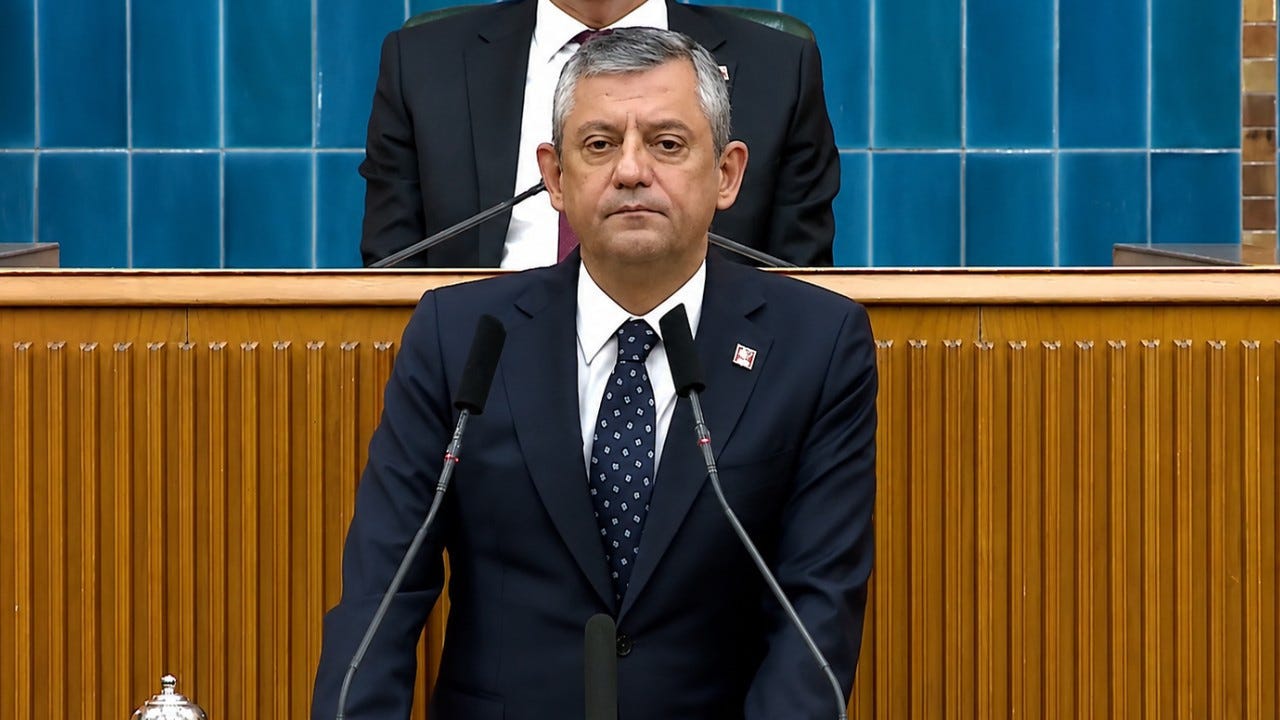
Özgür Özel announces: we are founding the new party all together
Özgür Özel, who left the CHP leadership following the absolute nullity ruling, has set out the road map for a new political formation at his parliamentary group meeting, declaring that they are founding the new party together, extending a message of unity to Ekrem İmamoğlu and Mansur Yavaş, and saying they are “on the march to power”. He said the party would be founded the next day, when they would come together with provincial chairs and MPs, adding that in politics they were not changing their shirts but donning a shirt of fire together for the country’s future. Repeating his call for unity, he said the matter should not be argued over through mayors and municipal councillors, and that everyone who had not said “I am not with Özgür Özel” was with them.
Özel said he had taken the podium with different feelings, carrying the sadness of a farewell whose time had perhaps come, and warned that no one should assume recent conduct would be forgotten or wash away, since history was recording where each person stood. He described a long-entrenched order in Türkiye that imposes unchanging actors on the nation, and said those in the hall had been the ones unwilling to accept the defeats of 14 and 28 May, and unable to make excuses for failing to prevent those with a quarrel with the Republic from continuing to govern it in its centenary year. He contrasted those who had said the reaction would pass in a few days, or who declined to rule out standing again, or who spoke of steering the ship to a safe harbour through one more local election, with those who warned that the party was falling to 13 or 14 per cent in the polls, that turnout would hit a historic low and that the public would lose hope in the ballot box — and said the roads parted that day. He added that he valued equally those who came to the same position later, arguing that returning from an initial mistake was itself a virtue, and that what mattered was sincerity, standing in the right place and self-sacrifice rather than selfishness.
Recalling the change congress, Özel said many had insisted change was impossible with that delegate structure, and that no incumbent leader had ever lost a contested leadership race in the party’s century-long history. He said he had answered that he could not change the delegates’ will himself, but that they would be changed by what a barber whispered to them, by a 16-year-old neighbour, by a spouse or a grandchild — and that the hall had been filled with the chant “delegate, listen to the street”. None of those elected, he said, had come from outside the party; they had competed, won, and for the first time changed an incumbent leader through a contested election, putting the first spoke in the wheel of the order that imposes unchanging actors. He said he had repeatedly been asked whether messages had come from the state or “deeper” places, whether he had reached an understanding or given undertakings, and had always said no — to which people replied that they would never let him have the party or the system without bargaining and proving himself harmless within it.
Özel said the party’s name and logo might change and times might turn, but that this togetherness could not be split — not into 60-40 or 30-70 like a watermelon — because it rested on a 103-year tradition. He recalled that only four months separated the congress from the local elections, in which importance was given to women, young people and polling data, with candidates chosen for their capacity to convey change: in İzmir, he said, nine women were nominated and eight elected, and 14 young candidates nominated with 13 elected, taking 29 of 31 races, while nationally 65 per cent of the country was won, with mistakes paid for in Kırklareli and Hatay.
Turning to the present, Özel said those in the “deep state” had come again, telling him to conduct Ankara-centred politics, to get off the campaign bus and to abandon İmamoğlu, who they said would be broken up by the courts, offering him cement and mortar to pour concrete over his own colleagues and sit at the head of the party for 30 years. This, he said, was the parting of the ways: whether to hand over the country’s clean and honest sons to what he called the AKP’s dark new order — a politics that could not defeat them through its women’s or youth branches and had sidelined politicians for bureaucrats — and rule within the party atop that concrete, or to fight for his comrades. Declaring that they were founding the new party, he said no one should reproach mayors or councillors for not crossing over, that neither İmamoğlu nor Yavaş would be left behind, and that everyone from whom no disavowal had been heard was with them on the march to power.
İYİ Party columnist: Dervişoğlu’s “third way” vision finding traction on the ground
The İYİ Party is making its mark on Turkish politics at a time overshadowed by fruitless quarrels and economic straits, according to a column in the newspaper Yeniçağ, which argues that leader Müsavat Dervişoğlu’s tireless energy and committed party organisation are turning the party into the strongest alternative to the government. Writing at a time when Turkish politics is described as blocked, the main opposition is embroiled in legal disputes and the burden of government economic policy on citizens is growing, the paper’s columnist İsmail Türk portrays Dervişoğlu as the shining star of centre politics, whose arrival has given the “third way” vision traction on the ground. Türk writes that he confesses to struggling at times, as a journalist, to keep up with Dervişoğlu’s whirlwind pace, praising his determination and industry, and argues that the leader’s sincere, direct style of communication with the public lends the party organisation great strength — a bond he describes as the greatest guarantee of the party’s future. Relaying his impressions from a recent visit to Cyprus, Türk says the trip was far from a routine protocol occasion and carried the determination of a movement marching towards power, adding that the belief and enthusiasm in the party organisation was palpable from the outset and that its cadres were building the ground district by district and street by street with a clear sense of purpose and high discipline. He argues that public and organisational trust in Dervişoğlu reinforces his unifying role in Turkish politics, that the party is rising as an alternative government, and that its potential to become the country’s second and then largest party grows by the day. Türk concludes by noting that the final word always belongs to the electorate, but says the picture he saw in the field shows the party preparing seriously and strongly for that goal, underlining his view that it will be a decisive main actor in the period ahead.
Claim that Çalık was transferred from Silivri to İzmir: lawyer responds
Melih Koçhan, the lawyer for Beylikdüzü mayor Mehmet Murat Çalık, who is in custody as part of the İBB case, has responded to claims that his client was transferred from Silivri prison to Buca in İzmir, denying the reports and drawing attention to the sensitivity of the matter for Çalık’s family. In a post on social media, Koçhan said there was no transfer order concerning Çalık: while some transfers had been carried out at the prison that day, none involved his client, and no such information or development had been conveyed to them during a lawyer’s visit held shortly beforehand. He said the family was understandably sensitive on the issue because of transfers that had taken place before previous visiting days, and that the circulating posts had caused them worry and unease. Koçhan added that any official development concerning his client would be shared publicly by his legal team, and asked the public to act only on confirmed information in the meantime.