

The Grand National Assembly of Türkiye (TBMM) is officially in recess, it reconvenes on 1 October 2026, and so, your correspondent is off on holiday. I will return to the bulletin on 2 September 2026, which marks the first anniversary of this blog. We shall celebrate it all together.
⚖️ Justice System and Everyday Life in Türkiye
British plastic waste polluting irrigation channels in Turkey’s Çukurova plain
An investigation carried out in Turkey by the Guardian, reported by Karen McVeigh and Ayça Aldatmaz, has found that plastic waste from the UK is contaminating farmland and irrigation channels around Adana, with researchers detecting high levels of microplastics and other plastic residues in a water channel close to a major recycling zone used by British companies. The channel overflows onto agricultural land during heavy rain and feeds into a larger channel used to irrigate crops on the Çukurova plain, one of Turkey’s largest and most fertile farming basins. Samples taken by Sedat Gündoğdu, a marine biologist at Sabancı University’s Istanbul Policy Centre, and published in the journal Environmental Monitoring and Assessment showed microplastic concentrations near the recycling zone reaching ten times those found in samples taken further away; he warned of serious risks to agricultural pollution and food safety, said the contamination is reaching the Mediterranean and adding to plastic accumulating at sea, and called for a total ban on plastic waste imports, mandatory microplastic filtration at recycling plants and independent monitoring of wastewater discharges in farming areas. According to the Environmental Investigation Agency, roughly 13 per cent of British plastic waste sent to Turkey between May 2021 and July 2024 went to eight facilities in the Adana zone, with 13 UK companies making 545 shipments totalling 52,000 tonnes; the report makes no allegation that exporters acted unlawfully, though British rules place a duty on them to ensure waste is recycled without environmental harm. The UK exported 675,000 tonnes of plastic waste in 2025, its highest figure in eight years, of which 139,000 tonnes went to Turkey, while EU exports to the country rose 19 per cent to more than 500,000 tonnes. The EIA’s legal specialist Amy Youngman said Britain has persisted with an export-based system rather than cutting plastic use and recycling at home, lagging behind the EU and creating a structural inequality that shifts pollution it would not tolerate domestically onto communities in Turkey — evidence, she argued, of “waste colonialism”, the practice of richer countries sending plastic waste to states with weaker waste management and oversight. Greenpeace documented in 2021 that plastic waste from British supermarkets was being dumped and burned on open ground in Adana; Turkey banned imports of certain wastes that year, including the polyethylene that made up 94 per cent of British plastic exports, but withdrew the ban after pressure from the recycling industry. From November the EU will bar plastic waste shipments to non-OECD countries, though environmental groups fear that, since Turkey is an OECD member, the change may increase the volumes sent there.
Waste engulfs Turkey’s blue bays as the microplastic spiral spreads from sea to air
Plastic pollution long visible along the shores of Adana and Mersin has this year extended west to Kemer, Fethiye and Alanya, with data from the Microplastic Research Group showing that concentrations measured at all four stations sampled off Alanya reached between two and 65 times the highest figures previously reported in the scientific literature for Turkey’s Mediterranean coast, and that between 59 and 93 per cent of the particles bore processing marks characteristic of recycling plants. Turkey became one of Europe’s principal destinations for plastic waste after China banned such imports in 2017, and in April monthly imports passed 80,000 tonnes, the highest level in a decade, much of it destined for facilities in Adana and Mersin. The energy policy specialist Önder Algedik argues the problem is not confined to plastic in the sea but lies in a system that has itself become a pollution mechanism: regulatory changes in 2016 and 2019 turned waste incineration into a state-supported activity with incentives for the electricity generated, driving burning upwards, while the absence of an effective recycling system means much waste is never recycled at all — a system that claims not to pollute the sea, he says, while filling the air, with Turkey’s mountains, land and waters covered in refuse and its airspace turned into something like a refuse collection site. Rainfall has compounded this year’s picture: the Mediterranean region saw exceptional precipitation in the 2025-26 season, the heaviest since meteorological records began, and higher flows and surface runoff in the Seyhan, Ceyhan, Tarsus and other rivers may have carried land-based plastic into water systems. Earlier work on Adana’s irrigation channels found that illicit discharges from recycling facilities raised microplastic levels along a channel by up to 132-fold, with more than 5.3 billion particles an hour estimated to pass through just three of the channels examined. The extraordinary concentrations off Alanya are thought to be linked to recycling activity concentrated in Adana and Mersin, possible illegal discharges, heavy rain and flooding, with transport by eastern Mediterranean currents over weeks or months among the plausible scenarios — though specialists stress the larger question is how waste enters Turkey, how it is processed, how much is genuinely recycled and where the remainder ends up.
Police block miners marching on energy ministry over months of unpaid wages
Miners from the Eti Gümüş silver mine in Elazığ, part of the Yıldızlar SSS Holding group and members of the Bağımsız Maden-İş union, were cordoned off by police outside the National Library in Ankara as they tried to march on the Ministry of Energy and Natural Resources to press for the honouring of guarantees given to them. Union president Gökay Çakır said detained miners had been given neither water nor food, and demanded that the energy, labour and interior ministries secure payment of between five and seven months of wages and outstanding entitlements; inspectors had already established that 536 workers from the Elazığ and Doruk mines were owed severance and other rights, he said, but the promises made had not been kept. Insisting that the ministries and not the company were their counterparts, Çakır said ministers and the president should intervene, noted the group’s licences had been cut from 3,000 to 180 and could be cancelled altogether, and said the workers would not leave even if detained, since they had reached breaking point and had families to feed. The YENİ Party’s İzmir MP Ümit Özlale said an agreement signed on 28 April under the guarantee of the labour, interior and energy ministries should be implemented, and criticised the Ankara governor’s office for issuing what he called a tailor-made six-day ban on joint protests by Doruk and Eti Gümüş workers, arguing this showed the holding company’s influence over state institutions; he added that officers had even asked the miners to remove their helmets while they waited for a meeting with a deputy minister. Erkan Baş, leader of the Workers’ Party of Turkey, said courts, ministers and everyone else acknowledged the workers were in the right, yet they were hungry, their children waiting at home for bread, and they were left on the streets. He said the ministers should admit their promise had been broken and apologise, and pointed to the contradiction between being told to wait for a meeting and being told they could not wait there, pledging to do whatever the workers did.
State school’s enrolment demands: six months of bills, boxes of paper towels — and batteries by brand
A list of requirements said to have been handed to parents enrolling children at a state school in Istanbul ahead of the new academic year has drawn criticism. According to a report in Sözcü, alongside identity papers and proof of residence the school asked for the last six months of electricity, water and gas bills as well as a dated residence document, ostensibly to verify addresses. Parents were also reportedly asked to supply two boxes of Z-fold paper towels, five reams of A4 paper and a box of whiteboard markers. The item that attracted most attention was a request for five batteries, with a particular brand — Duracell — specified in brackets. Parents objected to being asked for stationery and hygiene supplies on this scale simply to register a child at a state school.
🏛️ Politics
Erdoğan receives parliamentary speaker Kurtulmuş at the presidential complex
President Recep Tayyip Erdoğan has received the speaker of parliament, Numan Kurtulmuş, at the Presidential Complex in Ankara. The two are said to have discussed the legislation drawn up for the process the government calls “Terror-Free Türkiye”. The meeting is also understood to have covered the steps to be taken next as part of that process.
Turkish parliament rises for recess until 1 October
The decision for the Grand National Assembly of Turkey to go into recess until 1 October has been published in the Official Gazette. Under it, parliament adjourned from Monday 10 August and will reconvene at 2pm on Thursday 1 October. The decision was taken at the 125th sitting of the general assembly, held on 10 August.
First move after the framework law: interior ministry summit to set out how it will be applied
Following parliament’s approval of the Bill on Strengthening National Solidarity and Social Integration — the measure widely known as the framework law — the interior ministry has announced that Interior Minister Mustafa Çiftçi has urgently summoned the governors, police chiefs and gendarmerie commanders of all 81 provinces to a video conference to clarify the roadmap for implementation. The wide-ranging meeting, which begins at 3pm tomorrow, will also be attended by the speaker of parliament, Numan Kurtulmuş, bringing the legislature and the provincial administration responsible for carrying the process out onto a single screen. Speaking ahead of the summit, Çiftçi said everyone would do their part to ensure the process did not falter. Governors will be asked to monitor developments in their provinces in real time, and the meeting will cover social integration, rehabilitation and the maintenance of public order, along with the difficulties governors and law enforcement may encounter on the ground — among the most critical items on the agenda — with a call for vigilance against provocations, waves of disinformation and any quarters seeking to derail the process. Governors are to act as the most senior coordinators of the process in their provinces, ensuring cooperation between institutions and accurate public information, while police in urban areas and the gendarmerie in the countryside are to apply a zero-tolerance approach to public order, preventing provocation while strengthening public trust. The summit is intended to settle the practical guide for applying the “Terror-Free Türkiye” vision and formally to open the next stage of the process.
Direct flights launched between Tehran and Trabzon
The first direct flight between Trabzon and the Iranian capital, Tehran, has landed on Turkey’s Black Sea coast, with the Airbus A320 operating as flight TBN7279 touching down at Trabzon Airport after a journey of about two hours and greeted with the traditional water salute. Folk dance troupes performed at a ceremony at the airport, where passengers were welcomed with flowers and given scarves made from the region’s claret-and-blue keşan cloth. Trabzon’s metropolitan mayor, Ahmet Metin Genç, said the launch mattered greatly to the city, that work on the route had been under way for roughly two years and had been held up by war, and that the service would benefit local tourism, adding that the number of countries whose aircraft now serve Trabzon proved its standing as a destination. The provincial culture and tourism director, Tamer Erdoğan, said Iranian travel agents had previously been hosted in the city, that the flights would operate twice a week on Tuesdays and Fridays, and that more than 9,000 Iranian visitors came to Trabzon last year; he also expressed the belief that Trabzonspor’s signing of the Egyptian forward Mohamed Salah would help tourism, and said North Africa and Egypt were the next targets. Iran’s consul general in Trabzon, Hossein Khosravi, described the long-awaited launch as a historic day, while the head of the Trabzon Chamber of Commerce and Industry, Erkut Çelebi, said the route had been pursued for some time and would be significant for business. The travel agency owner Amir Shahabedin Ansari also spoke at the ceremony, after which passengers passed through passport control.
🤝Ruling Government (AKP, MHP, CHP and DEM coalition aka People’s Alliance)
AKP hails 467-vote majority for framework law as historic show of parliamentary consensus
Speaking at party headquarters, AKP spokesman Ömer Çelik drew attention to the 467 votes by which parliament approved the Bill on Strengthening National Solidarity and Social Integration, known publicly as the framework law, calling the figure significant in the political history of the republic in both numerical and political terms. He argued that the scale of support showed a very high proportion of MPs, each carrying the sentiments and demands of constituents and representing different sections of society, had found the legal framework reasonable, and that this amounted to a clear signal of backing for the disarmament and dissolution process on a subject that has generated half a century of debate and literature. Çelik said the result also exposed as hollow the claim that parliament had been weakened or pushed aside under the presidential system of government, demonstrating instead the assembly’s capacity to discharge its responsibilities on behalf of the nation. He noted the sharpest exchanges had come the previous day, drew a distinction between criticism heard in civil society and that voiced in the chamber, and accused some of seeking visibility through highly destructive attacks; when AKP speakers asked what those critics proposed, he said, nothing was forthcoming, revealing an absence of strategic or political approach and a marked inability to read the issue in the light of its history or of regional developments. Rejecting the idea that Turkey needs a third eye, Çelik said the country has only a national one, belonging to its 86 million people, and that the situation does not resemble those in countries where conflict resolution literature has developed: the matter has never been one between Turks and Kurds, he said, and even at moments of greatest social strain citizens of every background, Turkish, Kurdish, Arab, Alevi and Sunni, acted with a consciousness of being a single nation, so the question cannot be explained in terms of sectarian or ethnic division but concerns the dissolution and disarmament of the PKK/KCK.
MHP’s Feti Yıldız sends note to live broadcast: is Selahattin Demirtaş covered by the law?
The passage of the framework law through parliament has prompted debate over who stands to benefit from it, with conflicting statements about the position of the imprisoned former HDP co-chair Selahattin Demirtaş. His lawyer, Mahsuni Karaman, wrote on social media that Demirtaş and his co-defendants are held solely under article 302 of the penal code, which falls within the scope of the law, and that there is no legal doubt about their release once it takes effect. On a Habertürk television programme, the journalist Alişer Delek said that while Demirtaş’s brother Nurettin, a member of the armed cadres, would be able to return, Selahattin Demirtaş’s own position was unclear. Delek then reported that the MHP’s deputy chairman, Feti Yıldız, had sent a note to the broadcast in response, stating that Demirtaş is covered by the law.
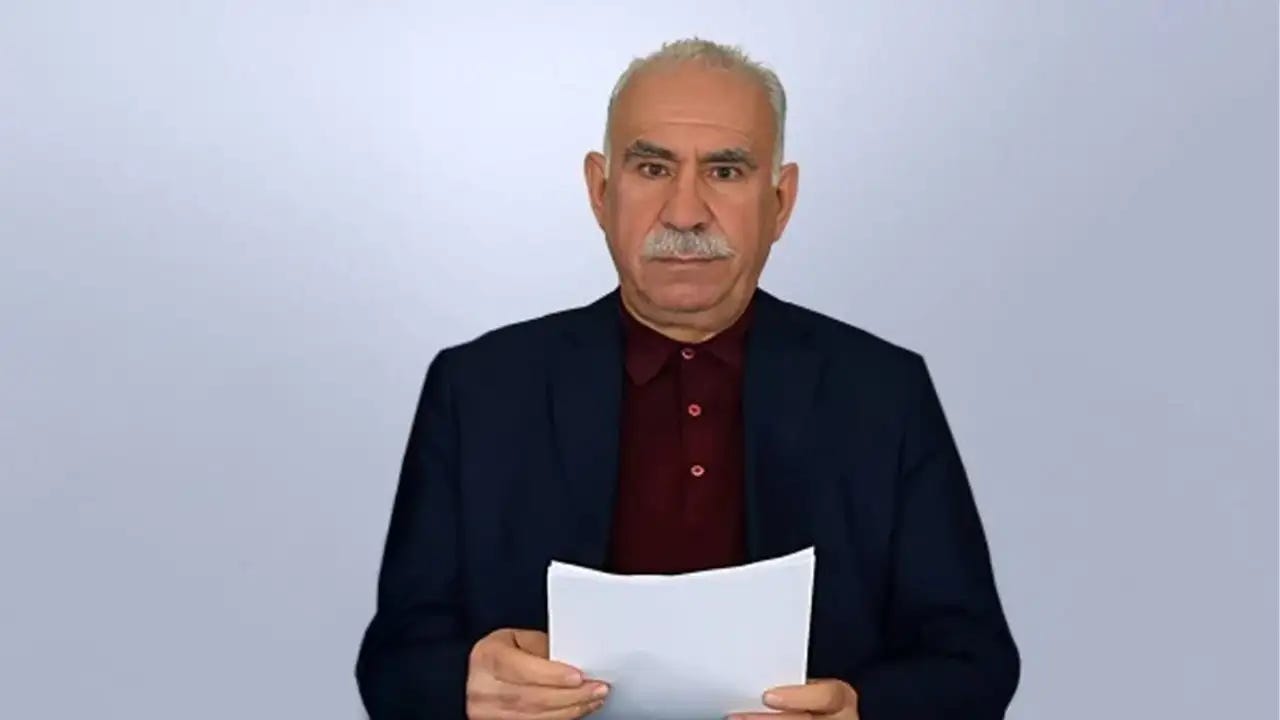
Law passed and attention turns to Öcalan, with October seen as the moment of implementation
The framework law’s passage through parliament by 467 votes has opened a new phase in the process, but its provisions cannot take effect until the security services establish and confirm that the PKK has dissolved itself and completed disarmament, a finding that must then be settled by the National Security Council and published in the Official Gazette. According to a report in Türkiye Gazetesi, that verification — covering the end of the organisation’s activities and the surrender of all weapons — is among the critical stages, after which the matter is expected to be taken to the security council. A timetable of roughly six weeks to two months is said to be under consideration for the handover of weapons, the vacating of caves and the surrender of logistical materiel, with Abdullah Öcalan expected to call shortly on members to give up their weapons to the relevant units and return to Turkey, and the Kandil leadership reportedly due to make a statement in the coming days about the caves being abandoned. If disarmament is completed by the end of September and the security council decides accordingly, implementation of the law is anticipated to begin in October. The national intelligence organisation and other bodies are said to be in contact with the central Iraqi government, the authorities in northern Iraq and the Syrian administration over the method and location of the handover, with PKK members in Iraq expected to apply to special units to be set up in Erbil and Sulaymaniyah, where the collection centres are also to be established.
KCK’s Mustafa Karasu on the framework law: “this is not a law that solves the Kurdish question”
Mustafa Karasu, a member of the KCK executive council, has responded to parliament’s approval of the framework law — the Bill on Strengthening National Solidarity and Social Integration — by 467 votes to 87, with seven abstentions. Speaking to Medya Haber, he said the law matters at this stage and that a course has been embarked upon, though there is much in it to criticise: given a century-long rupture between the Turkish state and the Kurds, which a democratic and political settlement exists to repair, he said the measure should be read as the beginning of entry into a legal and political process, invoking the leadership’s phrase that a thousand kilometres begins with a single step. It is not, he said, a law that resolves the Kurdish question, and its failure to mention that question or to acknowledge Kurdish reality is a significant shortcoming already noted in the movement’s own statement; what matters now is whether the process is carried forward with the necessary speed and determination or slows as it has over the past eighteen months to two years, though his side is determined to see it succeed. Karasu also stressed language, arguing that peace begins with the words used and that without a change in vocabulary, tone and approach it cannot be achieved — there is no longer any point, he said, in talk of “terrorists” and “terrorist organisations”, and neither the press, the government nor its spokespeople have been careful on this front. He argued that implementing what the law sets out will be impossible unless Abdullah Öcalan is at the centre of the process and plays a directing role, since the matter concerns not one person but a society, thousands of fighters and thousands of cadres. Although the PKK has dissolved itself, he said, a community remains — the movement was never one run by statutes but by an organisational culture — and its conduct and orientation will be determined by Öcalan; without his direction, neither long-standing members nor newer recruits will act individually, and the movement itself does not have the power to substitute for that.
🗳️ Opposition Parties (New Party and İYİ Party)
Özel breaks his silence after the framework vote: “my conscience is clear — this wasn’t one man’s win, it was Turkey’s”
Speaking for the first time since the framework law passed, YENİ Party leader Özgür Özel told Deniz Zeyrek of Nefes and Saygı Öztürk of Sözcü why his party backed it and rejected suggestions of a split among his MPs, saying each voted according to the conscience of their own province. He described the approach as a hybrid model and a new kind of politics: imposing a party line would have put MPs in difficulty and forced some to break group discipline, so he asked them to trust him to make his case from the rostrum and left them alone with their consciences and their voters. Support was strongest in Diyarbakır and in Istanbul districts with large Kurdish electorates, he said, while in his own province of Manisa the prevailing view was against and two of its MPs voted no. Özel complained that the process lacked transparency even within parliament, with the text sent to his party only half an hour beforehand and the public believing it contained things it did not; in those circumstances, he said, a blanket instruction was impossible, while a collective no would have positioned the party against peace and left it open to the charge of opposing an end to terrorism. He said his conscience was clear, that reversing a long-held position merely out of opposition to Erdoğan would have been wrong, and that if something has finally been won, at least the president has not won it alone — the country is the winner. Politics that says black whenever Erdoğan says white does not always pay, he argued, adding that the AKP was the party most discomfited by his MPs’ yes votes, since it had expected otherwise and would have exploited a no just as readily. On prisons, where the remand and convicted population now exceeds 433,000, Özel said he had personally visited party colleagues in six prisons before the vote and found almost all of them in favour of supporting the law, provided it is followed by democratisation: an end to lengthy pre-trial detention, the right to a fair trial, and European-standard rules on matters such as anonymous witnesses and pressure on defendants to confess. Excluding those involved in the coup attempt of 15 July, those who shot at police, and perpetrators of femicide and child abuse, he argued that the state should extend the same compassionate hand to other prisoners he called victims of circumstance, and said Turkey must return swiftly to the rule of law and an independent judiciary through social consensus, since without social peace neither development nor a solution to unemployment is possible.
YENİ Party MPs issue declaration of support for Özgür Özel: “we are demonstrating our complete unity”
The YENİ Party’s parliamentary group has published a joint statement backing its leader, Özgür Özel, after the split in the party’s vote on the framework bill drew attention: although Özel voted in favour, 54 of his MPs voted against and 35 voted in favour. The declaration says the country is passing through one of the most difficult periods in its political history, and describes the party as having been born out of the nation’s will for change and named by the nation, now growing along the path the nation opened. It says Özel has not bent an inch, retreated a step or left a word unsaid despite the suffering, persecution and attempts at domination directed at him — told there was no party, he said one would be founded; told there was no money, he said it would be found; told the problems were many, he said they would be overcome — and that these injustices continue today. The statement presents his approach as a new generation of democratic politics beyond old habits, one that showed itself in the parliamentary vote by favouring collective judgement over the dominance of a leader, pluralism over uniformity and consultation over imposition, and claims the party heard the voice of all 86 million citizens and of every section of society. Praising his determination to widen the space for democratic politics and bring different parts of society together around a shared future, the group declares its complete unity, saying its members stand tightly and arm in arm behind Özel and regard it as a great honour to walk under his leadership and share in the same struggle.
YENİ Party opens online membership
The YENİ Party, founded on 24 July, has begun accepting membership applications online. The announcement was made by Burhanettin Bulut, the party’s MP for Adana, who wrote on social media inviting people to join in order to have a say in Turkey’s future and be part of change, adding that the party draws its strength from the nation and its hope from the days ahead. Applications are being taken through the address uyelik.yeni-parti.org.tr.