

⚖️ Justice System and Everyday Life in Türkiye
Second wave of operations in AHBAP investigation: detention orders for 17 people
The investigation into the AHBAP Association is widening, with the Istanbul Provincial Gendarmerie Command issuing detention orders for a further 17 people in a case in which the association’s founder, Haluk Levent, is already in custody. The second-wave operation was carried out as part of the investigation being conducted by the Istanbul Chief Public Prosecutor’s Office, which is understood to concern charges of violating the Law on Associations and of laundering assets derived from crime. Levent, the singer who founded the association, had previously been detained in Bursa; he is reported to remain in custody in Istanbul and is expected to be referred to the courthouse once the detention period is complete. The second wave, carried out in the early hours, saw detention orders issued for 17 people, with the investigation continuing under the coordination of the Istanbul Chief Public Prosecutor’s Office.
Roads to be closed in Istanbul tomorrow for 15 July commemorative run
The Istanbul Governor’s Office has announced the roads that will be closed to traffic on Wednesday 15 July for a commemorative run held as part of the events marking the anniversary, with numerous points along the Beşiktaş, Üsküdar and 15 July Martyrs’ Bridge route closed to vehicles between 3am and 3pm. The Traffic Inspection Branch of the Istanbul Police Directorate said certain roads would be shut for the “15 July Democracy and Martyrs’ Commemoration Run”, held as part of the 15 July Democracy and National Unity Day events. According to a written statement from the governor’s press and public relations directorate, many points connecting to the 15 July Martyrs’ Bridge — chiefly in the districts of Beşiktaş and Üsküdar — will be closed to vehicle traffic during those hours, and drivers have been asked to use alternative routes to avoid difficulty. In Beşiktaş, the closures cover the Barbaros Boulevard Sait Çiftçi bridge slip road, the slip road above the Sait Çiftçi variant, the Yıldız Posta Street southbound D-100 slip road at Gayrettepe, the Barbaros Boulevard southbound D-100 slip road at Zincirlikuyu, and the northbound D-100 slip road from Barbaros Boulevard towards Sarıyer. On the 15 July Martyrs’ Bridge, the southbound D-100 at the Beşiktaş-Sarıyer junctions and the northbound D-100 at the Ümraniye-Altunizade junctions will be closed. In Üsküdar, the affected points are the Beylerbeyi bridge slip road, the Kısıklı Street bridge slip road at Altunizade, the Altunizade junction and the Tophaneli Street bridge slip road.
Nemesis of the tick returns: partridges and pheasants ready for battle
Agriculture and Forestry Minister İbrahim Yumaklı has announced that a total of 51,000 wild birds will be released into the wild across 62 provinces by the General Directorate of Nature Conservation and National Parks (DKMP). Thousands of birds reared each year at the ministry’s conservation stations are sent to suitable areas to prevent damage to the ecological system and strengthen wildlife populations, with breeding carried out continuously at partridge stations in Afyonkarahisar, Kahramanmaraş, Yozgat, Gaziantep and Malatya and at pheasant centres in Samsun, Istanbul and Gümüşhane. Yumaklı said the partridges and pheasants released played a key role in the biological fight against invasive species such as ticks and the brown marmorated stink bug thanks to their natural hunting instincts. He said the directorate had released 36,250 partridges and 9,000 pheasants in 2025 and aimed this year to return 51,000 birds to the wild, comprising 39,250 partridges and 11,750 pheasants, adding that around one million birds — some 750,000 partridges and 250,000 pheasants — had been released over the past decade. Technical analyses and habitat assessments have been completed, he said, with releases due to begin at designated sites after field work. Criteria for choosing release points include the birds’ ecological needs, the adequacy of food and water sources, shelter, predator pressure and the intensity of human activity; under the plan, chukar partridges are being released at 116 sites across 50 provinces, pheasants at 34 sites in 16 provinces and grey partridges at six sites in five provinces, with the release areas closed entirely to hunting for three years to protect these sensitive ecosystems. Special measures are also applied beforehand: Yumaklı said partridges were treated against tick infestation before release, while pheasants would be sent particularly to provinces in the Black Sea region as part of efforts against the brown marmorated stink bug, which causes major damage to farmland, stressing that the aim was to conserve wildlife through sustainable management and pass it on to future generations in good health.
Union purge continues at Italian High School: Özgür Doğu dismissed
Özgür Doğu, the Turkish deputy head teacher at the Private Italian High School, has been dismissed at the school where a collective bargaining agreement was signed following a 123-day strike by unionised teachers. Two union-member teachers had already been let go in recent days. Speaking to Cumhuriyet, Doğu said that during the strike he had effectively been placed in administrative isolation by the Italian head teacher because of his union membership, adding that he was not included in any management meetings and was not consulted on decisions. According to a report by Çağdaş Bayraktar for the paper, Doğu recalled that, while expecting the agreement to bring industrial peace and to see the rights secured by the signed contract implemented, they had first learnt that the contracts of two unionised teachers had been terminated; ministry inspectors who came to the school following a union application confirmed what had happened, he said, and warned of sanctions over the unacceptable situation. Just 24 hours later, he said, he was informed that his own contract had been terminated for cause and without compensation, and he claimed the school’s lawyer had stood over him as deputy head teacher and told him to clear his room at once, that the lock would be changed and that he must take his belongings and leave the school immediately — an act he described as a clear attack on his professional standing and personal rights. Doğu said that, as a teacher who had faced no disgraceful accusation or allegation, he had been subjected to crude and undeserved treatment by his employer and the employer’s lawyer, and that he had heard the removal of unionised teachers would continue, with staff let go in groups rather than en masse so as not to provoke a public backlash.
Impound-lot racket uncovered: 34 detained across six provinces
Thirty-four suspects have been detained in an Istanbul-centred operation across six provinces, accused of stripping vehicles held in judicial impound lots and making unlawful gains, with the parts sold both to buyers and as spares. The suspects were caught in a simultaneous operation on suspicion of aggravated fraud, rigging tenders and abuse of custodial duty. The investigation, launched by the Istanbul Anadolu Chief Public Prosecutor’s Office, began following allegations that vehicles under seizure or subject to court orders were being dismantled at impound lots. According to evidence obtained through technical and physical surveillance, the suspects were found to have stripped vehicles held in the lots, fitted old parts to vehicles they had bought at auction, sold some parts to people who had acquired vehicles through enforcement proceedings and put others on the market as second-hand spares. A total of 34 suspects were detained in the simultaneous raids in Istanbul, Ankara, İzmir, Kocaeli, Şanlıurfa and Tekirdağ, and the investigation is continuing.
🏛️ Politics
2.5 million people changed province in Türkiye: which city received the most migrants?
According to figures from the Turkish Statistical Institute (TÜİK), 2,475,019 people migrated between provinces in Türkiye in 2025, with Istanbul receiving the most incomers while also being the province that lost the most people, and the greatest mobility recorded in the 20-24 age group. The institute’s internal migration bulletin shows that the share of the population migrating between provinces, which stood at 3.18 per cent in 2008, has fluctuated over the years and reached 2.87 per cent in 2025; of those who moved, 47.5 per cent were men and 52.5 per cent women. Istanbul received the most migrants, at 329,912 people, followed by Ankara with 176,833 and İzmir with 106,083, while the provinces receiving the fewest were Ardahan (4,914), Bayburt (5,064) and Tunceli (6,078). Istanbul also saw the largest outflow, with 371,258 people leaving, followed by Ankara (145,661) and İzmir (98,728), with Ardahan (5,916), Bayburt (6,388) and Tunceli (7,558) losing the fewest. The greatest mobility last year was in the 20-24 age group, with 480,185 people, of whom 41.5 per cent were men and 58.5 per cent women. Of all those who moved between provinces, 564,114 did so as dependents of a household member, while 510,226 cited better housing and living conditions and 406,144 education. Among men, the leading reason was better housing and living conditions (253,093), while among women it was moving as a household dependent (334,900); other significant reasons were dependent migration and job transfers or changes for men, and education and better housing and living conditions for women. Within the most mobile 20-24 age group, education was the leading factor, cited by 179,612 people, followed by starting or finding work (75,591) and better housing and living conditions (42,391). Those who moved to another province after the earthquake of 6 February 2023 and have since returned to the provinces where they lived beforehand were counted under the heading of returning to family or their home region.
Erdoğan: NATO summit showed those who vowed to demolish the Presidential Complex what it is for
Speaking after a cabinet meeting, President Recep Tayyip Erdoğan said the NATO summit in Ankara had shown those who had asked what need there was for the Presidential Complex, and the “poor of vision” who had said they would demolish it if they came to power, exactly what the building was for and what it meant for Türkiye, adding that alienation was bad but that alienation from and hostility towards one’s own country and nation was far worse. Responding to criticism of the summit’s organisation and of the use of the Ottoman military band and janissary costumes at the ceremony, Erdoğan said that, like it or not, there was no longer a Türkiye that repudiated its heritage, but rather one that embraced its civilisational and cultural legacy, and that the Republic was the latest link in a millennia-old chain of states. He said there was a marginal group in Türkiye unable to tolerate a single positive sentence about their own state and government, who could not stomach the praise offered by visiting leaders, ministers and journalists, and who produced outlandish claims to smear the summit and Türkiye’s hosting of it — a group he said was a matter for medicine rather than politics. He described the Presidential Complex as the seat of representation of the state and the nation, the meeting point of Türkiye’s power and standing, where he said the heart of global diplomacy now beat. Erdoğan thanked the people of Ankara for their patience over the disruption caused by the security measures, said the Etimesgut military airfield had been restored and opened to service as a modern airport for the capital, and noted that Ankara would host the Organisation of Turkic States summit on 29-30 October. On the summit’s substance, he said the Ankara meeting had clarified Türkiye’s central role, embodying a new period in which European allies took on more responsibility and burdens were shared more fairly; that the removal of obstacles and restrictions to defence-industry cooperation had been placed on record; that a centre of excellence against unmanned systems would be established in Konya; and that Türkiye had raised the attacks suffered in Gaza and Lebanon and again stressed a negotiated end to the Russia-Ukraine war. He called Donald Trump’s official visit — the first by a US president in 17 years — highly significant, welcomed his praise for the country and the summit, and said they would continue working together on reaching a $100bn bilateral trade target and on regional peace and stability. Turning to the economy, Erdoğan listed measures for exporters and manufacturers, including a corporate tax rate cut to 12.5 per cent for the export sector, rediscount credit volumes raised to 5bn lira a day, monthly employment support of 3,500 lira per job and a 100bn lira credit package, and announced that the budget of the investment-linked advance credit programme would be expanded to 750bn lira, alongside a further 250bn lira favourable credit package for manufacturing — opening the way, he said, to a total of one trillion lira in favourable credit for the sector.
Longer consultation times dropped after NATO summit
The practice of extending consultation times at outpatient clinics — introduced as part of measures to reduce hospital congestion ahead of the NATO summit — has been abandoned, with consultation times falling back to as little as three minutes. According to a report in BirGün, temporary arrangements made to public services because of the summit held in Ankara on 7-8 July have now been reversed: appointment numbers at outpatient clinics had been cut and consultation times lengthened beforehand, but the previous system was restored once the summit ended. The intensive appointment system, which for a long time has resulted in patients being seen roughly every three minutes at some city hospitals, had been temporarily altered for the summit. The trainee doctors’ commission of the Ankara Medical Chamber had announced that, between 6 and 8 July, the number of appointments opened per doctor through the central appointment system fell from around 43 to 21, with consultation times extended to about 20 minutes. Doctors, scientists and health professional bodies have long stressed that adequate time must be allotted to each patient for quality care, arguing that consultations of under five minutes harm diagnosis and treatment, increase burnout among doctors and heighten the risk of violence in healthcare settings. The measures introduced to ease summit-related congestion showed that consultation times could be lengthened — but the practice was dropped once the summit was over, with appointment numbers raised again and the previous arrangements reinstated.
🤝Ruling Government (AKP, MHP and DEM coalition aka People’s Alliance)
Vice-President Yılmaz: a new constitution cannot be made by a single party
Vice-President Cevdet Yılmaz has said a new constitution is not something a single political party or the People’s Alliance alone can produce, but a process that must advance through broad consensus and the contribution of the parties in parliament, expressing the hope that all political actors would engage constructively. Speaking to reporters after a cabinet meeting at the Presidential Complex, Yılmaz said the government had largely completed its own preparations, with technical assessments and fine detail still being worked on, and that these would be presented to the President as soon as they were finished — though it was too early to speak of a firm timetable. He said the next stage depended on the consensus that emerged in parliament. On legislation relating to the “Terror-Free Türkiye” process, Yılmaz said intensive efforts were under way to establish the necessary legal framework before parliament rises, noting that the parliamentary commission had completed its work and set out a roadmap for the required regulations, that all groups except one party had taken part, and that the next stage was essentially for parliament to decide; he expressed hope that the commission’s shared will would carry into the legislative process. Asked about the European Parliament’s resolution on Türkiye’s 1974 intervention in Cyprus, Yılmaz said the decision had no legal or moral basis, that Türkiye regarded it as null and void and rejected it outright, and that the parliament had acted under the influence of Greek Cypriot lobbies in a way that damaged its impartiality and institutional standing — adding that the EU had lost the ability to view the Cyprus question impartially from the moment it admitted the Greek Cypriot administration as a member. He argued that if history warranted condemnation, attention should turn to the conditions that made the operation necessary, recalling the coup and the actions of EOKA groups, and questioned the European Parliament’s silence over the humanitarian tragedy in Gaza, saying it was unacceptable for those who failed to show such sensitivity to take politically motivated decisions on Cyprus. He said the operation, carried out under Türkiye’s rights and responsibilities as a guarantor, had brought peace and security to the island for both Turkish and Greek Cypriots and prevented far greater tragedies, and expressed the hope that members of the European Parliament would adopt a fairer, more balanced approach based on historical facts, saying its duty was to defend Europe’s fundamental values, the law and fairness rather than to serve the political calculations of particular circles.
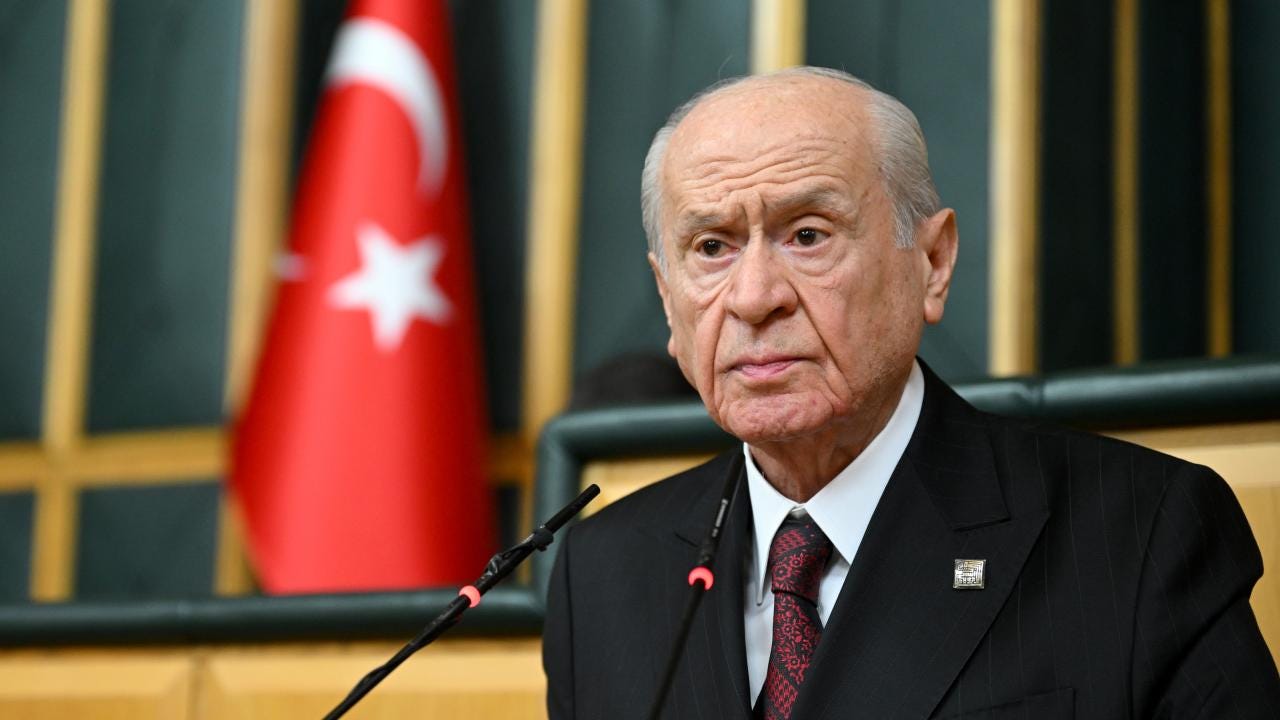
Bahçeli criticises Trump over Iran: trust in peace has been shaken
MHP leader Devlet Bahçeli has sharply criticised US President Donald Trump’s approach to Iran, saying that the neutralising of an agreement within barely a month has damaged the will for peace and stressing that Iran has a right to protect its security. Bahçeli said Iranian territory had been struck again and Iranian citizens killed, that these facts must be acknowledged, that treating this as an isolated attack was not a matter of conscience, and that trust in peace had been shaken. No state, he said, would accept being attacked while expecting the agreement it had signed to protect it; security concerns could be discussed at the negotiating table, but they could not be made the pretext for a greater crisis, and agreements could not be conducted through personal initiatives. Turning to the Ankara NATO summit, Bahçeli said it would be shallow to read it as an ordinary diplomatic exercise, arguing that it had taken stock of more than 70 years of alliance law and addressed a wide security belt at once — from the spirit of collective defence under Article 5 and the future of military support to Ukraine, to procurement moves worth over $50bn, joint production in the defence industry, Europe’s long-deferred deterrence gaps, contradictions over embargoes and restrictions among allies, Iran’s nuclear programme, navigational safety in the Strait of Hormuz, Syria, and sensitivities in the Eastern Mediterranean. He said Türkiye had become one of the founding actors of the new era, not merely through its strategic position but through its historical experience, political will and national strength, and that NATO stood at the dawn of a new age in which paper commitments must be turned into production, capability and deterrence. Security, he argued, would be measured not by the size of budgets but by the continuity of production, and he asked whether the alliance would stop treating the defence industry as the privileged domain of a few countries and remove covert embargoes, licence restrictions and supply obstacles among allies. He welcomed the will shown towards lifting CAATSA sanctions and revisiting the F-35 process, but said the erosion of trust caused by years of unfair treatment of Türkiye had to be repaired. Bahçeli also emphasised the role of space, cyber and intelligence in the new security age, praising the İMECE satellite as evidence of a state mindset that thinks about defence in space as well as on land, at sea and in the air, and listing an array of domestic systems — among them KAAN, KIZILELMA, AKINCI, AKSUNGUR, TCG Anadolu, MİLGEM, the Altay tank, the Tayfun and Bora missiles, and the Siper and Hisar systems of the “Steel Dome” — as uncompromising guardians of Türkiye’s sovereign rights. On Europe, he said the continent stood at a crossroads, that Türkiye wanted Europe to be honest with itself, and that Türkiye’s place was not in Europe’s waiting room. He sharply criticised remarks by the Greek Prime Minister Mitsotakis as grave, saying no one could make their own disputes a matter for Europe, that Türkiye was not a bargaining chip and its national interests could not be up for negotiation. Türkiye, he concluded, was not an option for Europe but a security rope by which it might climb out of the well it had fallen into, and those who accepted this would prosper while those who did not would sooner or later fall apart.
Kılıçdaroğlu: there can be no parallel structure within the party
CHP leader Kemal Kılıçdaroğlu has said that while it is natural for different figures to compete democratically within the party, parallel structures cannot be permitted, and that there is no justified reason for a split in the CHP. Answering questions in a live broadcast on TV100, he said the CHP was among the parties where internal debate was conducted most intensely and in a civilised manner, described what happened at the party’s 38th ordinary congress as a first for Türkiye, and stressed that a party’s delegates must cast their votes according to their own independent will. Recalling that the “absolute nullity” case was brought in Bursa, he noted that the claim in it — that some delegates’ will had been bought with money or favours — came not from members of other parties but from CHP members themselves: it was CHP members who took the money, CHP members who gave statements, and CHP mayors who said they had handed over money for the congress, with one saying they had been taken out, entertained at a nightclub and sent home with money in their pockets. He said people assumed only he had returned to the CHP after the ruling, when in fact former party assembly and executive committee members had returned too, and that the ruling told the old administration there had been irregularity at the 38th congress and a new one should be held — which, he said, they would do. Asked whether he had hesitated over the decision, he said no, adding that he had told visitors beforehand that he would never accept a trustee appointment, but that if absolute nullity were ruled the whole former administration would return and they would sit and talk; the party, he said, needed to be cleansed of corruption, since its defining feature was moral superiority. On claims that group chairman Özgür Özel would found a new party, Kılıçdaroğlu asked what reasoned justification there was for a split, saying it would be graver still if the reason given was that he intended to weed out thieves. He said no CHP MP or mayor could avoid being held to account, and questioned the propriety of remaining in the party as group chairman while working to establish a separate one, adding that they had not fought or come to blows and could of course talk. Asked whether he would call on Özel not to leave, he said Özel was free to compete within the party — different actors had contended within the CHP before — but that a parallel structure within it was unacceptable, noting that the party already had a spokesperson while the other camp had formed its own executive committee and spokesperson, which he said was untenable. Asked whether this was an allusion to FETÖ, he said he would say nothing more for now but would warn his colleagues: touring the provinces, districts and mayors to declare a candidacy for the leadership and seek votes was entirely normal, but setting up separate, parallel structures was not.
Firm overpaid 21.8m lira in tender belongs to an Erdoğan associate
A company belonging to Hasan Dağcı — said to have served as deputy private secretary during Recep Tayyip Erdoğan’s time as mayor of Istanbul — was overpaid by 21.8 million lira in a Turkish State Railways (TCDD) tender for a grade-separated junction. According to a report by Mustafa Bildircin for BirGün, the tender for the construction of the Alifuatpaşa junction and its connecting roads was held on 14 July 2023 by TCDD’s First Regional Materials Directorate and, awarded through a negotiated procedure, went to Dağcı’s firm Belen İnşaat, with a contract worth 262,884,000 lira signed between the company and the regional directorate. Auditors examining the works in 2023 found that revised unit prices had been calculated without following the procedures set out in the regulations: unit-price calculations were revised for certain work items, producing new prices lower than those annexed to the contract, yet the company was paid at the contract rates rather than the revised ones. On that basis, auditors recorded an overpayment of 21,854,358 lira excluding VAT, and TCDD’s management was warned that, where revised unit prices apply, the lower of the official published analyses and rates or the contract’s annexed unit prices should be taken as the basis. Dağcı, a businessman known for securing large public tenders, came to public attention over the so-called “Yalı Partisi” — a gathering allegedly held at his home before the 2023 elections with the aim of obstructing the CHP’s presidential candidate — claims he denied. He began his career as a journalist at a local newspaper and at one point ran the canteens of the İDO ferry operator; he has denied having served as Erdoğan’s deputy private secretary at the Istanbul municipality. Alleged to have amassed his wealth through money-driven ties to politics, Dağcı said in a statement in 2023 that he had not become rich through the AK Party and had been wealthy beforehand.
MHP marks anniversary of Kirkuk massacre
The Nationalist Movement Party (MHP) has issued a commemorative message on its social media account to mark the anniversary of the Kirkuk massacre, saying it remembers the Turkmen kinsmen killed with prayers and mercy. The message was published to mark the anniversary of the massacre, which took place on 14 July 1959. In the statement posted on the party’s social media account, the MHP said that on the anniversary of the Kirkuk massacre it remembered with prayers those Turkmen kinsmen who were killed.
🗳️ Opposition Parties (CHP and others)
Çankaya mayor Hüseyin Can Güner referred to courthouse
Hüseyin Can Güner, the mayor of Çankaya, has been referred to the courthouse after the completion of his questioning at the police station. Güner was detained as part of the Ankara Chief Public Prosecutor’s Office investigation into Çankaya municipality. During police questioning he was asked about cancelled cleaning tenders, and said the tenders had been annulled because competition could not be ensured, that the decision had subsequently been found appropriate by the Public Procurement Authority and ruled lawful by the Council of State, and that later tenders had concluded at lower prices, thereby serving the public interest. He said there had been no steering of any tender, that he had neither taken nor given instructions and had obtained no benefit from anyone. The operation against the CHP-run municipality was carried out on the morning of Saturday 11 July, with searches at the municipal building and affiliated units and detention orders issued for 36 people, including Güner. The mayor, who said he would be in Ankara within a few hours and had sent a spare key to the teams who had come to search his home, was detained at Esenboğa Airport on his return to Ankara from Northern Cyprus.