

Happy 23rd of April — National Sovereignty and Children’s Day. Wishing all a proud and joyful celebration of this meaningful day, a symbol of Türkiye’s national sovereignty. 🇹🇷 And do stick around to the end of today’s bulletin — you’ll find some heartwarming photos of founding father Mustafa Kemal Atatürk with children. Although he had no children of his own, he shaped not only the way of life in modern Türkiye but also the minds and hearts of all Turks. In that sense, he does have 85 million kids today.
Right then — let’s get into today’s bulletin.
🇹🇷 🇹🇷 🇹🇷
Justice System and Everyday Life in Türkiye
👦 More than 300,000 children drawn into crime in Türkiye last year
According to 2025 data from Türkiye’s Ministry of Justice, investigations were opened into more than 332,000 children over the past year, with each child on average implicated in two separate offences. Interviews conducted by the ministry’s social work researchers and psychologists with 607 children aged 12 to 18 held in prisons uncovered some of the key drivers behind juvenile crime. 81 per cent of the children involved in the study reported having been subjected to physical or psychological violence at home, while 43 per cent had a family member who had committed a crime and 60 per cent had criminal offenders within their social circle — figures which experts say turn such profiles into “role models” for the children around them. Asked what would have prevented them from offending had their lives been different, many of the children pointed to the breakdown of the family unit, violence from a stepfather and being cut off from education, with a significant proportion saying they would not have committed the offence had they stayed in school. Specialists argue that simply increasing penalties will not solve the problem and that preventive rehabilitation is essential. Associate Professor Ayhan Erbay, head of the Department of Psychology at Istanbul Kültür University, said the tendency towards violence among children was rising, with wounding offences now accounting for between 35 and 40 per cent of all crime types. Professor Miraç Burak Gönültaş, head of the Department of Social Work at Sivas Cumhuriyet University, noted that offending family members directly influence children’s future behaviour patterns and can lead them to internalise the world of crime.
Politics
🇹🇷 Parliament Speaker Kurtulmuş marks 23 April National Sovereignty and Children’s Day
Turkish Grand National Assembly Speaker Numan Kurtulmuş has issued a message to mark 23 April National Sovereignty and Children’s Day, describing the occasion as a unique holiday commemorating the founding steps of the Republic of Türkiye, the proclamation of national sovereignty and a gift presented to the nation’s children with future generations in mind. Addressing children directly, Kurtulmuş said the holiday, the Parliament and the country belong to them, and that the future will rest on their shoulders. The Speaker reiterated the principles that sovereignty belongs to the nation, that representation is carried out in the nation’s name, that politics exists for the nation, and that both the Republic and the Parliament draw their strength and meaning from it. Marking the 106th anniversary of the founding of the Turkish Grand National Assembly, Kurtulmuş paid tribute to Mustafa Kemal Atatürk, the founding members of the First Assembly, the martyrs who gave their lives for independence, veterans who made great sacrifices and all members of parliament who have contributed to the will of the nation, before extending his greetings on the occasion of the holiday.
🛣️ Highway authority denies claims Ankara Ring Road will be tolled
Türkiye’s General Directorate of Highways (KGM) has denied reports that the Ankara Ring Road is to be turned into a toll road, following claims by a CHP MP that the route was being lined up for privatisation. In a statement posted on its account on the US-based social media platform X, KGM described recent social media claims that the ring road would be tolled as untrue and inaccurate, stressing that no work is under way within the agency to introduce charges on the route. The statement noted that ring roads operated by KGM continue to provide the public with uninterrupted and free access as part of the agency’s public service remit, and urged the public not to give credence to what it described as deliberately misleading and incomplete content aimed at causing unrest and manipulating public opinion. The denial came after CHP Deputy Chair and Zonguldak MP Deniz Yavuzyılmaz claimed that the free-to-use Ankara Ring Road was set to be privatised for a 25-year period, warning that if the plan went ahead the route would be tolled and billions of lira in fees would be collected from drivers.
Ruling Government (AKP, MHP and DEM coalition aka People’s Alliance)
🏛️ Turkish state officials mark 23 April at Anıtkabir, Erdoğan and Bahçeli absent
A delegation of Turkish state officials led by Grand National Assembly Speaker Numan Kurtulmuş has visited Anıtkabir, the mausoleum of Mustafa Kemal Atatürk, to mark the 106th anniversary of the opening of the Turkish Parliament and 23 April National Sovereignty and Children’s Day. Vice-President Cevdet Yılmaz, CHP leader Özgür Özel, Family and Social Services Minister Mahinur Özdemir Göktaş, Education Minister Yusuf Tekin, Health Minister Kemal Memişoğlu, AKP Group Chair Abdullah Güler, İYİ Party leader Müsavat Dervişoğlu, members of the Parliamentary Presidency Council, MPs and political party representatives attended the ceremony. AKP leader and President Recep Tayyip Erdoğan and MHP leader Devlet Bahçeli did not take part in this year’s ceremony, as was also the case in previous years. The delegation walked down the Road of Lions to Atatürk’s mausoleum, where Speaker Kurtulmuş laid a wreath before the group observed a moment of silence and sang the national anthem, later posing for photographs on the steps leading up to the mausoleum. Kurtulmuş then moved to the National Pact Tower to sign the Anıtkabir Special Book, writing that it was a profound honour to visit the first Speaker of the Turkish Grand National Assembly on the 106th anniversary of the opening of the First Assembly, which he described as the heart of Turkish democracy and the site where the national will finds expression. He hailed the founding act by which the nation personally took ownership of its independence and declared that sovereignty belongs unconditionally to the nation, and said the idea of national sovereignty at the foundation of the Republic remains the guarantor of justice, democracy, social peace and a shared future. Pointing to the heavy burden borne by children amid today’s conflicts, inequalities, poverty and humanitarian disasters, Kurtulmuş said the meaning of 23 April has grown even deeper, arguing that protecting children is inseparable from protecting human values and the claim to civilisation. He set out the goal of strengthening a society in which every child lives in safety, has access to quality education, can develop freely and moves towards the future guided by science, art and ethics, pledging that the Republic — entrusted to the nation by its heroes of independence — would be carried forward with determination and that the will of the nation, the rights of all citizens and especially children, and the future of the country on the shoulders of strong generations would never be forsaken.
Opposition Parties (CHP and others)
🧒 CHP highlights child poverty and inequality ahead of 23 April
CHP Family and Social Services Policy Council Chair Aylin Nazlıaka has used the eve of 23 April National Sovereignty and Children’s Day to draw attention to child poverty, violence and inequality in Türkiye, warning that four out of every ten children are under threat of poverty and social exclusion according to the official TÜİK figures alone. Speaking at a press conference at the Presidential Candidacy Office, Nazlıaka said the 106th anniversary of the Turkish Grand National Assembly was being marked on a day that began with operations against CHP-run municipalities, which she described as interference with the national will. Recalling the recent school attack in Kahramanmaraş, she said children who should have been waking up joyfully on a holiday morning were instead being mourned, and asked how this could be forgiven or forgotten. Nazlıaka argued that the government cannot protect children and that no environment is safe for them, noting that violence has security, economic, social and psychological dimensions. She said Türkiye ranks second among OECD countries in child poverty after Costa Rica, that children are going to school hungry, going without food at school and lacking access to clean water, and accused the government of backing away from its pre-2023 election pledge of free school meals, arguing that budgets can always be found for waste, luxury spending by state officials and interest payments but not for children. She said weak social state mechanisms and a charity-based rather than rights-based approach meant poverty was being passed from parents to children, while disabled children faced the harshest exclusion and structural problems in care and rehabilitation centres were being ignored by the Family and Social Services Ministry. Nazlıaka noted that, according to the Labour Ministry, 13 to 14 children die each year in workplace incidents, though the real figures are thought to be higher given unregistered child labour — the İSİG Occupational Health and Safety Council puts the annual average at 60 to 70 since 2013, with 94 deaths in 2025 and 12 already recorded in the first quarter of this year. Criticising the 4+4+4 education system for facilitating child labour and early and forced marriage, she cited TÜİK data showing that 61,136 children were married between 2020 and 2025, of whom 57,618 were girls, and called for the marriage age to be set unconditionally at 18, for exceptions based on family consent or court decisions to be abolished, for stronger oversight and deterrent penalties against those facilitating child marriage, and for religious marriages performed in place of civil ceremonies to be prevented. Referring to Education Ministry statistics showing that around 18 million children should be in formal education in 2024-2025, she said data from the Education Reform Initiative indicated roughly 611,000 children of compulsory school age were outside the system, noting that one in four children aged 15 to 17 is in work. Setting out her party’s proposals, Nazlıaka pledged that a CHP government would reopen village schools, end bussed education, guarantee secular, modern, co-educational, scientific and free education for every child, implement the Lanzarote, Istanbul, UN Child Rights and ILO 182 conventions without exception, make at least one year of pre-school education compulsory and free, end malnutrition in small children (with stunting currently at 10 per cent among under-fives), introduce a basic citizenship income, eliminate child labour, take children forced to work, beg or live on the streets into state protection, prevent early and forced marriage, address regional inequalities and build a child-friendly, restorative justice system with children’s voices included in shaping policy. “Protecting children means protecting the homeland,” she concluded, pledging to bring about days when children’s voices in the country’s streets are heard as laughter rather than cries of fear.
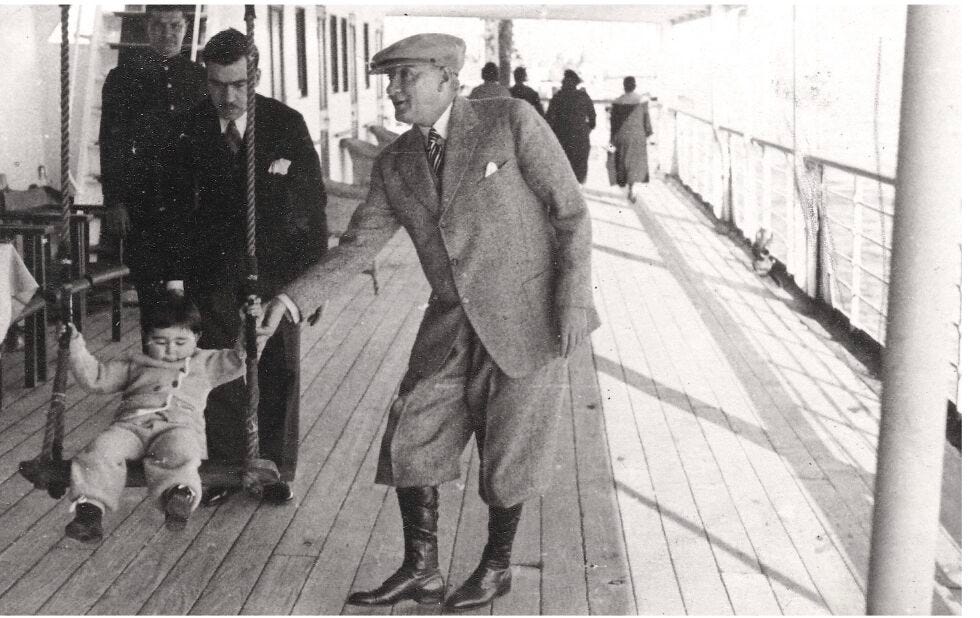
Mustafa Kemal Atatürk giving his adopted daughter Ülkü a push on the swing aboard the Ege ferry. (17 February 1935)🇹🇷