

Yes, it’s the weekend, and normally your correspondent does not write on weekends. But today I’m on parliamentary duty anyway, so think of today’s bulletin as back-pay for all the weekday editions I owed you these past weeks.
⚖️ Justice System and Everyday Life in Türkiye
Claims that Rasim Ozan Kütahyalı is the secret witness who put Cem Küçük behind bars — his lawyers hit back
Lawyers for the journalist Rasim Ozan Kütahyalı are preparing to file a criminal complaint over claims that he is the anonymous witness whose testimony led to the imprisonment of the pro-government commentators Cem Küçük and Tahir Sarıkaya. Küçük was detained last week over allegations of blackmail and disinformation and subsequently remanded in custody for publicly disseminating misleading information about the public; the secret witness in his case is said to have alleged that he posted on social media in return for payments from certain businesspeople and that he knowingly circulated misleading information about the İstanbul municipality investigation. Tahir Sarıkaya, a presenter on Beyaz TV between whom and Küçük money transfers were reportedly identified, was detained and remanded on a blackmail charge shortly afterwards, again on the strength of anonymous testimony. The journalist Fatih Altaylı wrote in his column that the witness may be Kütahyalı and that the inquiry could extend to further names, echoing earlier speculation that had pointed to Kütahyalı and cited social media posts by his wife made before and after Küçük’s detention. Kütahyalı — who was himself detained on 14 May 2026 in an Adana-centred investigation spanning 21 provinces into illegal betting, money laundering and aggravated fraud, and remanded four days later, denying the charges and telling investigators that the transactions recorded by the financial crimes board MASAK were personal debts and receivables — has instructed his lawyers, who have submitted expert reports and scientific opinions in his own case, to pursue a complaint over the allegations.
Teenager jailed for 16 years and 11 months over fatal stabbing of 16-year-old Mustafa Yağız Edik
A court in Aksaray has sentenced the defendant, identified only as R.M., to 16 years and 11 months in prison over the knife fight in which 16-year-old Mustafa Yağız Edik was killed. The incident took place in the early hours of 10 March 2026 on Şehit Mehmet Ali Demir Street in the Büyük Bölcek neighbourhood, and is said to have begun with an argument after R.M. harassed Edik’s 15-year-old cousin by telephone and on WhatsApp. When the argument escalated into a fight, R.M. stabbed Edik in the heart; he was taken to hospital but died despite efforts to save him. R.M. fled the scene, was apprehended by police and was remanded in custody by the court before which he was brought. The sentence was handed down at the concluding hearing, after final statements from the parties.
“Even if we faint from the heat, we have to keep working”: labourers on toiling through Turkey’s summer
Workers across several sectors have told T24 how extreme heat affects them on the job, following a joint statement on 4 August by the United Metal Workers’ Union (Birleşik Metal-İş) and the Turkish Medical Association arguing that existing legislation is inadequate in the face of the climate crisis and that statutory regulation of working in high temperatures has become a necessity. Their appeal cites an International Labour Organization report from 2024 which found that roughly 70 per cent of workers worldwide are exposed to extreme heat in summer, with around 19,000 deaths and close to 23 million heat-related workplace injuries each year, alongside longer-term risks including cancer, cardiovascular disease and kidney dysfunction. Halit Korkut, who works at a piston factory in Kocaeli and spends more than ten hours a day away from home, said no precautions were taken at his plant — no air conditioning, and ventilation systems left switched off, he was told, because they gave off a bad smell — and that with a monthly wage of 50,000 lira supporting a family of four, 15,000 of it going on rent, exercising the right to refuse work is simply not an option. Kevser Yılmaz, 49, a landscaping worker employed by an Istanbul municipality, said crews are stood down on muddy days in winter but not on the hottest summer days, and recalled being taken ill on the job last August; she and her colleagues have been campaigning for union recognition for four or five years in the hope of securing protections through a collective agreement rather than depending on the goodwill of supervisors. Ayberk Varlı, a nursing student working summers at a glass factory in the Polatlı industrial zone where his father is a longtime foreman, said temperatures around the furnace feel like 45 to 50 degrees and that young seasonal workers typically leave after three or four months having lost weight; while welcoming the unions’ statement, he argued that legal safeguards will require sustained pressure and must be paired with an ecological struggle against the climate crisis that creates the risks in the first place.
🏛️ Politics
Turkey, Saudi Arabia and Pakistan sign mutual defence pact: an attack on one is an attack on all
Turkey, Saudi Arabia and Pakistan have signed a joint defence agreement in Mecca, according to a statement from Turkey’s Directorate of Communications, which said President Recep Tayyip Erdoğan and Pakistani Prime Minister Shehbaz Sharif travelled to Saudi Arabia for a Mecca Joint Defence Summit held at the Safa Palace, where the three countries’ relations and matters of mutual interest were discussed. The statement said the pact was signed by Saudi Crown Prince and Prime Minister Mohammed bin Salman bin Abdulaziz Al Saud, Erdoğan and Sharif on the basis of what it described as deep historical ties, longstanding bonds of brotherhood and Islamic solidarity, shared strategic interests and established defence cooperation, and as a reflection of their common desire to strengthen collective security, promote peace and stability in the region and beyond, and build a secure and prosperous future together. Under its terms, the agreement is intended to reinforce collective deterrence against aggression of any kind and stipulates that an armed attack on any one of the three states shall be regarded as an attack on all of them, while also providing for the development of defence cooperation between them in all its dimensions.
Six more clauses passed on youth justice bill as penalties for parents are stiffened
Turkey’s parliament has approved six further clauses of the bill amending the Child Protection Act and several other laws, which covers arrangements for children drawn into crime and, following debate, has widened the provisions applying to parents and lengthened the prison terms attached to them. Amendments to the Turkish Penal Code raise the penalties under the article on breaching obligations arising from family law: failure to meet duties of care, education or support, prosecutable on complaint, moves from up to one year in prison to between three months and two years; abandoning a pregnant wife, or an unmarried woman with whom one lives and whom one knows to be carrying one’s child, in a helpless state rises from three months to one year to between six months and two years; and gravely endangering the morals, safety or health of one’s children rises from three months to one year to between one and three years. A change to the Code of Criminal Procedure requires courts, within fifteen days of receiving an indictment and investigation file, to return to the prosecutor’s office any indictment drawn up in respect of a child under fifteen without a social inquiry report, noting the deficiencies. Under the bill, child offenders will begin their sentences in closed penal institutions rather than directly in juvenile education centres, transferring only if assessed as being of good conduct by a panel of psychologists, pedagogues and child development specialists meeting every three months; those aged 12 to 18 will be housed in separate sections according to sex, physical development and type of offence, while children sentenced to a total of three years or less for intentional offences, or five years or less for negligent ones, will serve their terms directly in education centres. Children who abscond, are remanded over another offence, receive a finalised solitary confinement penalty or whose conduct is deemed a threat to order or personal safety may be sent back to closed institutions by decision of the administration and observation board. The bill also provides that, except in cases of intentional homicide, sexual offences, drug manufacture and trafficking and forming a criminal organisation, each day spent in custody before the age of fifteen will count as two towards conditional release, and bans the sale, display, purchase or carrying by under-18s of knives and other cutting, piercing or bruising implements not otherwise covered by law. After the first section was passed and debate on the second concluded, Deputy Speaker Pervin Buldan adjourned the sitting until Saturday 8 August.
30,000 security staff to be stationed at school gates before new term begins
Turkey plans to deploy 30,000 security personnel across all 81 provinces under an inter-ministerial protocol aimed at strengthening safety in schools before the academic year opens on 14 September 2026, according to a report in Yeni Şafak, with applications to be taken through the state employment agency İŞKUR. Background checks on candidates will be carried out by the Interior Ministry and interviews conducted by the Education Ministry, while deployments will take account of pupil numbers, a school’s location, its security requirements and physical conditions; eligible candidates will be able to apply once vacancies are advertised, with provincial governors’ offices expected to plan the allocation of places by province and by school. The new staff will work at school entrances and exits in support of the physical security and early-warning elements of the seven-tier school safety model, monitoring the movement of pupils, parents and visitors and reporting anything suspicious to school management and the security services, with the wider aim of reducing risks around school premises and helping to prevent bullying, fights and incidents involving knives and other sharp implements. The Education Ministry stepped up its school security work after attacks in Kahramanmaraş and Şanlıurfa; Minister Yusuf Tekin has previously announced plans for an artificial intelligence-assisted risk analysis and early-warning system assessing pupils’ absenteeism, disciplinary records and other risk indicators together, and said school CCTV would be integrated into the City Security Management System so that police units can monitor security through it.
Justice minister signals law for online journalism: “it must all be brought under one roof”
Justice Minister Akın Gürlek has signalled support for legislation covering internet-based news outlets, telling the 13th Digital Media Workshop organised by the online journalism association TİGAD in Iğdır — where he had earlier visited the provincial governor’s office — that online news must be brought together under a single roof and that current needs have made such a law necessary. Noting that the matter ought to have been considered earlier, Gürlek said that if the association had drawn up its own legislative proposals he would do what he could to help bring them before parliament. TİGAD’s chairman, Okan Geçgel, said he had previously discussed the idea with Vice-President Fuat Oktay, who had encouraged the association to prepare a draft and bring it forward with his support. Reiterating his own backing, Gürlek argued that with everyone now producing news online there needs to be clarity about who is doing so and who is producing genuine journalism, since the work carries responsibility, and described internet journalism as a force in its own right given how instantly news reaches people’s screens. He also referred to the social media bill expected to reach parliament in October, parts of which have already been made public, saying it would introduce significant provisions to address disinformation and information pollution online, where he said people trade accusations, expose one another’s private lives and spread false reports.
More than 2,000 checkpoints scrapped along the borders as peace process legislation advances
Activity has begun along Turkey’s borders while the twelve-article framework bill tied to the peace process continues to be debated in parliament’s justice committee, according to a report by Nefes. Troop numbers have been reduced at outposts sitting directly on the border in the Hakkâri districts of Yüksekova, Esendere, Şemdinli, Çukurca and Derecik, in the Şırnak districts of Beytüşşebap, Uludere and Silopi, and in Başkale and Gürpınar in Van, all of which adjoin Iran and Iraq. Some of the fortified military posts known as kalekol and kulekol — built from concrete blocks over the past decade to withstand mortar, rocket and heavy weapons attacks — along with associated high-security forward observation towers and control points, have also been removed. In total, 2,763 search and control points have been dismantled on road routes and on tracks leading into rural areas in provinces and districts bordering Iran, Iraq and Syria, of which 2,560 were operated by the police and 203 by the gendarmerie. Reconnaissance, interception and surveillance work is understood to be continuing at the border outposts. The report also notes that proceedings in the justice committee saw a heated exchange between the İYİ Party’s Türkeş and the MHP’s Bülbül, with MPs advancing on one another.
🤝Ruling Government (AKP, MHP, CHP and DEM coalition aka People’s Alliance)
Fists on the table as framework bill debate descends into scuffle in parliamentary committee
Tempers flared in Turkey’s parliamentary justice committee during debate on the “Bill on Strengthening National Solidarity and Social Integration”, with a fierce exchange between the İYİ Party’s Adana MP Ayyüce Türkeş Taş and the MHP’s Sakarya MP Muhammed Levent Bülbül. Türkeş Taş had criticised the attempt to confine the committee’s consideration of the bill to a single day, arguing that legislating is a serious business requiring proper thought, and went on to object to the use of Alparslan Türkeş’s political legacy, saying it could not be used as bleach to launder the filth of others’ own actions. Bülbül reacted sharply, telling her to mind her language and insisting she could not describe the MHP leader’s actions as filth, to which Türkeş Taş replied that she had said no such thing about the party leader. As the row escalated, Bülbül said his side fought so that no one in the world could threaten her, and struck the table with his fist; when the İYİ Party’s Balıkesir MP Burak Dalgın challenged him, Bülbül rose and advanced on him, before MPs from both parties intervened and he was removed from the committee room. The committee’s chair, Cüneyt Yüksel, briefly adjourned proceedings. Türkeş Taş also rejected the use of the honorific “Sayın” for both the president and Abdullah Öcalan under parliament’s roof, saying she refused as both an MP and a citizen to see them placed on an equal footing, and recalled that during debate on the defence ministry’s budget the Turkish army had been described in insulting terms with no one but her objecting. Criticising assessments framed around the financial cost of terrorism, she asked what the cost would have been had the PKK not been fought and the country divided, demanding to know what price could be put on the land and on those killed.
Framework bill reaches justice committee amid rows over Öcalan honorific and Demirtaş: “he is not your useful tool, he is our comrade”
The twelve-article framework bill prepared for the process the government calls “Terror-Free Türkiye” — formally the Bill on Strengthening National Solidarity and Social Integration, submitted to the speaker’s office on 5 August — came before parliament’s justice committee at 3.30pm amid repeated flare-ups, beginning before proceedings opened when İYİ Party MPs protested that the doors had not been unlocked and that the room was too small for the occasion, with a crush as they were finally opened; the party, which had asked the speaker’s office for the sittings to be held in the ceremonial hall, broadcast live and opened to bar associations, academics, veterans and families of the fallen, streamed the session on its own social media accounts instead. Speaking as an initial signatory, the AKP’s Abdulhamit Gül said the goal was the legacy of those killed and wounded in the conflict, described the bill as the nation’s rather than any one party’s and as the product of an unprecedented parliamentary consensus with 367 signatures, and said it had not emerged from bargaining. The MHP’s Feti Yıldız said terrorism that had cost tens of thousands of lives and vast resources was about to be consigned to history, tracing the process from Devlet Bahçeli’s call of 1 October 2024 through Abdullah Öcalan’s disarmament appeal to the organisation’s self-dissolution on 12 May 2025 and insisting the unitary state, Turkish as the official language and secularism were preserved. His party colleague Erkan Akçay set out the mechanics, arguing that the bill is not an amnesty but a conditional deferral regime: nothing operates until the security establishment certifies disarmament and dissolution and the National Security Council publishes that finding, intentional killings and pre-June 2005 offences carrying life terms fall outside its scope, individuals must apply in person within six months, deferral periods run to five or ten years depending on sentence, and any fresh terror offence cancels the arrangement. DEM’s Gülistan Kılıç Koçyiğit called the moment a historic threshold and the bill a first step towards a “Democratic Republic” belonging to all 86 million, but sparked uproar when she thanked Öcalan alongside President Erdoğan, drawing shouts from İYİ Party benches. The CHP’s İnan Akgün Alp gave qualified support, saying Turkey must emerge not authoritarian but democratic, and criticised the omission of the parliamentary commission’s democratisation proposals. The YENİ Party’s Murat Emir objected to the absence of live broadcasting, argued the text was carelessly drafted and silent on democratisation, and pointed to unimplemented Constitutional Court and European Court of Human Rights rulings concerning Can Atalay, Selahattin Demirtaş, Figen Yüksekdağ, Osman Kavala and the Gezi defendants; his exchange with Yıldız over whether Demirtaş would benefit from the law prompted DEM’s Saruhan Oluç to interject that Demirtaş was not their useful tool and should not be used to build their sentences, but was their comrade.
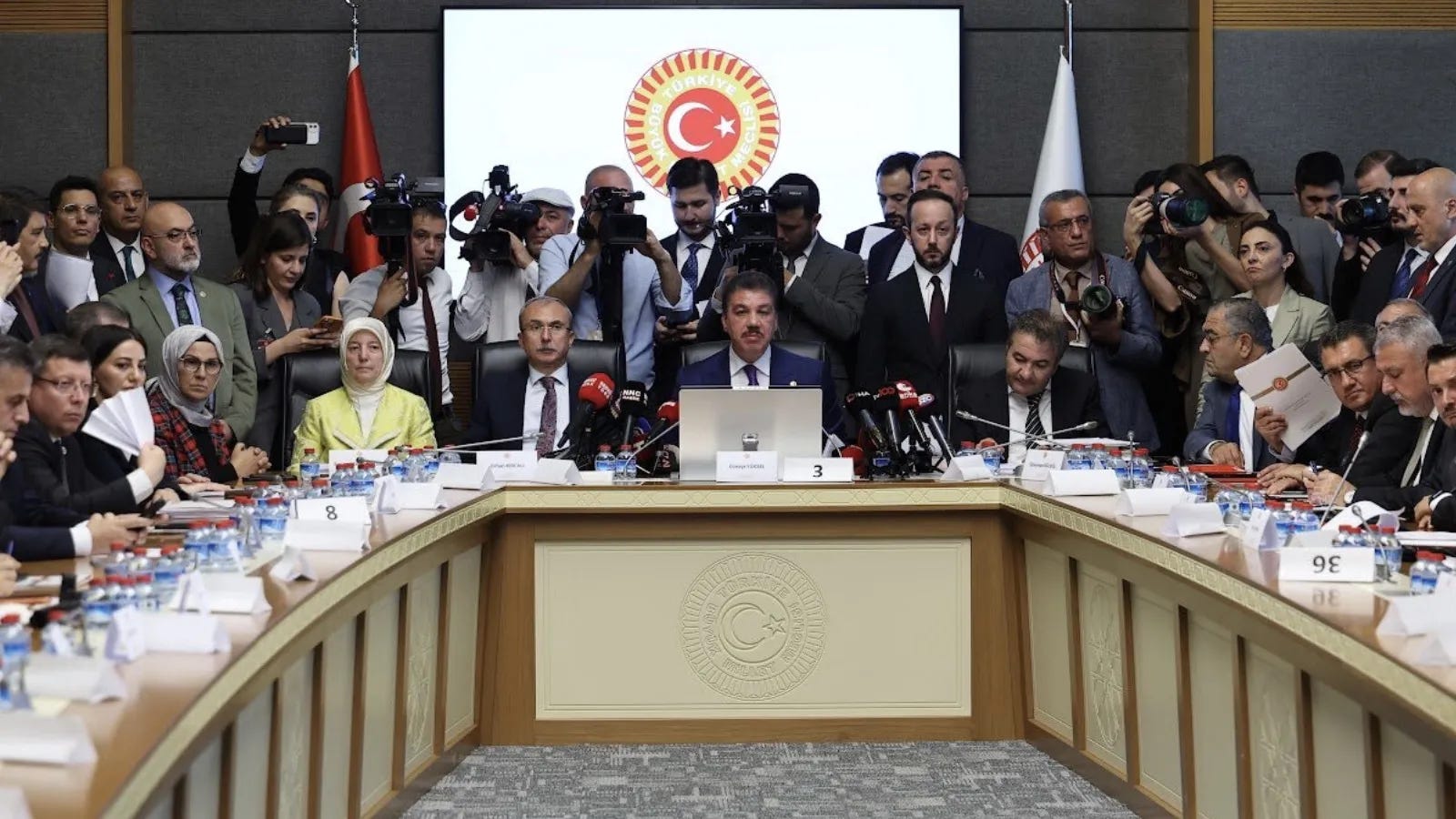
Can you spot me? A little “Where’s Waldo?” to start your morning. Fair warning: I’m not the one in the striped shirt, because in this room the dress code is strictly Grey Suit and Grim Expression.
Framework bill clears justice committee after 18 hours and angry scenes; YENİ Party votes in favour
Turkey’s parliamentary justice committee has approved the Bill on Strengthening National Solidarity and Social Integration — widely known as the framework law — after eighteen hours of debate, with DEM’s Saruhan Oluç reporting that the AKP, MHP, DEM and the YENİ Party all voted in favour, and the MHP’s Feti Yıldız announcing the result on social media; the bill is expected to reach the floor of the chamber on Monday 10 August. Proceedings, which began at 3.30pm the previous day after İYİ Party MPs protested that the doors were locked and the room too small, were repeatedly disrupted: the MHP’s Muhammed Levent Bülbül struck the table and advanced on the İYİ Party’s Burak Dalgın, restrained by MPs from both parties, after an exchange over remarks that Devlet Bahçeli could not launder his own conduct through Alparslan Türkeş’s legacy; İYİ Party members objected to DEM’s Gülistan Kılıç Koçyiğit thanking both President Erdoğan and Öcalan with the honorific “Sayın”; and a clash between the YENİ Party’s Murat Emir and Yıldız over Selahattin Demirtaş’s position prompted Oluç to say Demirtaş was not their useful tool but his party’s comrade. Substantively, the bill makes everything conditional on the security services establishing that the PKK/KCK and any linked structures have ended their existence and surrendered all weapons and munitions, confirmed by a National Security Council decision published in the Official Gazette. It then defers investigations, prosecutions and the enforcement of sentences — five years where the offence or sentence involves up to 15 years, ten years where it exceeds that or involves a life term — while excluding intentional killings committed in the course of the organisation’s activities and offences before 1 June 2005 carrying life or aggravated life sentences. Limitation periods are suspended, files and evidence preserved, assets subject to confiscation liquidated to the Treasury, and deferral decisions recorded in a dedicated system accessible only to prosecutors and courts in connection with a case; committing a terror offence during the deferral period cancels it, while completing the period without offending brings a decision of no prosecution, discontinuance, or the sentence being treated as served. Those wishing to benefit must apply in writing within six months to prosecutors or designated bodies. Implementation will be monitored by a board chaired by a vice-president and comprising the justice, foreign, interior and defence ministers, the presidency’s secretary-general, the head of the national intelligence agency and the secretary-general of the National Security Council, with power to form sub-commissions, to review progress periodically, to request judicial, administrative and legislative measures, and to apply for the lifting of consequential disqualifications after two or three years depending on the deferral length. The board will report regularly to parliament, where a separate monitoring commission will be set up, and officials carrying out duties under the law will bear no legal, administrative or criminal liability for doing so.
🗳️ Opposition Parties (New Party and others)
No luxury, no ostentation: YENİ Party opens the doors of its new headquarters
The YENİ Party, founded by Özgür Özel after his departure from the CHP, has given journalists a look inside its new headquarters in the Çankaya district of Ankara, where refurbishment is nearing completion on both the interior and the façade and where, on the leader’s instructions, extravagance has been avoided in everything from the furniture to the decoration. The building, in Mustafa Kemal neighbourhood and previously used by the Gelecek Party, is due to open on 30 August; the party’s leadership is still working out of parliament, but much of its activity is expected to move there once the premises come into use. The eight-storey building comprises a ground floor, three basement levels and four upper floors, with Özel’s office on the third floor — the room formerly used by Gelecek Party leader Ahmet Davutoğlu, now being prepared for him. The second floor is set aside for members of the central executive committee, the fourth for party media staff and personnel, and part of the ground floor is to be made available to journalists covering the party, while the headquarters also contains meeting rooms, a canteen, further offices and an underground car park. Gas, water and electricity connections have reportedly been completed. Monthly rent on the building is said to exceed four million lira, with payments due to begin in October.
YENİ Party makes its first gain in Muğla as Yatağan mayor quits the CHP
Mesut Günay, the mayor of Yatağan in Muğla province, has announced his resignation from the CHP and joined the YENİ Party, becoming the new party’s first mayor in the province; CHP members of the municipal council resigned alongside him and made the same move. An event was held outside the town hall to mark the switch, with party supporters and others gathering there before walking to the YENİ Party’s district headquarters, where Günay and the councillors formally joined. Günay said the decision was not an individual one but the collective will of Yatağan, taken after consultation with party members, the district organisation, the youth and women’s branches, the municipal council and residents who had and had not voted for him. Leaving what he called the ancestral home of the CHP had not been easy, he said, and he carried respect and loyalty towards it; the move was made not by abandoning the party’s legacy but by claiming it, carrying the values he believes in forward under one roof without denying the past. He added that he had backed the leader from the outset and would continue to do so, and said he was proud to wear the YENİ Party badge pinned on him by Özgür Özel.
Menderes mayor İlkay Çiçek remanded in custody along with nine others as CHP moves to expel him
Ten people, including İlkay Çiçek, the mayor of Menderes in İzmir province, have been remanded in custody as part of an investigation into the municipality, while six others were released subject to judicial control. The inquiry, run by the İzmir chief public prosecutor’s office, saw 16 people detained by gendarmerie teams on 4 August on suspicion of forming a criminal organisation, membership of a criminal organisation, bribery, extortion, forgery of official documents, misconduct in public office and causing unlawful development. The suspects, among them Çiçek and several of his deputy mayors, were taken to the İzmir courthouse after questioning at the provincial gendarmerie command, with 15 of the 16 referred to a magistrate with a request for remand following their statements to prosecutors. Earlier the same day, Çiçek was referred to his party’s disciplinary board with a request for permanent expulsion; CHP general secretary Rıfat Turuntay Nalbantoğlu said the conduct that had come to light was judged incompatible with the party’s principles and that proceedings had been opened on a precautionary basis.